You’ve probably asked yourself: “Do I really need a website to start affiliate marketing?”
That question alone stops a lot of people before they even begin. The truth is, you don’t need a blog, fancy tech skills, or years of experience to start earning as an affiliate. What you do need is a clear path, the right beginner-friendly affiliate programs, and a simple way to promote them.
This guide is here to walk you through the best affiliate programs for beginners who want to start earning without a website. We’ll cover the easiest networks to join, tools that pay recurring commissions, and practical ways you can promote offers using only social media affiliate marketing, YouTube, or even email.
By the end, you’ll not only know which programs to choose, but also how to confidently start affiliate marketing without a blog, all with low risk and no big upfront investment.
This guide is part of our Complete Affiliate Marketing Guide, where we cover everything from picking a niche to scaling your commissions.
Can You Really Start Affiliate Marketing Without a Website?
It’s easy to believe affiliate marketing is only for bloggers with huge websites. That was true years ago, but today, the internet runs on social platforms. Creators build entire businesses on Instagram, TikTok, YouTube, and even email newsletters without ever touching a traditional blog.
Think of it this way: a website is just one traffic source. But if you already spend time on platforms like TikTok, YouTube, or Pinterest, you have everything you need to get started. These platforms allow you to share content, build trust, and add affiliate links in bios, descriptions, or captions.
Here are a few practical examples of affiliate marketing without a blog:
- Posting TikToks or Reels that showcase a product, then linking it in your bio.
- Creating YouTube tutorials and placing affiliate links in your video descriptions.
- Building a small but engaged email list with a free tool, then sharing affiliate offers.
- Designing Pinterest pins that link directly to affiliate products.
When you focus on platforms you already use, you can start affiliate marketing without a website and still build consistent income streams.
Best Affiliate Programs for Beginners With No Website
The most important step is choosing affiliate programs that are easy to join, pay reliably, and don’t require you to own a blog. The following programs are beginner-friendly, free to sign up for, and work perfectly with social media affiliate marketing or YouTube promotion.
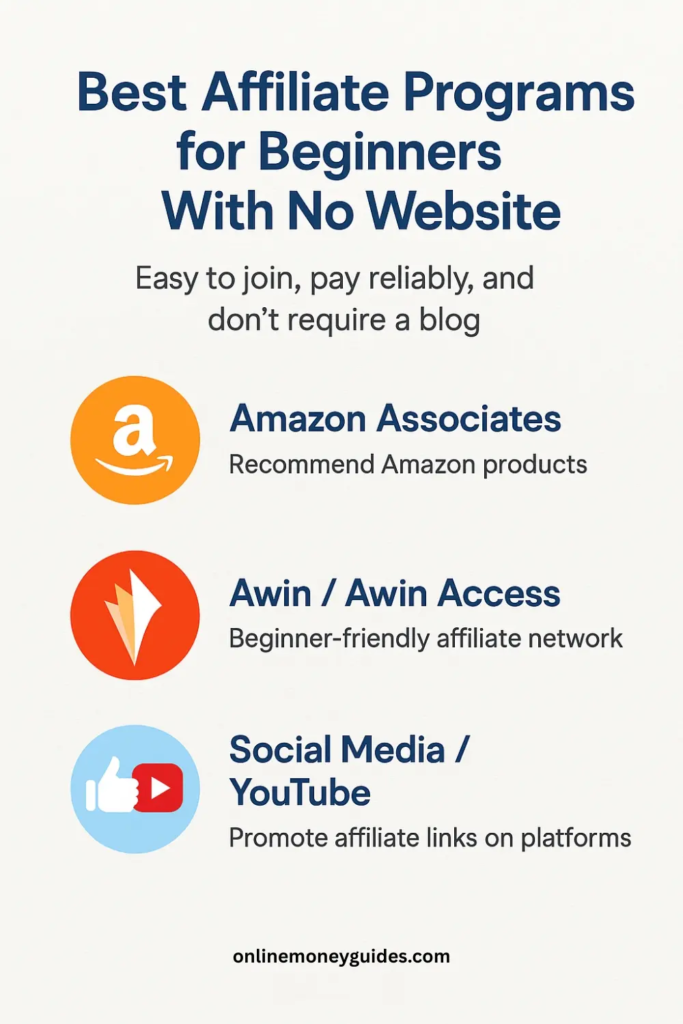
Amazon Associates
Amazon Associates is the most popular entry point for new affiliates. It’s simple: you recommend products from Amazon, and when someone buys through your link, you earn a commission.
- Commission range: 1%–10% depending on category.
- Cookie window: 24 hours (extended to 90 days if a product is added to the cart).
- Minimum payout: $10.
Why it works for beginners:
- Everyone knows and trusts Amazon.
- Millions of products to choose from, so you can always find something relevant to your niche.
- Links can be shared directly on YouTube, TikTok bios, Instagram Stories, or even email newsletters.
It may not have the highest commission rates, but it’s a low-barrier way to get started and see your first earnings.
Awin
Awin is one of the largest affiliate networks in the world. It recently absorbed ShareASale, meaning many merchants that used to live on that platform are now available through Awin.
- Commission range: Varies by merchant, usually 5%–20%.
- Minimum payout: $20.
- Access type: Awin Access is their beginner-friendly option that lets you apply for programs quickly.
Why it works for beginners:
- Thousands of brands across fashion, lifestyle, travel, and SaaS.
- Many merchants approve affiliates even without a website.
- Easy tracking dashboard and reporting.
If you want flexibility, Awin is a great “umbrella” network where you can experiment with different niches before narrowing down.
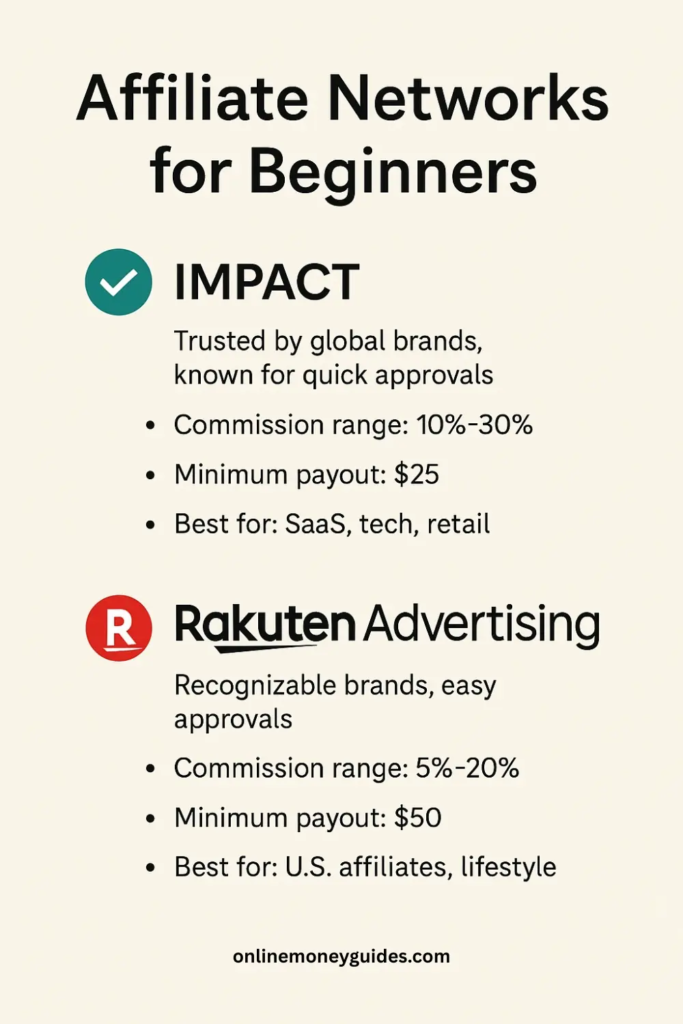
Impact
Impact is another large affiliate network trusted by big global brands. It’s known for its clean interface and quick approvals.
- Commission range: Varies widely (often 10%–30%).
- Minimum payout: $25.
- Best for: SaaS, tech, retail, and lifestyle niches.
Why it works for beginners:
- Transparent tracking and reporting.
- Many merchants allow social media and YouTube promotion.
- Gives you access to household names as well as up-and-coming brands.
Impact is particularly strong if you want to promote tools, apps, or digital services, which often come with higher commissions than physical products.
Rakuten Advertising
Rakuten is another long-standing affiliate network that partners with big recognizable companies like Walmart, Macy’s, and Best Buy.
- Commission range: 5%–20% (depending on brand).
- Minimum payout: $50.
- Best for: U.S. affiliates looking to promote mainstream products.
Why it works for beginners:
- Promoting well-known brands builds instant trust with your audience.
- Perfect for lifestyle, fashion, and general consumer niches.
- Approval is straightforward for many merchants.
While it has a higher payout threshold than Amazon or Impact, Rakuten offers credibility and trust that can make your promotions convert better.
Systeme.io
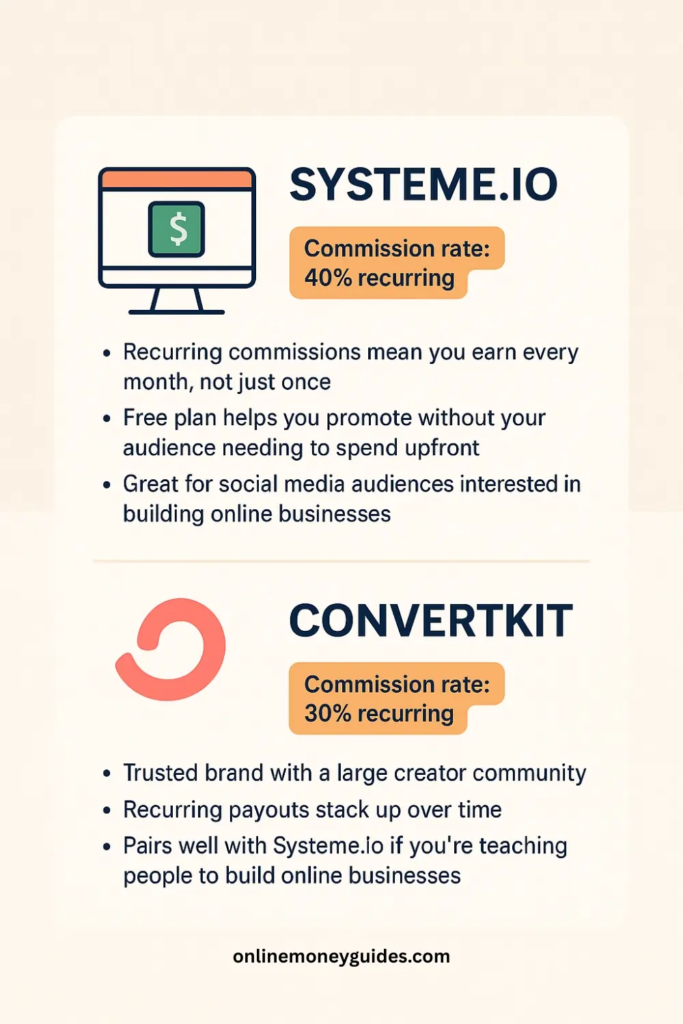
Systeme.io is an all-in-one online business platform for email marketing, landing pages, and digital courses. Unlike Canva, which restricts its program, Systeme.io actively encourages affiliates.
- Commission rate: 40% lifetime recurring.
- Minimum payout: $30.
- Free plan: Yes, which makes it very easy to recommend.
Why it works for beginners:
- Recurring commissions mean you earn every month, not just once.
- The free plan helps you promote without your audience needing to spend upfront.
- Great for social media audiences interested in building online businesses.
This program is a gem for high commission affiliate programs, especially for readers who want passive, recurring income.
ConvertKit
ConvertKit is one of the most popular email marketing platforms for creators. Its affiliate program is beginner-friendly and offers recurring payouts.
- Commission rate: 30% recurring.
- Minimum payout: $50.
- Best for: Content creators, bloggers, and online educators.
Why it works for beginners:
- Trusted brand with a large creator community.
- Recurring payouts stack up over time.
- Pairs well with Systeme.io if you’re teaching people to build online businesses.
ConvertKit is perfect if your audience is content-driven or creator-focused.
vidIQ
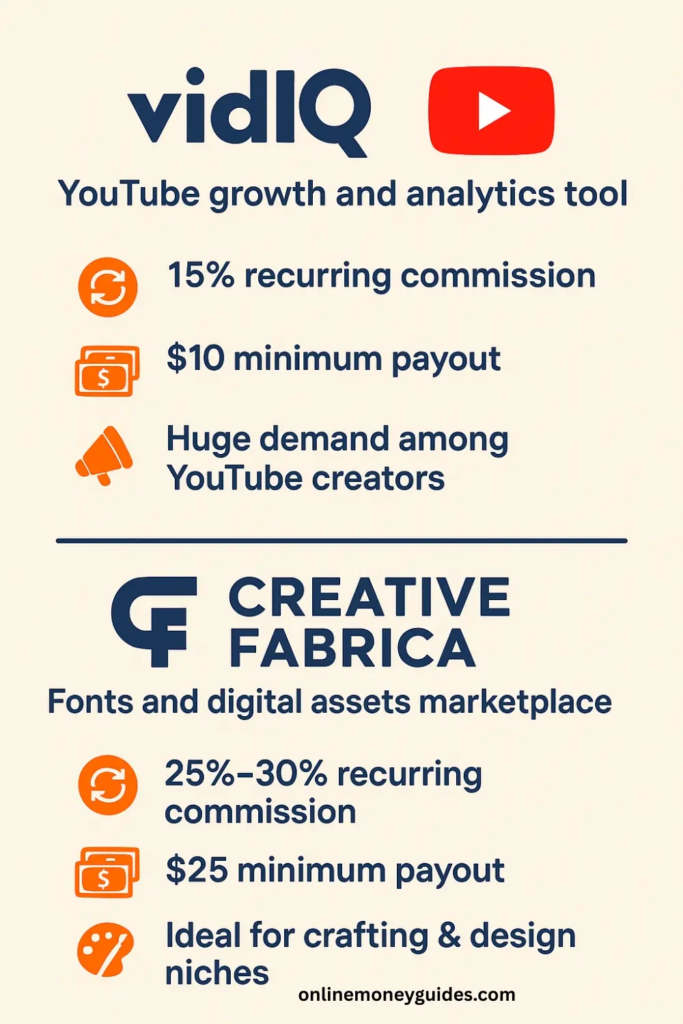
vidIQ is a YouTube growth and analytics tool, and its affiliate program is open, transparent, and pays recurring commissions.
- Commission rate: 15% recurring, up to 25% at higher tiers.
- Minimum payout: $10.
- Best for: Anyone targeting YouTube creators.
Why it works for beginners:
- Huge demand. Everyone wants to grow on YouTube.
- No website needed; you can share links directly with video creators.
- Lifetime recurring commission while the subscriber stays active.
This is a strong replacement for TubeBuddy, whose affiliate program has closed to new signups.
Creative Fabrica
Creative Fabrica offers fonts, templates, and digital assets used by Etsy sellers, print-on-demand entrepreneurs, and online creators.
- Commission rate: 25%–30% recurring.
- Minimum payout: $25.
- Best for: Crafting, design, and print-on-demand niches.
Why it works for beginners:
- Perfect for creators who design with tools like Photoshop or Procreate.
- Recurring income potential.
- Lower payout threshold makes it easier to see results sooner.
Creative Fabrica is an underrated choice if your audience leans toward Etsy, KDP, or digital product creation.
Social Media Affiliate Marketing: How to Promote Without a Blog
One of the biggest myths about affiliate marketing is that you can’t make money without a website. The reality? Most beginners today start with social media affiliate marketing because it’s faster, free, and you’re probably already on the platforms.
When you think about it, social media is built for trust and storytelling. That’s exactly what affiliate marketing requires. Instead of trying to build a complicated blog from scratch, you can share products naturally on platforms where your audience already spends time.
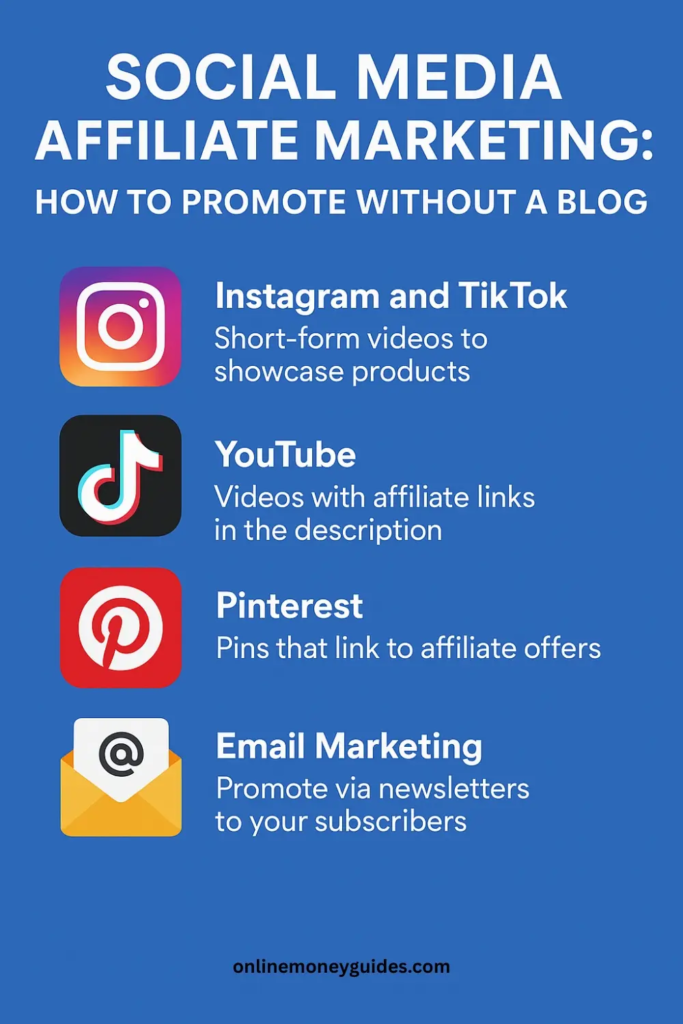
Instagram and TikTok
Short-form video is the easiest way to share affiliate products right now. A quick TikTok or Reel showing how you use a product, paired with a link in your bio, can drive clicks almost instantly. Both Instagram and TikTok also allow you to tag products directly in posts if you join their creator commerce programs.
YouTube
YouTube is powerful because videos work as long-term traffic drivers. A short tutorial, a review, or even a “day in the life” vlog can include affiliate links in the video description. Many YouTubers start earning their first affiliate commissions long before they qualify for YouTube ads.
Pinterest is essentially a visual search engine. A well-designed pin can show up in searches months after you post it. You can link your pins directly to affiliate offers or to landing pages you’ve built with tools like Systeme.io. This makes Pinterest a solid long-term strategy.
Email Marketing
Email is one of the most underrated ways to promote affiliate products without a blog. Tools like ConvertKit make it simple to set up a free landing page and collect subscribers. Once people join your list, you can recommend tools, courses, or products they’ll find useful.
The key to making social media affiliate marketing work is focusing on value over spam. Instead of just dropping links, tell a story, share a tip, or explain how the product makes life easier. That personal touch is what builds trust and leads to actual conversions.
High Commission Affiliate Programs (No Website Required)
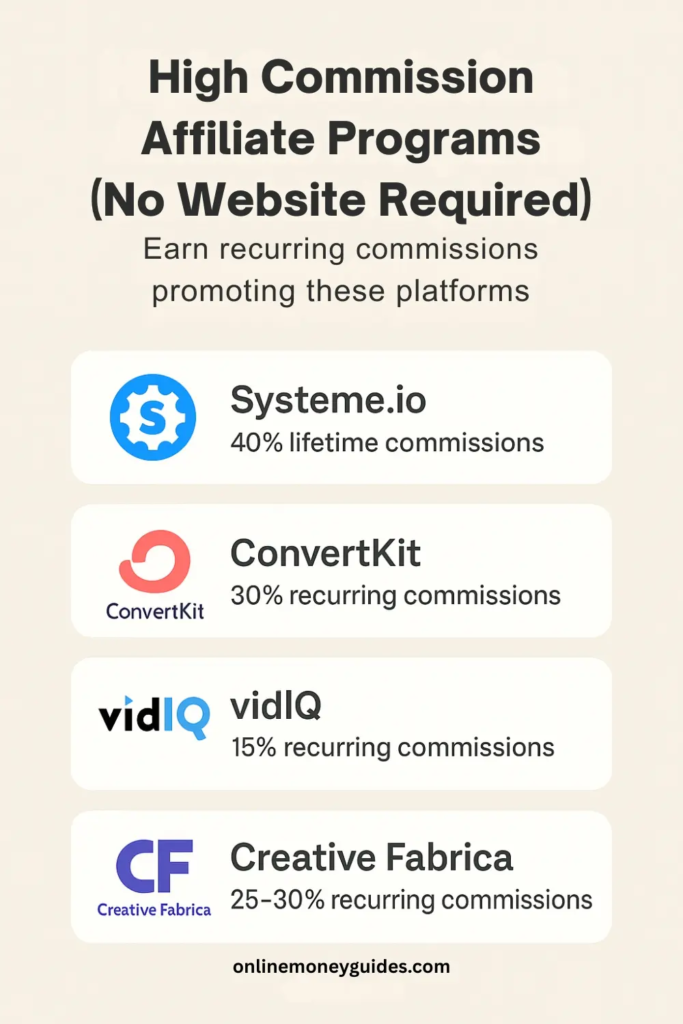
When you’re just starting out, it can be exciting to see a few dollars come in from Amazon Associates. But let’s be honest: small commissions alone won’t move the needle if you want real side income. That’s where high commission affiliate programs come in. These are tools and platforms that pay out a much larger percentage, often on a recurring basis, which means your effort today can keep paying you month after month.
Systeme.io
This platform is one of the most beginner-friendly ways to build funnels, landing pages, and email automation, all without paying up front. For affiliates, the draw is huge: every person you refer earns you a 40% recurring commission for life.
Because Systeme.io offers a free plan, it’s easy to recommend to your audience without pressure. This makes it one of the strongest programs in the “no website” category, especially for people interested in online business tools.
ConvertKit
ConvertKit is trusted by thousands of creators, from YouTubers to podcasters to writers. Its affiliate program is powerful because it offers a 30% recurring commission.
That means if someone signs up for ConvertKit through your link, you’ll keep earning every month they stay a customer. Beginners love this program because ConvertKit also provides a free plan, which makes it an easy “yes” for anyone dipping their toes into email marketing.
vidIQ
For anyone creating content on YouTube, vidIQ is a tool that helps with keyword research, analytics, and video optimization. The affiliate program pays 15% recurring commissions, with the chance to earn more as you refer additional customers. It’s perfect if your audience is made up of aspiring YouTubers who want to grow their channels. Since you can talk about your own growth journey, recommending vidIQ comes across naturally.
Creative Fabrica
Creative Fabrica serves a huge audience of Etsy sellers, crafters, and print-on-demand creators. It offers fonts, templates, and digital design resources, which make it easy to promote visually on platforms like Pinterest or Instagram. The affiliate program pays 25–30% recurring commissions, making it a creative-niche option with solid income potential.
What sets these programs apart from low-commission options is their ability to compound over time. Instead of chasing one-time sales, you’re building streams of recurring income. Even if you only sign up a handful of people each month, the commissions can stack into something meaningful.
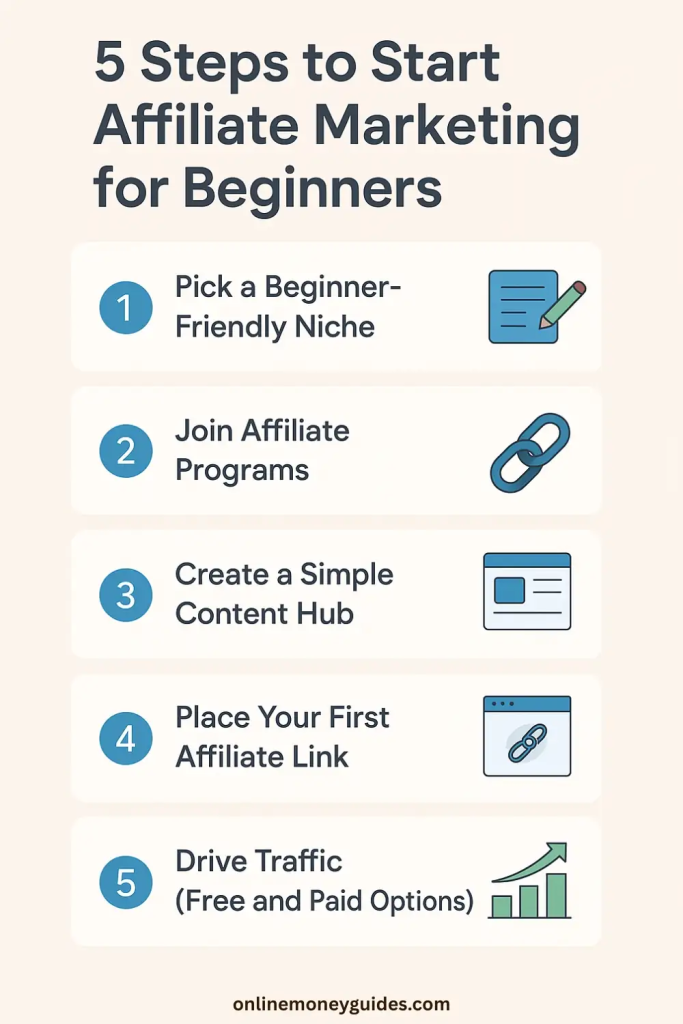
Affiliate Marketing Without a Blog: Step-by-Step Game Plan
Knowing the best programs is one thing. Putting them into action is another. Here’s a clear path you can follow to start affiliate marketing without a website and actually see results.
Step 1: Choose a niche you care about
Pick one area you enjoy talking about: fitness, tech tools, travel, or design. Don’t overthink it. What matters is that you can consistently create content around it. Choosing a niche also helps you filter affiliate programs that are relevant to your audience.
Step 2: Select two to three affiliate programs
Instead of joining every program at once, start small. For example, if your niche is digital entrepreneurship, you might focus on Systeme.io, ConvertKit, and Amazon Associates. This keeps things simple and helps you learn how each dashboard works.
Step 3: Create content that shows value
Content is where trust is built. Short videos, carousel posts, or tutorials can highlight how a product works in real life. The goal isn’t to “sell” but to show how the product solves a problem. When people see the benefit, clicking your link feels natural.
Step 4: Share your affiliate links strategically
Every platform gives you a place for links. Instagram has the bio link, YouTube has video descriptions, TikTok has bios and comments, and Pinterest lets you link pins directly. Use tools like Linktree or Bitly to keep links neat and trackable.
Step 5: Track your results and improve
Most affiliate dashboards show clicks and conversions. Watch for patterns: Which type of content gets the most clicks? Which programs convert best? Double down on what’s working instead of spreading yourself thin.
This five-step process removes the overwhelm. Instead of worrying about websites, hosting, or SEO, you’re simply sharing products in spaces you already use. And once you see those first commissions, even if it’s only a few dollars, your confidence will grow.
Comparison Chart: Easy Affiliate Programs for Beginners
When you’re deciding which affiliate programs to start with, it helps to see them side by side. Here’s a quick comparison of the best affiliate programs for beginners that don’t require a website.
| Program | Commission | Payout Threshold | Works Without Website? | Best For |
| Amazon Associates | 1–10% | $10 | Yes | Everyday products, broad niches |
| Awin | Varies (5–20%) | $20 | Yes | Lifestyle, fashion, travel, SaaS |
| Impact | Varies (10–30%) | $25 | Yes | Tech tools, apps, retail |
| Rakuten Advertising | Varies (5–20%) | $50 | Yes | U.S. retail & household names |
| Systeme.io | 40% recurring | $30 | Yes | Digital entrepreneurs, online business |
| ConvertKit | 30% recurring | $50 | Yes | Creators, coaches, educators |
| vidIQ | 15–25% recurring | $10 | Yes | YouTube creators, video marketing |
| Creative Fabrica | 25–30% recurring | $25 | Yes | Crafters, Etsy, print-on-demand |
This table gives you a quick sense of which programs fit your niche and how easy it is to reach payout. For beginners, Amazon Associates is often the fastest way to start earning. But if you want long-term, higher payouts, Systeme.io or ConvertKit will give you stronger recurring income potential.
Mistakes Beginners Make in No-Website Affiliate Marketing
It’s easy to get excited when you first discover affiliate marketing without a blog. But many beginners fall into the same traps that slow down their progress. Knowing these mistakes ahead of time helps you avoid them and stay focused.
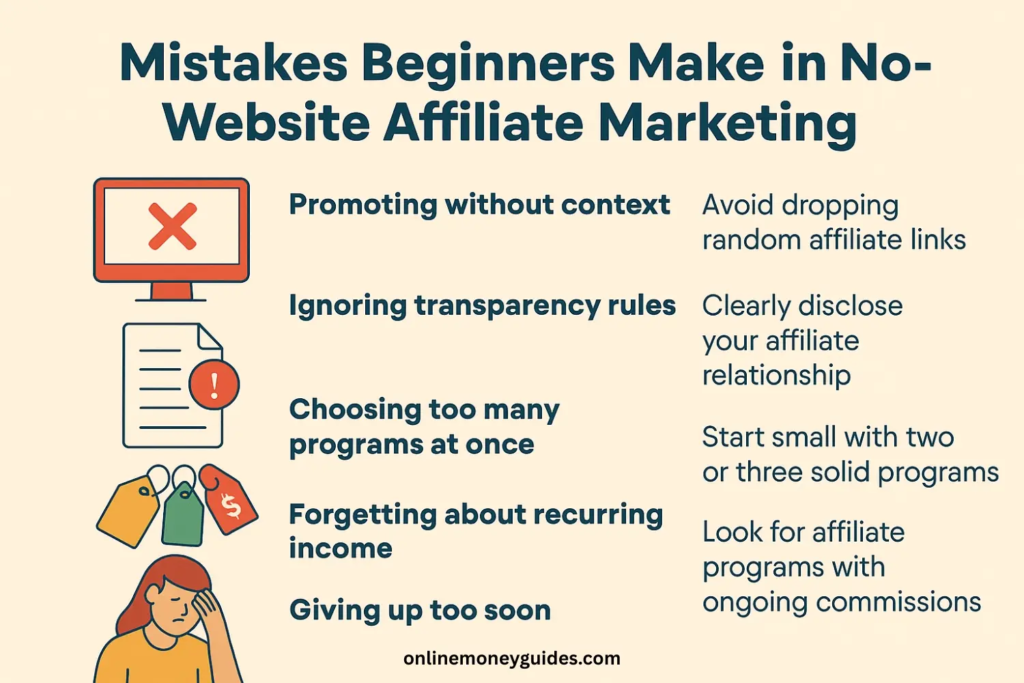
Promoting without context
Dropping random affiliate links in comments or messages might seem quick, but it doesn’t build trust. People click when they feel a genuine connection, not when they sense a sales pitch. Always add context, a tip, a story, or an explanation of why the product is useful.
Ignoring transparency rules
In the U.S., the FTC requires you to disclose when you use affiliate links. A simple “This post contains affiliate links” is enough. Skipping disclosure might not only hurt your credibility but could also cause compliance issues.
Choosing too many programs at once
Signing up for every program you find spreads your attention thin. It’s better to focus on two or three solid affiliate programs, create consistent content, and learn what converts before branching out.
Forgetting about recurring income
Programs like Systeme.io and ConvertKit pay every month as long as your referral stays active. Beginners often overlook these high-commission affiliate programs and instead chase small one-time sales. Over time, recurring programs can be the difference between $50 a month and $500 a month.
Giving up too soon
Affiliate marketing takes time. You may not see instant results in your first week or two, but consistent content builds trust. Most beginners quit right before their momentum starts to pick up.
The truth is, mistakes aren’t final; they’re just lessons. The key is to treat affiliate marketing like a skill you’re practicing. With patience, each step gets easier and the results compound.
Why You Don’t Need a Website to Begin
Starting affiliate marketing can feel overwhelming, especially when you see people talking about blogs, SEO, or complicated funnels. But the reality is much simpler. You don’t need a blog to take your first step. You already have the tools: your phone, your favorite social media platform, and a story to share.
The best affiliate programs for beginners aren’t reserved for experts. They’re designed to be accessible: Amazon Associates for everyday products, Awin and Impact for variety, Rakuten for trusted brands, and tools like Systeme.io, ConvertKit, vidIQ, and Creative Fabrica for higher recurring commissions.
What matters most isn’t having a website; it’s being willing to share value. When you tell stories, show how a product fits into your life, and connect with your audience, affiliate marketing stops being about selling and starts being about helping. That’s when people click your links, and that’s when income begins to grow.
Remember, your first commission might only be a few dollars, but it’s proof that this works. From there, the results stack up. Each piece of content is an asset that can earn for you again and again.
So if you’ve been waiting until you build a blog or until everything feels perfect, here’s your sign: start now, with what you have. Share what you know, recommend what you use, and let the journey unfold.
These beginner-friendly programs are a great place to start, but to learn how to build long-term, consistent income, read our How to Make Money with Affiliate Marketing (Everything You Need to Know) guide.