The secret to a profitable dropshipping business isn’t the fanciest store or the biggest ad budget — it’s finding winning dropshipping products that people genuinely want to buy. Every successful dropshipper, from the side hustler testing ideas at night to the full-time entrepreneur scaling with paid ads, has one thing in common: they know how to spot products before they go mainstream.
Finding those products doesn’t take luck. It takes strategy, curiosity, and a few powerful tools. The goal of this guide is to show you how to identify profitable dropshipping products using data, trends, and real-world validation so you don’t waste time guessing what will sell.
Whether you’re setting up your first Shopify store or adding new items to your catalog, you’ll learn step-by-step how to research, test, and validate dropshipping winning products with confidence. By the end, you’ll know exactly where to look, what signs to trust, and how to avoid the common mistakes that cost new sellers money.
This guide is part of our Ultimate 2026 Dropshipping Guide, where we cover everything from finding your niche to building, launching, and scaling your store profitably.

What Makes a “Winning” Dropshipping Product?
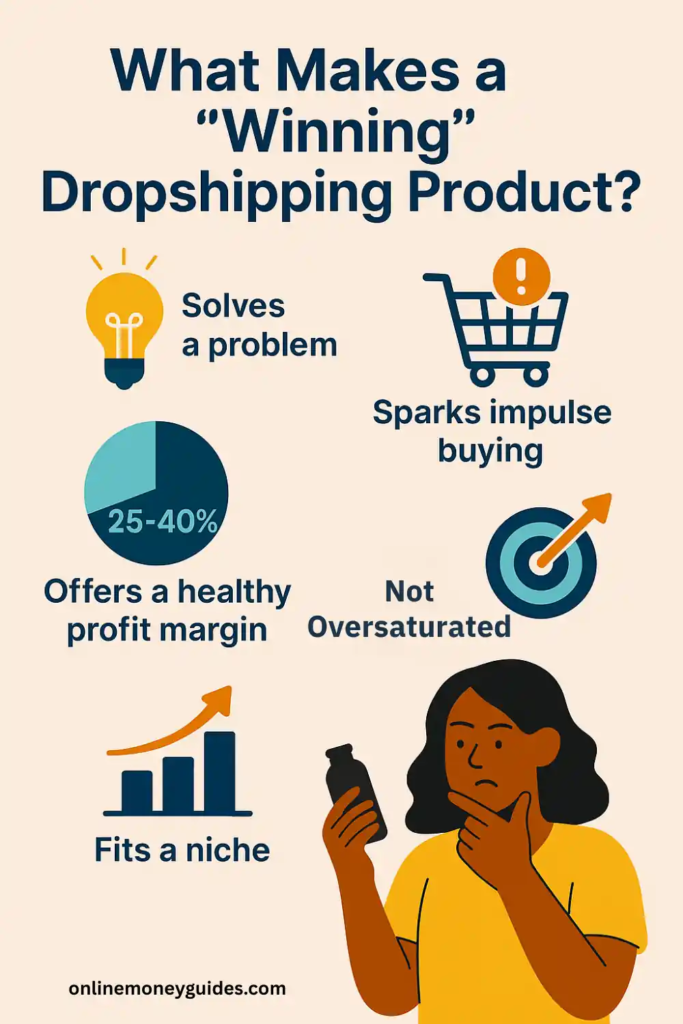
Before you can find winning dropshipping products, you need to understand what makes a product “win” in the first place. It’s not just about high sales volume or viral TikToks; it’s about products that combine emotional appeal, problem-solving potential, and consistent demand.
A winning product usually checks most of these boxes:
- It solves a real or emotional problem (e.g., posture correctors, pet hair removers, skincare tools).
- It sparks impulse buying through curiosity, novelty, or aesthetic appeal.
- It offers a healthy profit margin, ideally 25–40% after shipping and marketing costs.
- It’s not oversaturated, meaning fewer competitors are aggressively selling it.
- It fits within an evergreen or rising niche, ensuring it won’t disappear overnight.
Here’s a simple comparison to visualize the difference between an average product and a winner:
| Criteria | Average Product | Winning Dropshipping Product |
| Demand | Seasonal or inconsistent | Consistent or growing |
| Problem Solved | None or minor | Solves a real pain point |
| Emotional Appeal | Low | High (curiosity, satisfaction, excitement) |
| Profit Margin | < 20% | 25–40%+ |
| Market Saturation | High | Moderate or low |
| Social Proof | Little to none | Visible engagement and reviews |
A profitable dropshipping product is also one that aligns with your audience. For example, a gadget might perform better in the U.S. market if it ties to lifestyle improvements, while a wellness or eco-friendly item might resonate more with sustainable shoppers.
When you evaluate new products, remember this – it’s not about how cool it looks, but how well it connects with buyers’ real needs.
How to Find Dropshipping Products That Actually Sell
There’s a method behind discovering winning dropshipping products. It’s not about scrolling endlessly through TikTok or copying what another seller posts. The goal is to find items that have proven traction, then validate them with data before you invest time or money.
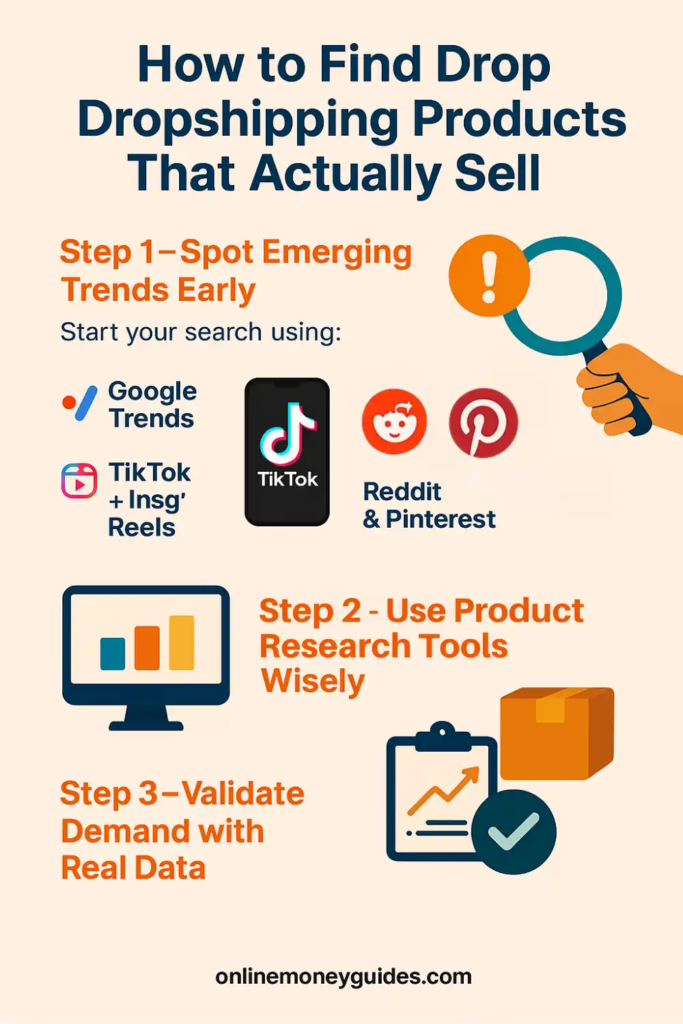
Here’s the simple truth: finding dropshipping winning products comes down to combining three skills — trend spotting, product research, and validation. Let’s break each one down step by step.
Step 1 — Spot Emerging Trends Early
Trends start quietly. A product might first appear in a few TikTok videos, a Reddit thread, or an Amazon subcategory before it becomes mainstream. Catching it early gives you a competitive edge.
Start your search using:
- Google Trends: Track rising search interest over time and compare multiple products. Look for steady upward growth over at least 90 days.
- TikTok and Instagram Reels: Watch for hashtags like #TikTokMadeMeBuyIt or #TrendingProducts. Engagement spikes here often lead to viral sales later.
- Reddit and Pinterest: Reddit forums (like r/Entrepreneur and r/Dropship) and Pinterest trend pages reveal what people are currently obsessing over.
- Trend Hunter: A reliable platform to discover innovation-based trends and early demand signals.
For Instance, when “wireless car vacuum” searches started rising on Google Trends and people began sharing mini vacuum videos on TikTok, early adopters made thousands before the niche became saturated.
Step 2 — Use Product Research Tools Wisely
Manual research works, but automated data makes the process faster and more reliable. Tools like Minea, Ecomhunt, and Sell The Trend analyze millions of products and ads in real time to help you spot what’s selling.
Here’s a quick overview of popular tools:
| Tool | Best For | Why It’s Useful |
| Minea | Ad tracking across social platforms | Helps you find viral products before competitors |
| Ecomhunt | Curated product ideas | Gives you engagement data and supplier links |
| Sell The Trend | All-in-one product finder | Integrates Shopify data and competitor stores |
| Niche Scraper | Market analysis | Ranks products by daily sales and demand |
| Koala Inspector | Competitor store spying | Lets you view any Shopify store’s top sellers |
Each of these tools helps you narrow down your list of profitable dropshipping products by providing data you can actually act on — not just guesses.
Step 3 — Validate Demand with Real Data
A trend means nothing if people aren’t buying. Before choosing any product, validate it through real-world indicators:
- AliExpress and Alibaba Data: Sort by order volume and supplier feedback. A steady rise in orders shows genuine demand.
- Amazon Best Sellers: Filter by category to spot consistent performers, not just fads.
- Facebook Ad Library: Search ads for the same or similar products. If multiple brands are running ads continuously, it’s a good sign it’s working.
- Google Keyword Planner or Ahrefs: Check monthly search volume and CPC (cost per click). Products with high interest and moderate competition usually perform best.
When all three align — trend growth, data-backed demand, and positive customer engagement — you’ve likely found a winning dropshipping product.
How to Estimate Profit Margins Before You Commit
Many beginners skip this step and end up selling products that look exciting but barely make any profit. A winning dropshipping product isn’t just one that sells; it’s one that leaves you enough margin to reinvest, market, and scale.
A good rule of thumb is to aim for a 25–40% profit margin after deducting product cost, shipping, and ad spend. Here’s how to quickly calculate that:

Example:
Let’s say you sell a product for $39.99, and your total cost (including shipping and ads) is $26.
(39.99−26) / 39.99 = 34.9% profit margin
That’s a healthy number.
But if your margin falls below 20%, you’ll struggle to cover ad fluctuations or refund requests — which means the product isn’t sustainable long term.
When doing dropshipping product research, aim for products that meet these baseline numbers:
| Metric | Ideal Range |
| Product cost | 20–40% of retail price |
| Average order value (AOV) | $30–$80 |
| Ad spend per conversion | < 30% of retail price |
| Net profit margin | 25–40% |
To analyze potential profit quickly, use Sell The Trend’s ROI estimator. These give you a clear snapshot of whether your product idea is worth pursuing before spending a dollar on ads.
It’s tempting to chase “viral” products with razor-thin margins, but the smarter play is to choose profitable dropshipping products that give you room to test, adjust, and scale.
How to Choose a Profitable Dropshipping Niche
Choosing the right niche is just as important as finding winning dropshipping products. Think of your niche as the foundation. It decides who you’re selling to, what kind of products resonate, and how easily you can build trust with your audience.
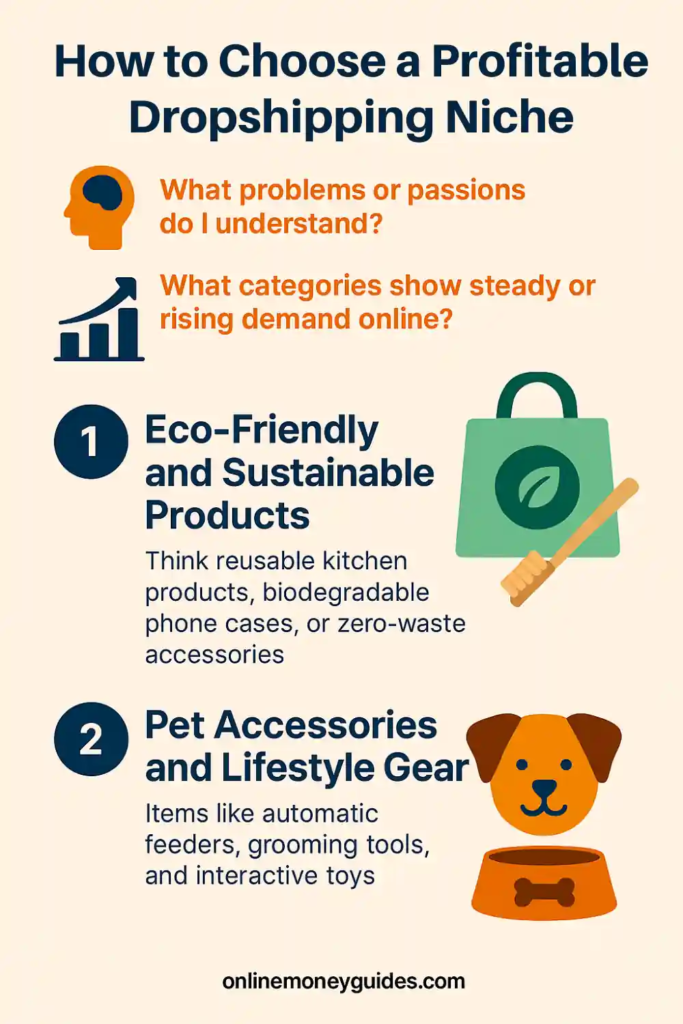
When selecting a niche, start with two questions:
- What problems or passions do I understand?
- What categories show steady or rising demand online?
Your best-performing products usually live where those two overlap. For example, if you love fitness, you’ll naturally notice gaps in gear or recovery products before others do. That insight gives you an advantage.
Let’s explore some of the best dropshipping niches that continue to perform in 2026 and continue to look strong into 2027:
1. Eco-Friendly and Sustainable Products
Consumers are becoming more eco-conscious, and sustainable items often command higher prices. Think reusable kitchen products, biodegradable phone cases, or zero-waste accessories. Tools like Ecomhunt can help identify trending eco-friendly products before they flood the market.
2. Pet Accessories and Lifestyle Gear
Pet owners love treating their animals, and this market has strong emotional buying triggers. Items like automatic feeders, grooming tools, and interactive toys tend to go viral because they blend utility with fun.
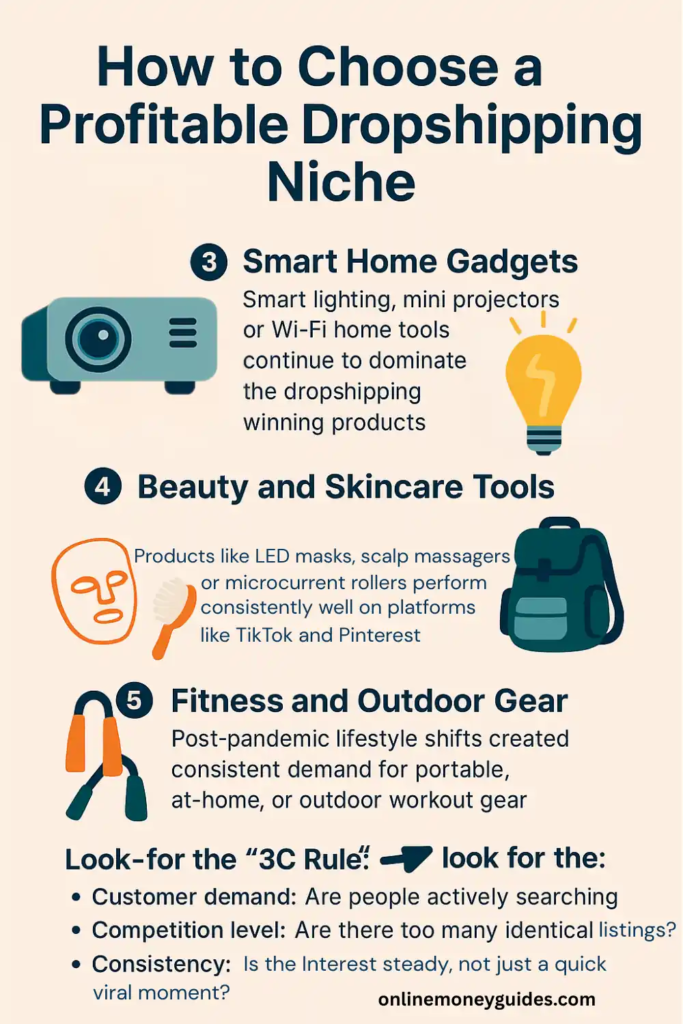
3. Smart Home Gadgets
Smart lighting, mini projectors, or Wi-Fi home tools continue to dominate the dropshipping winning products category. Use Minea or Koala Inspector to find gadgets that are getting ad traction on social media.
4. Beauty and Skincare Tools
This niche never loses relevance. Products like LED masks, scalp massagers, or microcurrent rollers fall into the “self-care meets tech” category, which performs consistently well on platforms like TikTok and Pinterest.
5. Fitness and Outdoor Gear
Post-pandemic lifestyle shifts created consistent demand for portable, at-home, or outdoor workout gear. Resistance bands, hiking accessories, and recovery tools are strong profitable dropshipping products that align with long-term trends.
When deciding on a niche, look for the “3C Rule”:
- Customer demand: Are people actively searching for these products?
- Competition level: Are there too many identical listings or stores?
- Consistency: Is the interest steady, not just a quick viral moment?
You can use Google Trends, Keyword Planner, and Amazon Best Sellers to cross-check this data. Once you find a niche with proven demand and healthy margins, building your store around it becomes far easier and more sustainable.
Tools That Help You Find Winning Dropshipping Products Faster
Finding winning dropshipping products doesn’t need to take hours of manual searching. With the right tools, you can filter thousands of options, see what’s trending in real time, and validate which ones have genuine potential. The trick is knowing which tools are worth your time and how to use them strategically.
Here are some of the best tools (and how to use them like a pro):
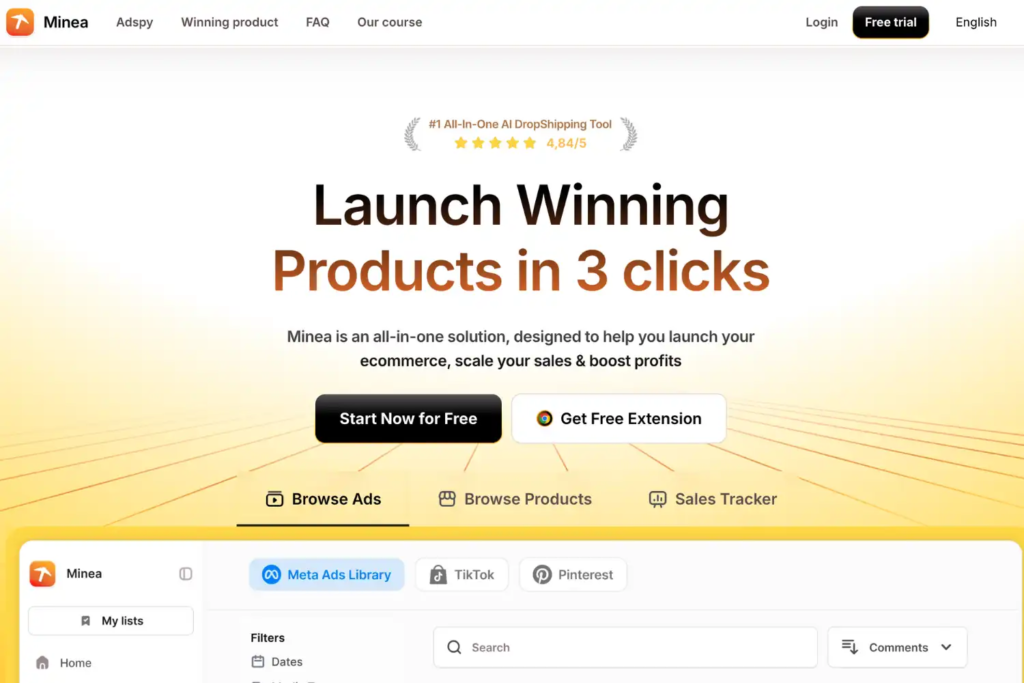
1. Minea — Ad Intelligence for Product Discovery
Minea is one of the top tools for ad-based product research. It scans ads across Facebook, TikTok, Pinterest, and Instagram to show you what’s currently converting. You can filter by engagement, country, and ad duration to see which products are gaining traction early.
Best for: Spotting viral and trending dropshipping products before your competitors.
Pro tip: Look for ads that have been running for over 30 days with consistent engagement. That’s a sign the product is profitable long term.
2. Ecomhunt — Curated Winning Product Database
Ecomhunt compiles a curated list of daily dropshipping winning products along with product descriptions, supplier links, engagement data, and ad examples. It’s perfect for beginners who want inspiration without drowning in data.
Best for: Quick validation and plug-and-play ideas you can test fast.
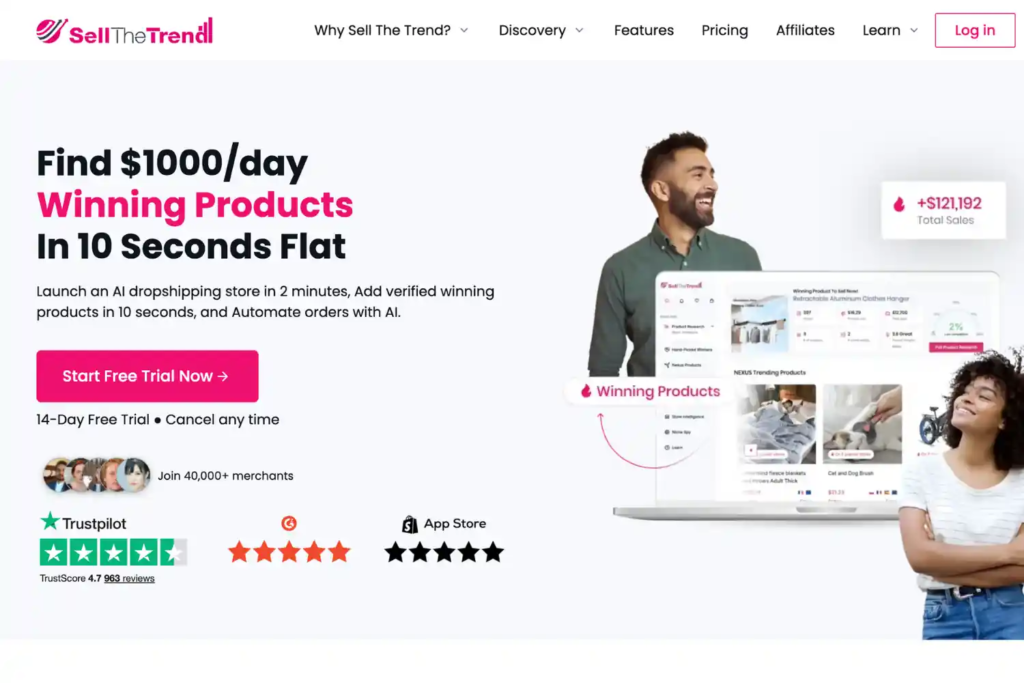
3. Sell The Trend — All-in-One Product Finder
This platform combines product research, niche analytics, and store tracking. It also has a “Nexus” AI feature that helps identify profitable dropshipping products based on performance signals across Shopify stores.
Best for: Data-driven sellers who want one dashboard for everything — trend tracking, competitor analysis, and ROI estimation.
4. Niche Scraper — Competitor Store Analyzer
Niche Scraper lets you see which products are performing well across thousands of Shopify stores. It even scrapes store data to reveal pricing, sales volume, and best sellers.
Best for: Reverse-engineering successful stores and spotting niche gaps.
5. Koala Inspector — Shopify Store Chrome Extension
This simple Chrome plugin lets you inspect any Shopify store to see what apps, products, and marketing strategies they use.
Best for: Identifying winning dropshipping products that top-performing stores are quietly selling.
6. VidIQ — Trend Discovery via YouTube
While most dropshippers focus on Facebook ads, YouTube trends often predict what people will buy next. VidIQ helps you track high-volume, low-competition keywords and trending videos in real time.
Best for: Finding evergreen product demand before it peaks — especially in niches like fitness, tech, and beauty.

7. AdSpy — Social Ad Performance Data
AdSpy is ideal for studying Facebook and Instagram ad performance. You can search by keyword, engagement, or advertiser name to see which ads are consistently driving sales.
Best for: Identifying patterns in successful ad creatives and refining your own product launch strategy.
8. Visme or Placeit — Design and Mockups
Once you’ve chosen a product, you’ll need eye-catching visuals. Visme and Placeit help you create professional product images, lifestyle mockups, and marketing materials — even if you’re not a designer.
Best for: Increasing trust and click-through rates on ads and product pages.
Using these tools together creates a full research loop: discover → validate → design → launch.
You’ll save time, reduce guesswork, and increase your chances of finding a true winning dropshipping product before the market gets crowded.

How to Validate a Winning Dropshipping Product Before You Sell It
Once you’ve found a few winning dropshipping products that look promising, the next step is validation. Validation means proving that real people want what you’re planning to sell, and that you can sell it profitably. Skipping this step is one of the main reasons new dropshippers lose money early on.
The goal here is simple: confirm demand, profitability, and customer appeal before committing to ads or inventory.
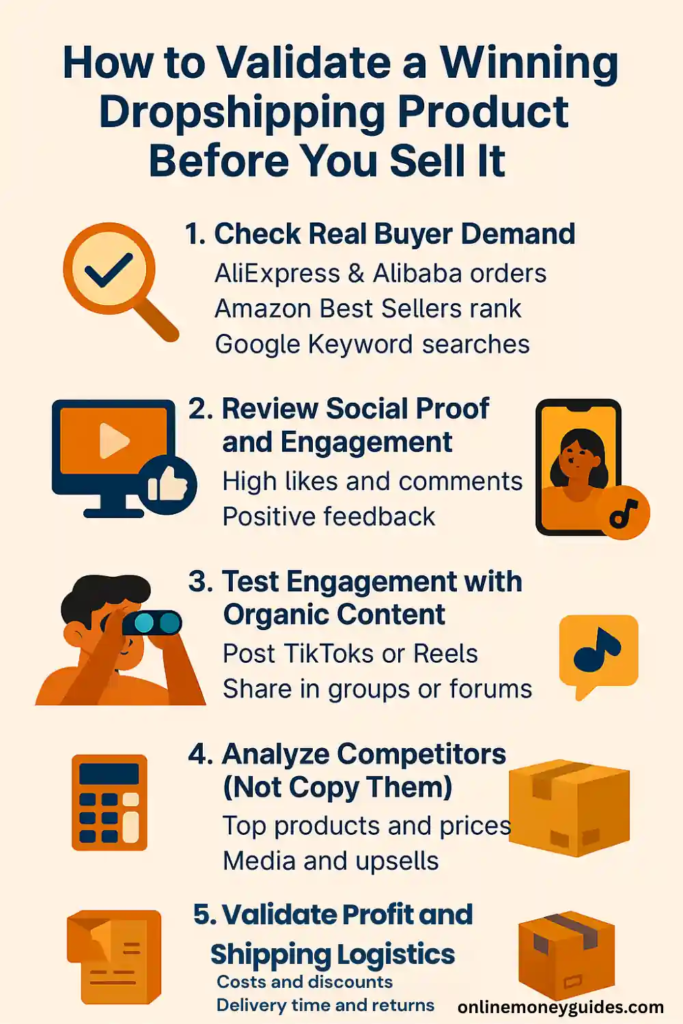
Step 1 — Check Real Buyer Demand
Even if a product is trending, you need proof that customers are actively buying. Here’s how to confirm:
- AliExpress & Alibaba: Look for suppliers with thousands of orders and consistent reviews above 4.6 stars.
- Amazon Best Sellers: See if your product appears in the top 100 within its category. This indicates stable, long-term demand.
- Etsy Trending Section: Great for niche or handmade-style products (e.g., personalized accessories, home decor).
- Google Keyword Planner: Search average monthly queries. A healthy range for beginner-friendly products is between 5,000–50,000 monthly searches with moderate competition.
Step 2 — Review Social Proof and Engagement
Social signals are the digital version of word-of-mouth validation.
Use Minea or AdSpy to study social media ads for your product. Look for:
- Ads with thousands of likes, comments, and shares over a 30+ day period.
- Comments that mention actual purchases or satisfaction.
- Multiple brands running similar products (a sign there’s room for competition).
This confirms the product isn’t just getting views — it’s generating sales.
Step 3 — Test Engagement with Organic Content
Before spending on ads, test your product concept through organic posts:
- Create a short TikTok or Instagram Reel showing the product in action.
- Post in Facebook groups or Reddit threads relevant to your niche.
- Watch how people respond. If you get saves, shares, or comments asking, “Where did you get that?” — that’s demand in action.
You can use VidIQ to find trending hashtags and keywords to help your posts reach the right audience.
Step 4 — Analyze Competitors (Not Copy Them)
Competitor research is about understanding why certain products succeed.
Use Koala Inspector or Niche Scraper to peek into their stores and note:
- Their best sellers and pricing.
- The style of images or videos they use.
- Which upsells or bundles increase order value.
Ask yourself: What can I do differently to stand out? Maybe you position the product as eco-friendly, add better visuals with Placeit, or target a slightly different audience segment.
Step 5 — Validate Profit and Shipping Logistics
Finally, confirm that your numbers make sense. Revisit your earlier profit margin formula and double-check:
- Product cost after bulk or negotiated discounts.
- Shipping time (keep it under 14 days when possible).
- Customer return or dispute rate (look at supplier history).
Many profitable dropshipping products lose traction because of delayed shipping or quality issues. Always order one sample before going live.
When all these steps align — real demand, solid margins, positive social proof, and smooth logistics – you’ve got a validated winning dropshipping product. You can move forward confidently, knowing you’re not gambling on guesswork but building on evidence.
Common Mistakes When Searching for Dropshipping Winning Products
Even with the best tools and data, it’s easy to make simple mistakes when hunting for winning dropshipping products. Most new sellers don’t fail because they’re lazy. They fail because they skip key steps or follow misleading “shortcut” advice online.
Here are the most common mistakes to avoid (and what to do instead).
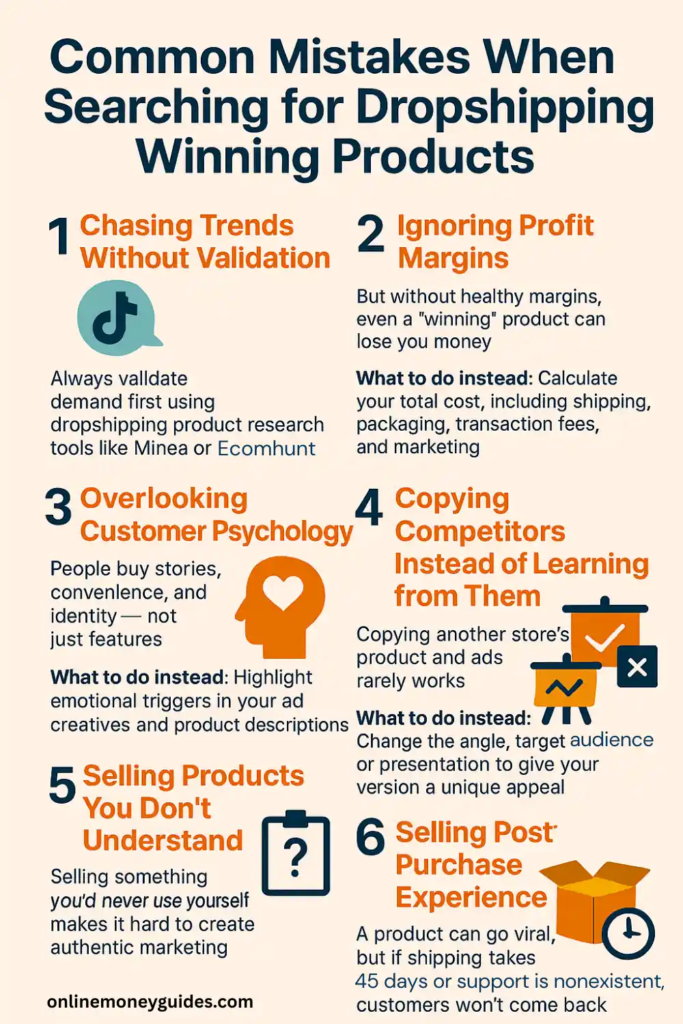
1. Chasing Trends Without Validation
Seeing a viral TikTok doesn’t mean you’ve found a winner. Trends can fade overnight, leaving you with ad costs and zero traction.
What to do instead: Always validate demand first using dropshipping product research tools like Minea or Ecomhunt, then check Google Trends or at least a 90-day pattern of steady growth.
2. Ignoring Profit Margins
Beginners often fall into the trap of pricing too low just to compete. But without healthy margins, even a “winning” product can lose you money once ad spend is added.
What to do instead: Calculate your total cost — including shipping, packaging, transaction fees, and marketing. Only move forward with profitable dropshipping products that maintain at least a 25% margin.
3. Overlooking Customer Psychology
A lot of products fail not because they’re bad, but because they don’t evoke emotion. People buy stories, convenience, and identity — not just features.
What to do instead: Ask yourself, Why would someone buy this? Highlight emotional triggers in your ad creatives and product descriptions. For visuals, you can create mockups or lifestyle imagery using Placeit to make your product relatable.
4. Copying Competitors Instead of Learning from Them
Copying another store’s product and ads rarely works. You’ll always be one step behind.
What to do instead: Use Koala Inspector to analyze competitor strategies, then adapt. Change the angle, target audience, or presentation to give your version a unique appeal.
5. Selling Products You Don’t Understand
Selling something you’d never use yourself makes it hard to create authentic marketing. Customers can sense it.
What to do instead: Choose products you can talk about confidently. Even if it’s just one small niche you enjoy, it’s easier to create real, engaging content that builds trust.
6. Ignoring Post-Purchase Experience
A product can go viral, but if shipping takes 45 days or support is nonexistent, customers won’t come back.
What to do instead: Test suppliers with sample orders. Check packaging quality and communication speed before scaling. Reliable fulfillment is just as important as finding a trend.
Building Your First Product List
By now, you’ve learned how to find, analyze, and validate winning dropshipping products. The next step is organization. Building a simple product shortlist that helps you stay focused instead of getting lost in endless research.
A clear system prevents you from chasing every shiny trend. You’ll be able to compare options side by side and see which products are truly worth testing.
Here’s a quick, easy-to-use format you can follow inside Google Sheets or Notion:
| Product Idea | Niche | Validation Score (1–5) | Supplier Link | Estimated Margin | Notes |
| LED Dog Collar | Pet Accessories | 4 | AliExpress / Minea | 32% | Strong engagement on TikTok, eco-friendly angle |
| Portable Blender | Health & Fitness | 5 | Sell The Trend | 38% | High search volume, consistent Amazon sales |
| Reusable Makeup Pads | Beauty | 3 | Ecomhunt | 28% | Steady trend, consider better packaging visuals |
| Car Phone Holder 2.0 | Smart Tech | 4 | Niche Scraper | 35% | Long-term product with solid reviews |
| Minimalist Desk Lamp | Home Decor | 4 | Koala Inspector | 30% | Low competition, modern design aesthetic |
This table keeps your process grounded and data-driven. A Validation Score of 4–5 means a product meets most winning criteria — real demand, strong margins, visible engagement, and manageable competition.
You can also color-code your list:
- 🟢 Ready to test now (validated and profitable)
- 🟡 Needs more data (trend still forming or margin unclear)
- 🔴 Discard (too saturated or low profit)
Once you have your top 3–5 profitable dropshipping products, start small.
Test one product at a time with a low-budget ad or influencer shoutout. Monitor performance for a week, then double down on the ones that show engagement or conversions.
Remember: your goal isn’t to find 100 trending products — it’s to find one or two that consistently sell and can scale.
Building your first winning list is more about focus and iteration than luck. Every product you test teaches you something valuable about what your audience wants.
Start Small, Test Fast, Learn Constantly
Finding winning dropshipping products isn’t a one-time event; it’s a repeatable skill that gets sharper with practice. The first few products you test might not be home runs, but each one teaches you what buyers respond to and what markets you truly understand.
Most successful dropshippers didn’t start with perfect instincts. They started with curiosity, tested quickly, and learned from feedback. The truth is, dropshipping product research is 80% strategy and 20% courage. The courage to take your research and actually launch.
Here’s your roadmap:
- Research emerging trends using Google Trends, TikTok, and Reddit.
- Validate those trends with data-backed tools.
- Calculate your margins.
- Test small, scale what works, and discard what doesn’t.
Once you’ve found one profitable dropshipping product, you can build systems around it. Automating your fulfillment, improving ad creatives, and expanding your catalog within the same niche.
You don’t need to be a marketing expert or tech genius to succeed in dropshipping. You just need focus, consistency, and the willingness to learn from each product launch.
Start today with one product idea that excites you, use the methods in this guide, and you’ll already be ahead of 90% of new sellers.
Once you’ve found a winning product, the next step is learning how to set up your store and scale your sales. Read our Ultimate Guide to Dropshipping in 2026 to see the full process.