So you’ve been Googling how to make money online, and you end up buried under a pile of clickbait promises. “Earn $10,000 overnight!” or “Quit your job tomorrow with this one weird trick.” No wonder it feels overwhelming and a little shady.
Here’s the truth: yes, you can make money online. Thousands of regular people are doing it every day, building side hustles, replacing their 9–5 income, or creating extra cash for things like travel, savings, or paying off debt. But the ones who succeed don’t do it with magic formulas. They do it by picking a path, starting small, and growing consistently.
This guide is built to help you do exactly that. Whether you’re a beginner dipping your toes into online side hustles or someone ready to explore digital entrepreneurship, you’ll find practical methods here. No scams. No hype. Just clear steps you can follow from your laptop, often without big upfront costs.
By the end, you’ll not only know the best ways to make money from home, but you’ll also have the confidence to take your first step today.
You don’t need to be perfect; you just need to start.

Why You’re Here: Breaking the “Is This Even Possible?” Doubt
If you’ve ever wondered, “Can I really earn money online, or is this all a scam?” you’re not alone. Most beginners feel that way. You might be juggling a job, classes, or family, and thinking:
- “I don’t have special skills.”
- “I don’t know where to start.”
- “What if I waste my time?”
Let’s clear this up: making money online is not about luck, and it’s not reserved for tech geniuses. It’s about choosing the right model for your situation, putting in consistent effort, and avoiding distractions.
You don’t need to go all-in right away. You can test things, learn as you go, and grow over time. Every big online business, from YouTubers with millions of subscribers to Etsy shop owners, started with zero followers, zero sales, and a lot of trial and error.
This guide is your shortcut to avoid the overwhelm and focus on what works.
The Big Picture: How People Actually Earn Money Online
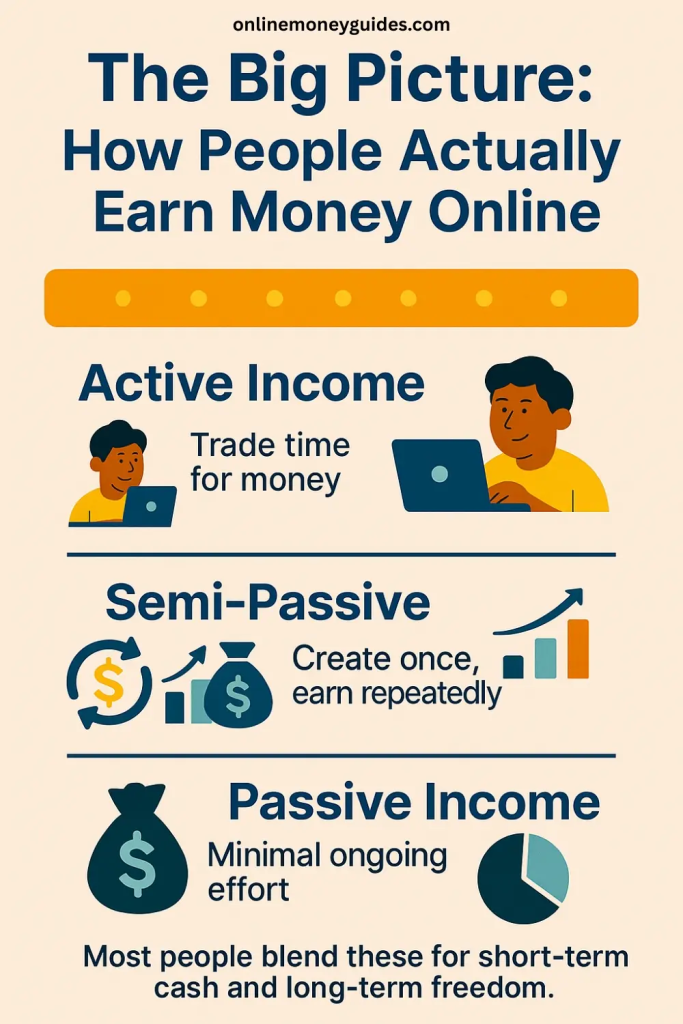
When you hear “make money online,” it can sound like a huge mystery. In reality, almost every method falls into three main categories: active income, semi-passive income, and passive income. Understanding these upfront helps you choose the right starting point for your goals and lifestyle.
Here’s a simple breakdown:
| Type of Income | What It Means | Examples | Effort vs Reward |
| Active Income | You trade time for money, just like a job, but online. | Freelancing, virtual assistant work, remote jobs. | Blogging, YouTube, and Etsy digital products. |
| Semi-Passive Income | You create something once, then keep earning as it gets used or sold repeatedly. | Slower to start, but it can snowball as your audience grows. | Affiliate marketing, online courses, and print-on-demand. |
| Passive Income | Systems or products earn money with minimal ongoing effort. | Affiliate marketing, online courses, print-on-demand. | Hardest to set up, but most scalable long-term. |
Most beginners start with active income because it brings in cash faster. Over time, shifting into semi-passive and passive streams builds stability and freedom.
Think of it like climbing a ladder: freelancing or remote work puts money in your pocket today, while things like affiliate marketing or digital products create a future where you’re not stuck trading every hour for dollars.
You don’t have to pick one path forever. Many online entrepreneurs blend all three over time to balance short-term cash flow with long-term freedom.
Beginner-Friendly Online Side Hustles You Can Start This Week
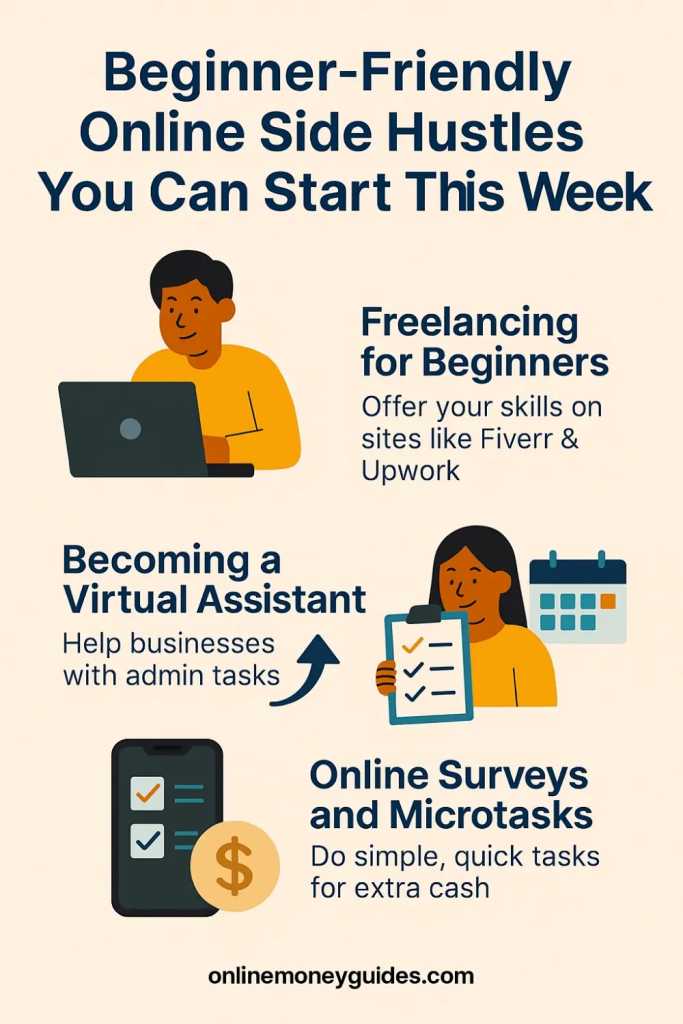
Not every way to earn money online takes months to set up. Some side hustles are beginner-friendly and can start paying you within days or weeks. These aren’t flashy, and they won’t make you rich overnight, but they’re perfect for building confidence and proving to yourself that online income is real.
Freelancing for Beginners
Freelancing is one of the fastest ways to earn online because you’re simply offering a skill in exchange for pay. That skill doesn’t need to be advanced; businesses need help with everything from writing social media captions to editing short videos.
Websites like Fiverr and Upwork connect freelancers with clients worldwide. Beginners often start at $5–$15 per project on Fiverr, but as you complete jobs and earn reviews, you can quickly raise your rates. On Upwork, entry-level gigs might pay $10–$20 an hour, while skilled freelancers often earn $40 or more.
The beauty of freelancing is flexibility: you can choose the projects you like, work as much or as little as you want, and learn new skills as you go. Many digital entrepreneurs who now run full businesses started with simple freelance gigs.
Don’t underestimate the skills you already have. Even if you think something is “basic” like proofreading, making PowerPoint slides, or organizing spreadsheets, someone else is willing to pay for it.
Becoming a Virtual Assistant
Think of a virtual assistant (VA) as a digital right-hand person. Entrepreneurs, coaches, and small businesses are always looking for VAs to manage email inboxes, schedule meetings, edit blog posts, or even do light social media management.
VA work often pays between $15 and $25 an hour for beginners, and rates can climb above $40 an hour as you specialize. The demand is strong because so many businesses run online now and prefer flexible help instead of full-time employees.
To get started, you don’t need certifications. You need clear communication, reliability, and a willingness to learn new platforms like Google Workspace, Trello, or ConvertKit.
Pro Tip: Treat your first few clients as both practice and proof. Deliver excellent work, ask for testimonials, and your reputation will open doors to higher-paying opportunities.
Online Surveys and Microtasks
Let’s be honest: online surveys and small tasks won’t replace your income. But they can be a safe and easy first step if you’re testing the waters. Websites like Swagbucks or InboxDollars pay you for short surveys, watching ads, or completing simple tasks.
You might earn $1–$5 per hour, which isn’t much, but the value lies in proving to yourself that money can flow into your PayPal account just from being online. Think of it as a warm-up, not a strategy to build long-term wealth.
Surveys and microtasks are best for extra pocket money, while freelancing and VA work can grow into real, sustainable income.
Content Creation as a Long-Term Asset
When most people think about how to make money online, they picture YouTubers with millions of subscribers or influencers posting from tropical beaches. What you don’t see is that almost all of them started small, often with no audience, basic equipment, and lots of trial and error.
Content creation is powerful because it’s not just about earning money today. It’s about building digital assets that keep working for you long after you hit publish. A blog post written today can bring in traffic for years. A YouTube video uploaded this week can generate ad revenue a year from now. A TikTok that blows up overnight can introduce thousands of people to your brand.
Let’s break down the three most beginner-friendly content paths.
Blogging
Blogging is one of the oldest but still most reliable ways to earn money online. When you create articles that solve problems or answer questions, you attract readers who are already searching for help. With consistent effort, those readers turn into loyal audiences and, eventually, income streams.
A beginner-friendly setup might cost around $50–$100 for hosting through SiteGround and a domain name. From there, your main investment is time. New blogs often take 6–12 months to gain traction in Google, but once they do, the income potential is real.
Common monetization methods include:
- Display ads (once you hit 10,000–50,000 monthly visitors).
- Affiliate marketing (linking to products like ConvertKit or Visme.
- Selling your own digital products or guides.
Typical income: new bloggers might earn $100–$500/month in the first year, while established bloggers often scale to $3,000–$10,000/month and beyond.
Don’t worry about writing like a journalist. Write like a mentor talking to a friend; clear, helpful, and real.
YouTube
YouTube has become a career path for millions of creators, but the barrier to entry is lower than you might think. You don’t need a professional studio. Many creators start with a smartphone and natural light.
The main requirement for monetization is joining the YouTube Partner Program, which requires 1,000 subscribers and 4,000 watch hours in the past 12 months. Once you hit that, you can start earning through ad revenue, typically ranging from $2 to $10 RPM (revenue per 1,000 views) depending on your niche.
But ads are just the beginning. Creators also monetize with:
- Affiliate links in video descriptions.
- Sponsorships once their audience grows.
- Selling courses, digital products, or merch.
Using tools like VidIQ, you can research trending keywords, optimize titles, and increase your chances of getting discovered.
Pro Tip: Focus on solving problems for your audience. Tutorials, reviews, and how-to content tend to grow faster than random vlogs.
TikTok
TikTok has exploded as one of the fastest platforms for growth. Unlike YouTube or blogging, where it can take months to get traction, TikTok videos can go viral overnight, even from brand-new accounts.
TikTok monetization options include:
- TikTok Creator Rewards (pays based on views and watch time).
- TikTok Shop (selling products directly within the app).
- Driving traffic to affiliate offers or your own website.
While earnings from Creator Rewards might be modest (often a few dollars per 10,000–50,000 views), the real opportunity lies in TikTok Shop and using TikTok as a funnel for bigger income streams like courses, services, or digital products.
TikTok is fantastic for fast audience growth, but it works best when paired with something long-term, like a blog, YouTube channel, or email list.
Content creation is a patience game. It may take months before you see money rolling in, but once it does, the income potential compounds. That’s why so many side hustlers transition from freelancing into blogging, YouTube, or TikTok. Over time, they want to build assets that keep paying them even when they’re not actively working.
Affiliate Marketing for Beginners
Affiliate marketing is one of the most beginner-friendly ways to make money online because you don’t need to create your own product. Instead, you recommend products or services you already use and love, and when someone buys through your special link, you earn a commission.
Imagine telling a friend about your favorite camera, book, or app. Affiliate marketing works the same way, except you get paid for the referral.
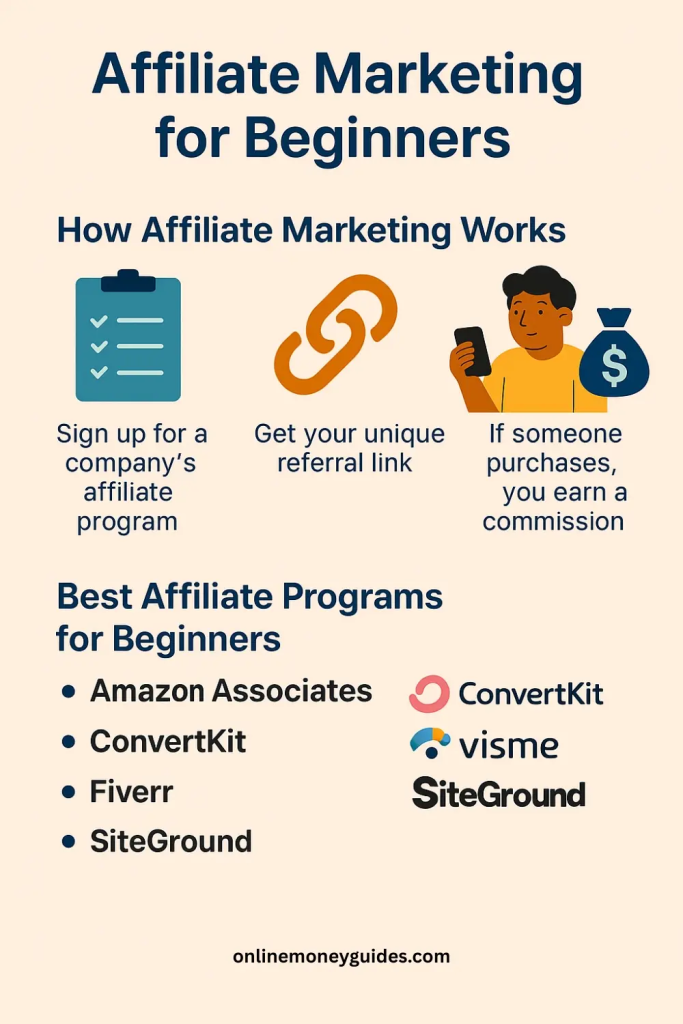
How Affiliate Marketing Works
At its core, affiliate marketing is simple:
- Sign up for a company’s affiliate program.
- Get your unique referral link.
- Share that link in your content, a blog, a YouTube video, TikTok, or even an email.
- When someone clicks and makes a purchase, you earn a commission (often between 5% and 40%, depending on the product).
Affiliate income is considered semi-passive because the same piece of content can keep generating clicks and sales long after you created it.
Best Affiliate Programs for Beginners
You don’t need to join dozens of programs right away. Start with a few that match your niche and audience. Some beginner-friendly options include:
- Amazon Associates → Wide product selection, but commissions are lower (1–4%). Great for getting started.
- ConvertKit→ Popular email marketing tool with generous commissions.
- Visme → Canva alternative for creators who need design tools.
- Fiverr → Earn commissions by referring people to freelance services.
- SiteGround → Reliable hosting, great for anyone starting a blog.
Pro Tip: Always choose products you’d genuinely recommend. Your audience can feel whether you’re being authentic or just pushing links.
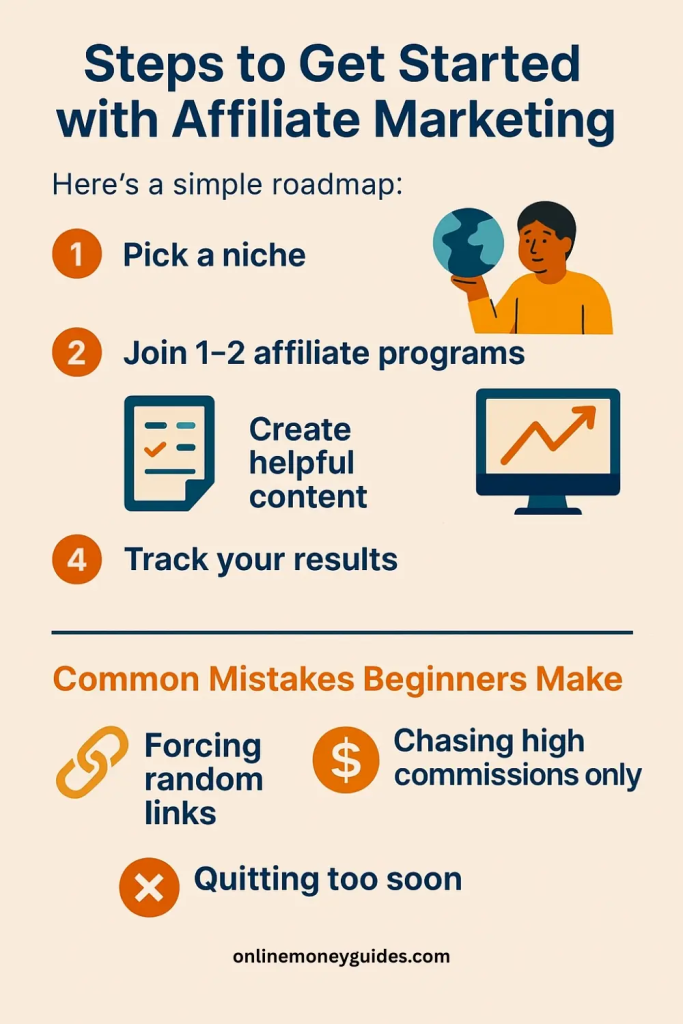
Steps to Get Started with Affiliate Marketing
Here’s a simple roadmap:
- Pick a niche. You’ll make more sales if your content is focused, for example, “beginner blogging,” “budget travel,” or “freelance design.”
- Join 1–2 affiliate programs. Keep it small at first to avoid overwhelm.
- Create helpful content. Instead of posting “buy this,” focus on tutorials, reviews, or case studies that show the product in action.
- Track your results. Most affiliate dashboards let you see clicks and conversions. Over time, you’ll learn what works best.
Tools like Skool (for building communities) or Teachable (for selling courses) also have affiliate programs, so as your business grows, you can expand into those too.
Common Mistakes Beginners Make
Many people give up on affiliate marketing because they expect fast results. Here are pitfalls to avoid:
- Forcing random links. Dropping affiliate links without context feels spammy and kills trust.
- Chasing high commissions only. A 50% payout doesn’t matter if the product is irrelevant to your audience.
- Quitting too soon. It often takes weeks or months for your first commission to come in.
Think of affiliate marketing as building trust, not chasing clicks. When you focus on genuinely helping people, commissions become a natural byproduct.
Affiliate marketing works best when it’s part of a bigger ecosystem like a blog, YouTube channel, or TikTok account. The more helpful content you create, the more opportunities you’ll have to recommend tools and earn passive income naturally.
Affiliate Marketing vs. Selling Your Own Products
| Aspect | Affiliate Marketing | Selling Your Own Products |
| Startup Cost | Usually free to join affiliate programs. | Can be low (digital PDFs) or higher (courses, software, physical products). |
| Control | Commissions typically 5 to 40% per sale. | Full control over product design, pricing, and delivery. |
| Earning Potential | Commissions typically 5–40% per sale. | Keep 100% of the profit after expenses. |
| Difficulty | Beginner-friendly, focus on recommending. | More advanced, requires creating and maintaining a product. |
| Timeline to Income | Faster, especially if you already have an audience. | Slower, but can grow into scalable, sustainable revenue. |
Both paths can be powerful. Many creators start with affiliate marketing to build confidence, then move into their own digital products once they understand what their audience needs most.
Selling Digital Products & Online Courses
One of the most exciting ways to make money online is by creating something once and selling it over and over again. Digital products and online courses fall into this category. They’re scalable, profitable, and give you full control over your business.
Unlike freelancing, where your time is limited, digital products work while you sleep. That could mean waking up to a notification that you’ve sold a $15 eBook or a $200 course without lifting a finger that day.
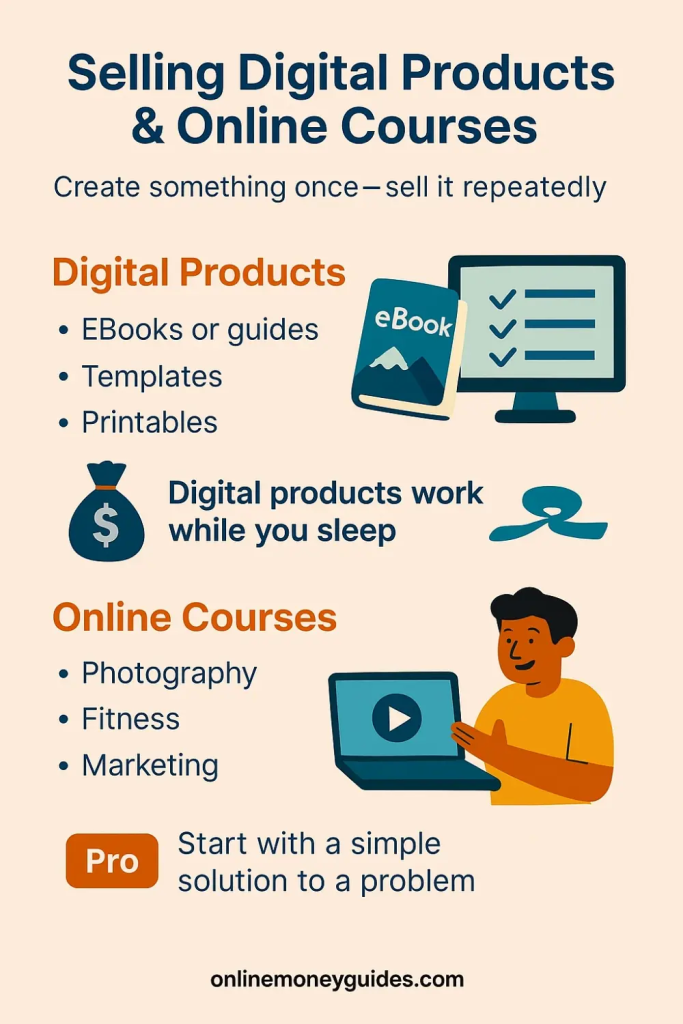
Digital Products
Digital products are one of the easiest and lowest-risk ways to start selling online. They cost little to create, require no shipping, and can be sold endlessly once you’ve made them. For beginners, this makes them the perfect stepping stone into an online business.
Examples of digital products include:
- eBooks or guides (e.g., “Beginner’s Guide to Remote Work”).
- Notion or Excel templates for productivity, budgeting, or content planning.
- Printable planners, journals, or art (delivered as PDFs).
- Stock photos, video clips, or design elements.
You don’t need to be a designer to make digital products. Tools like Visme and Creative Fabrica provide templates that help you design professional-looking assets quickly. Once created, you can sell them through platforms like Gumroad, Etsy, or your own blog.
Earning potential: Beginners often see $50–$200 per month from their first product, but with consistent promotion, some creators scale to $1,000–$5,000/month from just a few digital downloads.
Don’t overcomplicate your first product. Your audience doesn’t need a 100-page masterpiece. They need something simple that solves a specific problem, and they’ll happily pay for it.
Online Courses
If you have knowledge or skills in any area, such as photography, fitness, marketing, cooking, or even organization, you can turn that into an online course. People are willing to pay for guidance that helps them get results faster.
The easiest way to start is with a platform like Teachable, which handles the tech side of hosting, payments, and course delivery. All you need is your content, which could be recorded videos, written lessons, or both.
Course pricing typically ranges:
- $50–$200 for beginner-friendly, shorter courses.
- $300–$1,000+ for more in-depth, niche, or professional-level courses.
One advantage of courses is scalability. It takes the same effort to create a course for 5 people as it does for 500. The more your audience grows, the more your earning potential multiplies.
Pro Tip: Don’t wait until you feel like an “expert.” Beginners often prefer learning from someone who’s just a few steps ahead of them because the advice feels relatable and achievable.
Whether you start with a $10 template or a $300 course, selling digital products allows you to stop trading time for money and start building assets that generate income around the clock.

Coaching, Consulting, and Services
One of the fastest ways to earn meaningful money online is by sharing what you already know. You might not think of yourself as an “expert,” but chances are you’ve picked up skills or experiences others would happily pay to learn.
This is where coaching, consulting, and online services come in. Unlike digital products, which scale on autopilot, these are more hands-on, but they also bring in higher rates right away.
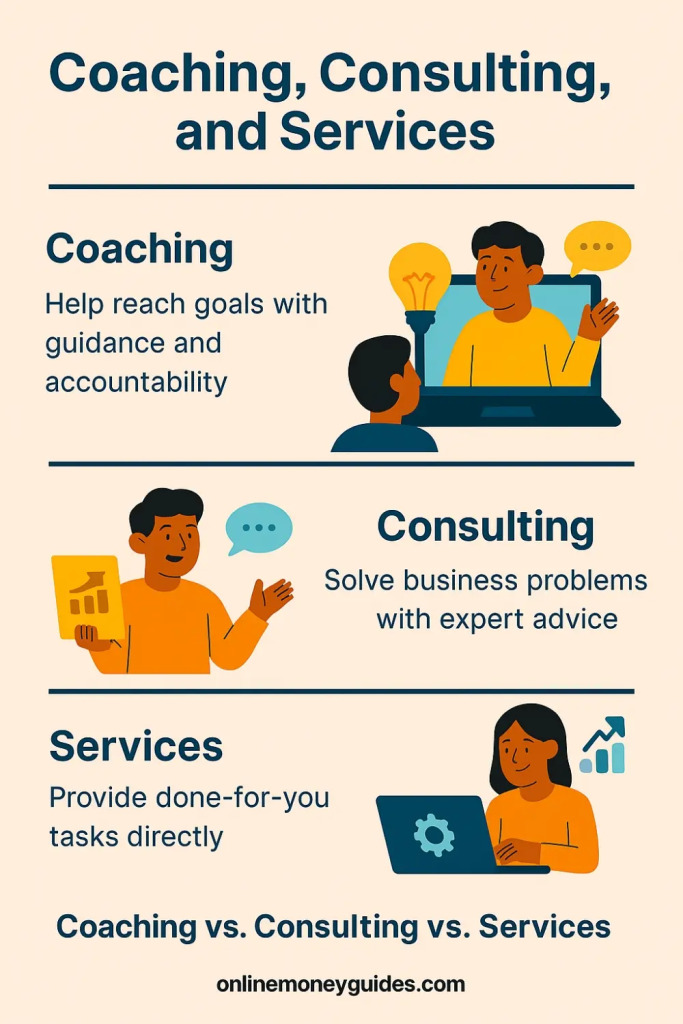
Coaching
Coaching is about helping someone get from point A to point B with clarity, accountability, and guidance. You don’t have to be a life guru to start coaching; you only need to be a few steps ahead of the person you’re helping.
Examples include:
- Career coaching for people looking to land remote jobs.
- Fitness or wellness coaching for beginners starting a routine.
- Social media coaching for small business owners.
You can host sessions over Zoom or Google Meet, charging anywhere from $50 to $150 per hour as a beginner. Over time, as your confidence and testimonials grow, many coaches increase their rates to $200–$500 per session.
Consulting
While coaching focuses on personal growth, consulting often focuses on solving business problems. If you’ve worked in marketing, sales, design, or operations, you already have valuable insights that others will pay for.
For example:
- A freelance web designer might offer consulting sessions on branding and user experience.
- Someone with HR experience could consult small startups on hiring strategies.
- A content creator could consult small businesses on building an Instagram presence.
Consultants often charge project-based fees, ranging from $500 to $2,000 for a package, depending on scope and industry.
Services
If you don’t want to coach or consult, you can still offer done-for-you services online. These are tasks where you take over and deliver results directly, such as:
- Managing social media accounts.
- Editing videos or podcasts.
- Setting up email funnels with tools like ConvertKit.
- Designing graphics with Visme or mockups using Placeit.
Service work often pays $15–$30/hour at the entry level, but specialists can earn $50–$100/hour or set flat rates for packages.
Don’t wait until you feel “ready.” Coaching, consulting, and services let you start with what you already know. Your lived experience has value, and there’s someone out there right now willing to pay for guidance or help with the skills you take for granted.
Coaching vs. Consulting vs. Services
| Aspect | Coaching | Consulting | Services |
| Focus | Guiding individuals toward personal or professional goals. | Advising businesses or clients on strategy and solutions. | Doing the work directly for clients. |
| Format | 1:1 or group sessions, often via Zoom/Google Meet. | Strategy calls, audits, or project-based advice. | Done-for-you tasks like editing, design, or management. |
| Time Commitment | Ongoing sessions (weekly or monthly). | Short-term or project-based. | Dependent on client workload. |
| Earning Potential | $50–$150/hr starting, scaling to $200–$500+. | $500–$2,000+ per package/project. | $15–$30/hr starting, specialists can charge $50–$100+. |
| Best For | Beginners with experience they can share and teach. | Professionals with specific industry knowledge. | Creatives or doers who like hands-on work. |
This makes it easier to see where you might fit. If you love working with people, coaching may be a fit. If you like problem-solving, consulting might be the way. If you prefer action, services are a great entry point.

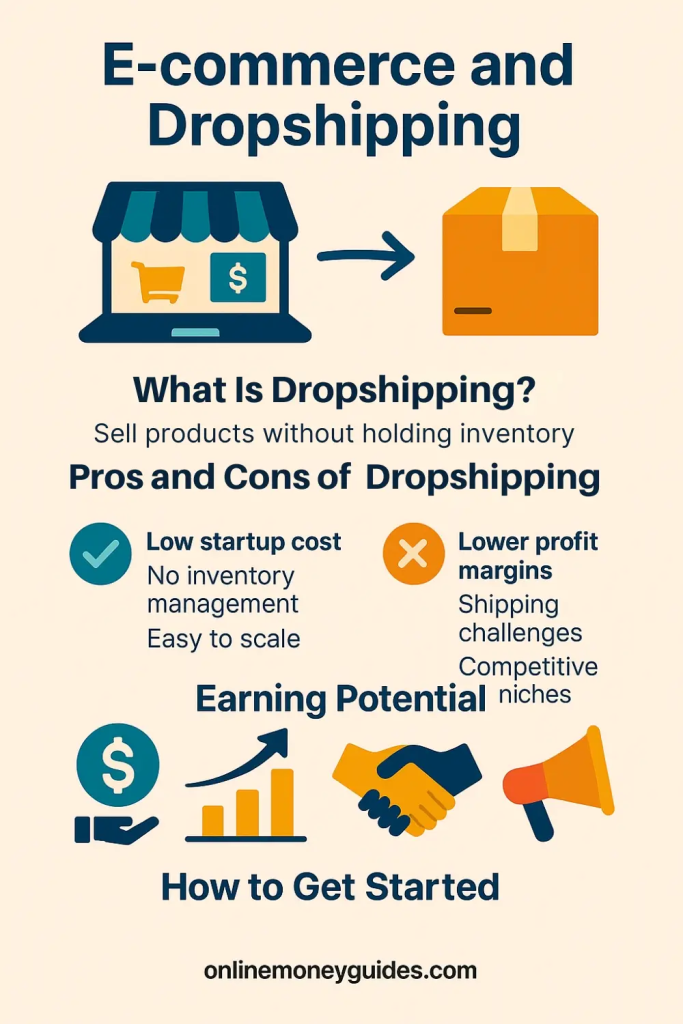
E-commerce and Dropshipping
If you’ve ever dreamed of running your own online store, e-commerce is the modern path to get there. Thanks to platforms like Shopify and WooCommerce, anyone can set up a store in a weekend without knowing a single line of code.
But here’s where beginners often get stuck: they think they need to create, store, and ship products themselves. That’s where dropshipping changes the game.
What Is Dropshipping?
Dropshipping is a model where you sell products online without ever touching inventory. Here’s how it works:
- You set up an online store.
- A customer places an order.
- The supplier ships the product directly to the customer on your behalf.
Your job is marketing and customer service, not packing boxes in your living room.
Pros and Cons of Dropshipping
Dropshipping is attractive because the barrier to entry is low, but it’s not a perfect model.
| Pros | Cons |
| Low startup cost (as little as $29/month with Shopify). | Lower profit margins since suppliers take a cut. |
| No need to manage inventory or shipping. | Less control over shipping times and product quality. |
| Wide range of products to test and sell. | Competitive, popular niches can get crowded fast. |
| Easy to scale once you find winning products. | Customer complaints may land on you, even if it’s the supplier’s fault. |
Earning Potential
Dropshipping income depends heavily on marketing skills and product choice. Beginners may earn a few hundred dollars a month once they start driving sales, while experienced sellers can scale stores to $5,000–$20,000/month in revenue. Profit margins are often 10–30%.
For example, if you sell a product for $40 but your supplier charges $25, you keep $15 in profit. Sell 100 units in a month, and that’s $1,500 in income.
How to Get Started
- Pick a niche. Focus on a specific type of product, like eco-friendly home goods or fitness gear.
- Set up your store. Platforms like Shopify or WooCommerce make this beginner-friendly.
- Find suppliers. Tools like Oberlo or Spocket connect you with suppliers who handle fulfillment.
- Market your store. Use TikTok, Instagram, or YouTube to showcase products. Paid ads can also speed up results.
Dropshipping isn’t a get-rich-quick scheme. It’s a low-barrier way to learn e-commerce fundamentals. Even if your first store doesn’t succeed, the skills you gain in marketing, branding, and customer service are valuable assets for future online businesses.

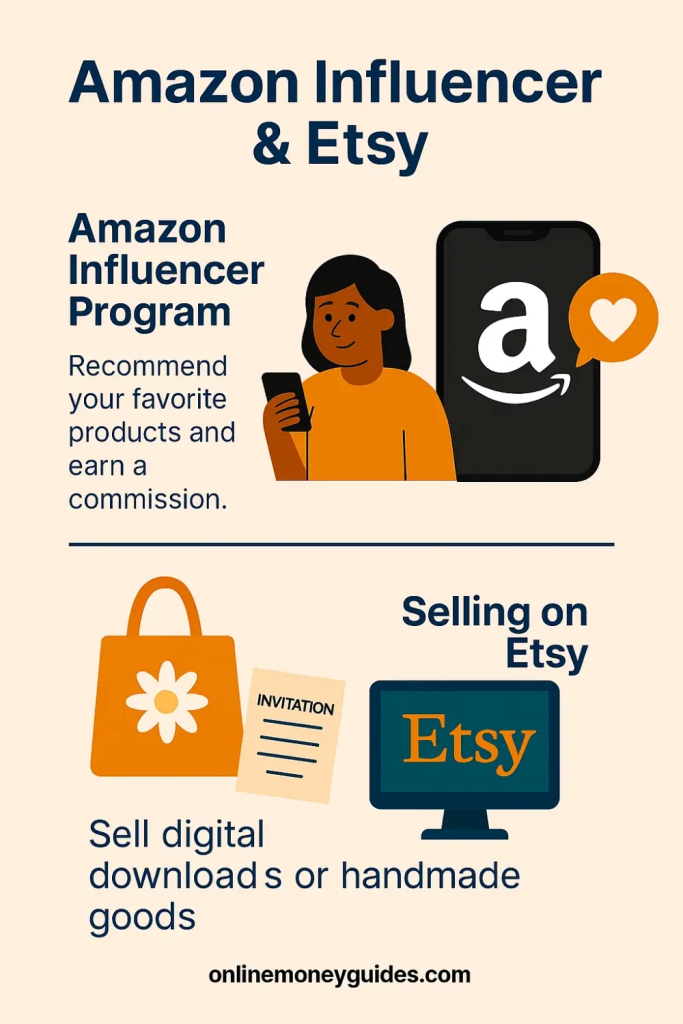
Amazon Influencer & Etsy
Not every online business requires you to reinvent the wheel. Platforms like Amazon and Etsy give you ready-made marketplaces with built-in traffic. Your job is to stand out, create value, and guide shoppers to your corner of the internet.
Amazon Influencer Program
Amazon is one of the world’s most trusted marketplaces, and its Influencer Program allows you to earn money by recommending products. Unlike the Amazon Associates affiliate program, the Influencer Program gives you your own Amazon storefront where you can curate product lists and earn commissions from people who shop through your page.
How it works:
- Apply with your social media account (Instagram, TikTok, YouTube).
- Once approved, you get a unique storefront link.
- You can create Idea Lists, upload short product review videos, or share recommendations.
- When someone buys, you earn a commission (usually between 1–10%, depending on category).
Income potential: Beginners might start with $50–$200/month, but creators with consistent traffic often scale to $1,000–$5,000/month as their storefront gains visibility.
Pro Tip: Focus on products you actually use. A genuine review video uploaded to Amazon itself can continue generating commissions for months or years.
Selling on Etsy
Etsy started as a marketplace for handmade goods but has grown into one of the best platforms for selling both physical and digital products. That means you don’t have to be an artist or crafter to succeed here; you can also sell templates, printables, or planners that people download instantly.
Examples of products you can sell on Etsy:
- Handmade jewelry or candles.
- Digital downloads like budget planners, wedding invites, or art prints.
- Print-on-demand items (shirts, mugs, tote bags) integrated with Printful or Printify.
Earning potential: Digital products on Etsy often sell for $5–$25 each. Sell just 10 a day, and that’s $50–$250 in daily income or $1,500–$7,500/month. While competition is strong, niches like weddings, productivity, and home décor still offer huge opportunities.
Pro Tip: The key to Etsy success is search optimization. Use keywords in your product titles and descriptions that shoppers are already typing into the Etsy search bar.
Amazon Influencer is great for creators who love recommending products, while Etsy is ideal for makers, designers, or anyone who wants to sell unique digital or physical items. Both are excellent stepping stones toward building a full-time online income.

Remote Jobs & Freelance Work
If you’re looking for a way to make money online that feels more like a “real job,” remote work and freelancing are excellent options. These paths don’t just put extra cash in your pocket; they can also lead to steady income streams and even full-time careers.
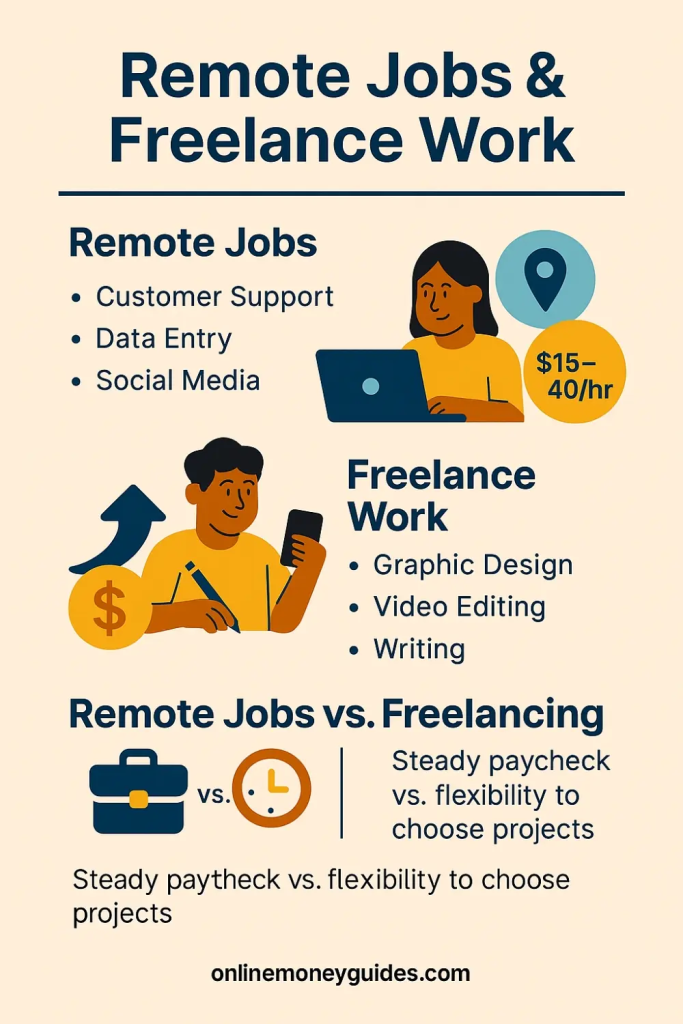
Remote Jobs
Remote jobs are essentially traditional employment roles, but you perform them online instead of in an office. They often come with steady pay, benefits, and predictable schedules.
Examples include:
- Customer support representative.
- Data entry clerk.
- Social media manager.
- Content writer.
- Project coordinator.
Websites like FlexJobs specialize in curating legit remote job postings, so you don’t waste time on scams. Other sites like Remote.co and We Work Remotely are also reliable.
Pay range: Entry-level remote jobs typically pay between $15 and $25 per hour, while specialized roles (like marketing or tech support) can reach $40/hour or more.
Freelance Work
Freelancing gives you more flexibility than remote jobs. Instead of being an employee, you’re a contractor who chooses your projects and clients. Freelancing platforms like Fiverr and Upwork make it easy to get started without needing to cold-pitch clients.
Examples of freelance work include:
- Graphic design.
- Video editing.
- Podcast editing.
- Blog writing.
- Virtual assistance.
Beginners may earn $10–$20 per hour, but experienced freelancers often charge $50–$100/hour, especially in specialized niches.
Remote Jobs vs. Freelancing
The choice between a remote job and freelancing comes down to your goals and personality:
- Remote jobs offer stability and a paycheck you can count on.
- Freelancing offers flexibility and the freedom to set your rates and choose your clients.
Many digital entrepreneurs start with freelancing or remote work as a way to gain experience and income, then expand into more scalable income streams like digital products or affiliate marketing.
Don’t underestimate the value of starting here. Remote jobs and freelancing may not sound as glamorous as “passive income,” but they provide the foundation for the skills, confidence, and cash flow that make bigger opportunities possible.
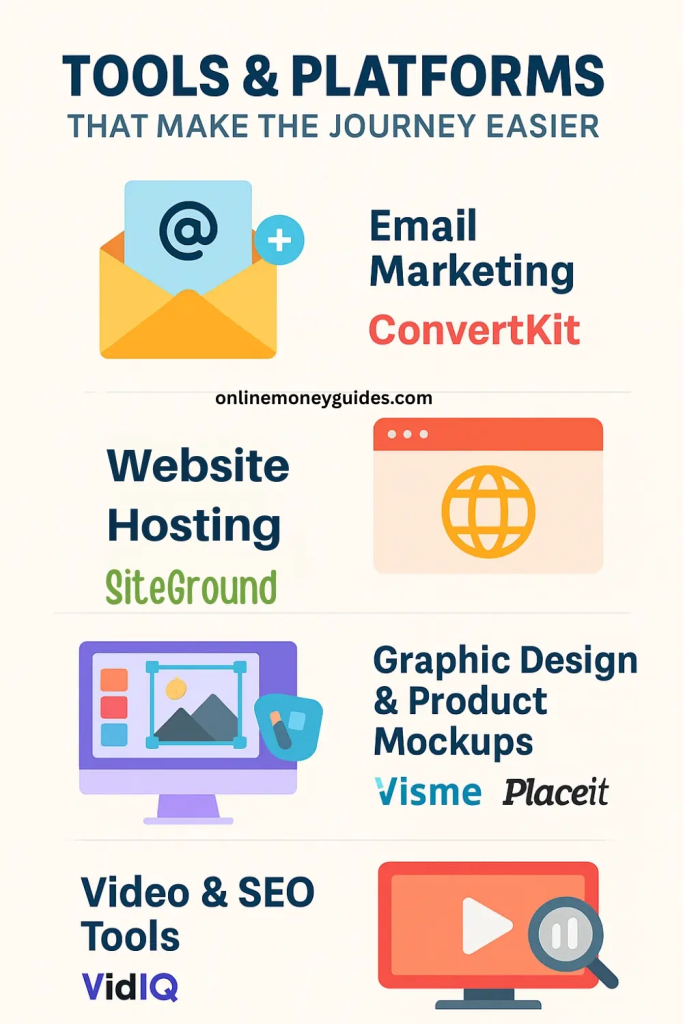
Tools & Platforms That Make the Journey Easier
One of the biggest mistakes beginners make when trying to earn money online is thinking they need every tool under the sun. In reality, you only need a handful of platforms to get started, and you can add more as your business grows.
Think of these tools as your digital toolbox. Each one helps you save time, stay organized, and grow faster.
Email Marketing: ConvertKit
Building an email list is one of the smartest moves you can make. Unlike social media, where algorithms change constantly, your email list is an asset you truly own.
ConvertKit is beginner-friendly, designed for creators, and allows you to:
- Collect email subscribers.
- Send newsletters.
- Set up automated funnels that work while you sleep.
If you plan to sell digital products, courses, or affiliate offers, your email list will be your most valuable long-term asset.
Website Hosting: SiteGround
If blogging or creating a website is part of your online income journey, you’ll need reliable hosting. SiteGround is affordable, beginner-friendly, and well-known for its excellent support.
A good host ensures your site loads quickly (which helps with Google rankings) and stays secure. Expect to pay around $3–$6/month to get started.
You’ll need graphics at some point, whether it’s a social media post, a lead magnet, or a product mockup. Canva is the most well-known, but since it no longer has an affiliate program, Visme is an excellent alternative.
Visme offers presentation templates, infographics, and branded content that look professional without needing design skills.
For product mockups (like t-shirts, books, or digital covers), Placeit makes it simple to create polished visuals in minutes.
Video & SEO Tools: VidIQ
If YouTube is part of your strategy, VidIQ is a must-have. It helps you:
- Research trending keywords.
- Analyze competitor channels.
- Optimize titles, tags, and descriptions for more views.
Think of it as a cheat sheet for getting discovered faster on YouTube.
Start with what you actually need: an email platform, a website host, a design tool, and maybe a video/SEO tool. Add more only when they solve a real problem. The goal isn’t to have fancy software; it’s to build momentum and start earning.
How to Avoid Scams and False Promises
When you start exploring ways to make money online, it’s easy to feel like you’re walking through a minefield. Every search result and YouTube ad seems to scream, “Make $10,000 in your first week!” or “One secret system that never fails!” It’s no wonder many beginners feel skeptical.
The truth is, there are legitimate ways to earn online, but there are also plenty of people selling false promises. Knowing how to spot red flags will save you time, money, and frustration.
Common Red Flags
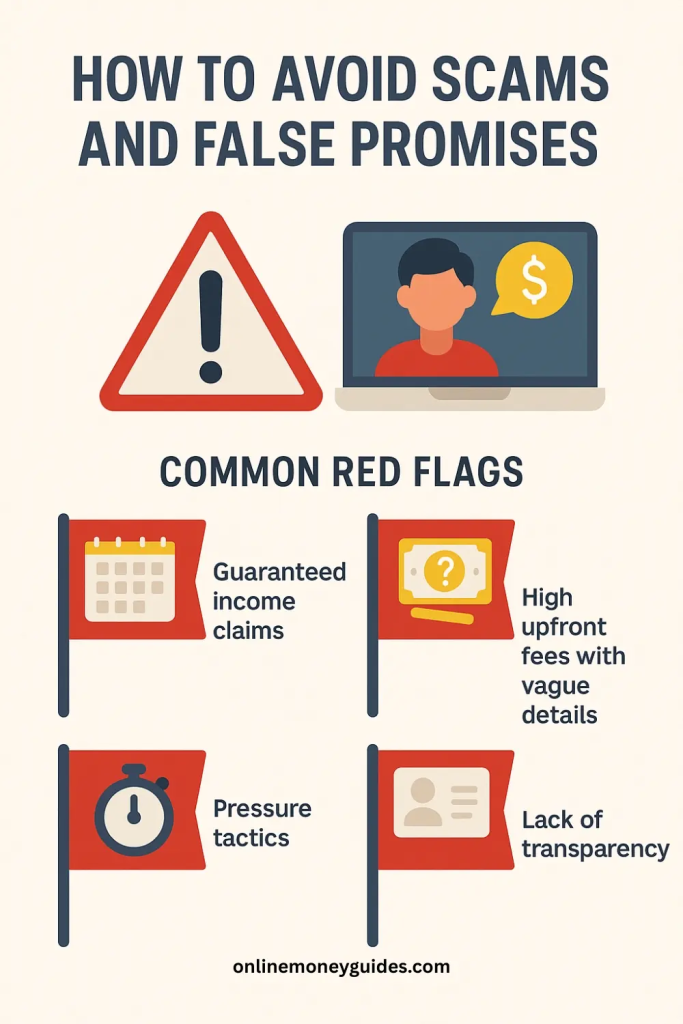
You don’t need to memorize every scam tactic, but there are a few warning signs that usually mean trouble:
- Guaranteed income claims. No legitimate opportunity can promise a specific income in a set timeframe.
- High upfront fees with vague details. Paying thousands for a program without clear explanations of what you’re getting is a huge risk.
- Pressure tactics. If someone tells you to “act now or miss out forever,” pause. Real opportunities don’t expire in 24 hours.
- Lack of transparency. If you can’t find real reviews, clear company info, or examples of what the product delivers, steer clear.
How to Protect Yourself
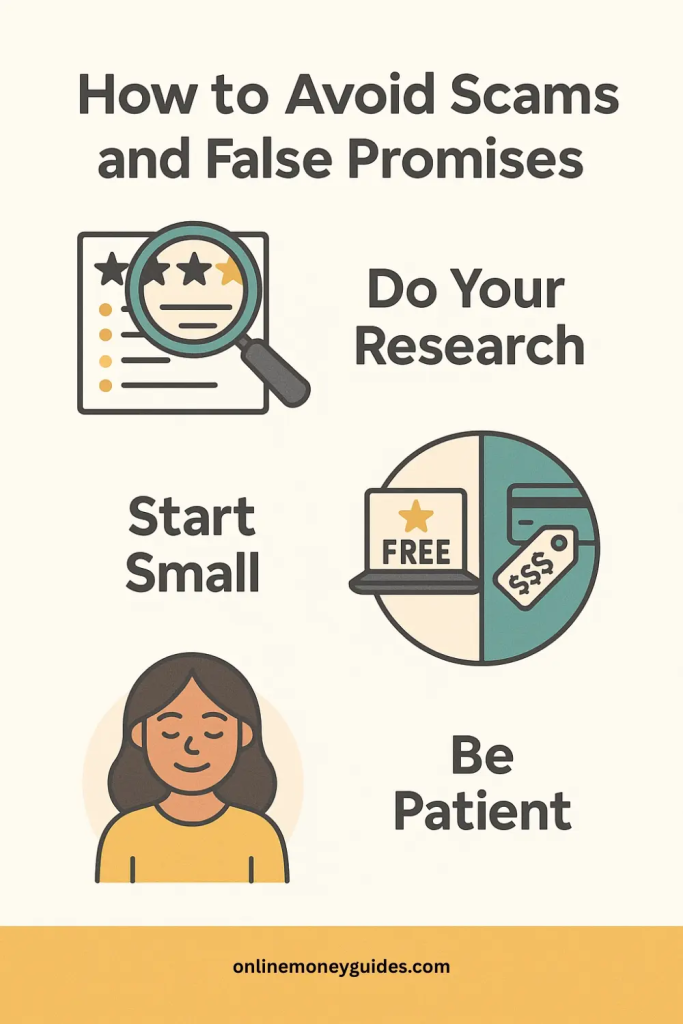
The best defense is doing a little homework before committing. Search for reviews on independent sites, check Trustpilot ratings, and look for YouTube reviews from real users. If you can’t find unbiased feedback, that’s often a sign to walk away.
Also, start with opportunities that don’t require large upfront investments. Freelancing, affiliate marketing, or selling digital products costs little or nothing to begin. You can always reinvest profits later into bigger tools or courses once you’ve validated the model.
Scams thrive on desperation. When you approach making money online with patience and curiosity instead of chasing shortcuts, you’ll avoid 90% of the traps out there.
Why Progress Beats Perfection When Earning Online
One of the biggest reasons beginners never make money online isn’t a lack of skill or opportunity; it’s waiting until everything feels perfect. Maybe you’ve told yourself:
- “I’ll start once I learn more.”
- “I’ll launch when my website looks professional.”
- “I’ll post videos when I get a better camera.”
Here’s the hard truth: waiting for perfect is just another way of staying stuck. The people earning online today didn’t wait until they had flawless websites, perfect logos, or expensive gear. They started with what they had, learned as they went, and improved over time.
Progress matters more than perfection. Your first blog post won’t be your best, but it will teach you how to write the next one. Your first Fiverr gig might pay only $20, but it proves someone is willing to pay you. Your first YouTube video might look amateur, but it could spark the confidence to publish ten more.
The internet rewards consistency more than polish. Search engines and social platforms don’t care if your logo looks fancy; they care if you’re showing up and creating value.
Your first step doesn’t need to be perfect. It just needs to happen. The sooner you start, the sooner you can adjust, improve, and grow.
Turning Opportunities Into Income: Your Next Step
By now, you’ve seen the wide range of ways people earn money online. From freelancing and remote jobs to affiliate marketing, content creation, e-commerce, and digital products, each path has its own timeline, income potential, and learning curve.
The important thing isn’t picking the “perfect” path. The important thing is picking a path and getting started. Action is what separates the dreamers from the doers.
Think of this guide as a menu. You don’t need to order everything at once. You just need to choose one option that feels right for where you are right now. Maybe it’s freelancing to get quick wins, blogging to build long-term traffic, or Etsy to dip your toes into digital products.
Once you’ve made your first dollar online, everything shifts. You’ll see proof that this works. You’ll have the confidence to keep going. And you’ll start building the skills and momentum that make bigger opportunities possible.
Next Steps: Choose one method that excites you, commit to testing it for the next 30 days, and see what happens. Progress, even small progress, compounds faster than you think.
The best time to start was yesterday. The next best time is today.