You Don’t Need to Be an Expert to Start Making Money Online
Let’s be real. You’ve probably heard the term “affiliate marketing” tossed around on YouTube, TikTok, or in some podcast promising passive income from your laptop. But if you’re like most beginners, you’re left thinking:
“Is this legit?”
“Do I need a huge audience?”
“Is this just another online scam?”
You’re not alone. A lot of us started here, skeptical, overwhelmed, and wondering if affiliate marketing is just for tech bros and lifestyle influencers.
The truth?
Affiliate marketing is one of the most beginner-friendly, low-risk, and scalable ways to start making money online, even if you’re starting from scratch.
Whether you’re a side hustler, content creator, or aspiring digital entrepreneur, this guide will walk you through everything you need to know to go from confused to confident.
We’re not here for get-rich-quick hype. We’re here for real strategies, honest expectations, and actionable steps you can take even if you don’t have a website (yet), a huge following, or a single clue where to start.
This is your full beginner-to-intermediate roadmap to affiliate marketing in 2026.
If you’re just starting out, your first milestone will be hitting your first $100 in commissions. We’ve created a Beginner’s Guide to Affiliate Marketing that shows step-by-step how to get there.

What Is Affiliate Marketing, Really?
Affiliate marketing is a way to earn money by recommending products or services online and getting a commission when someone buys through your special link.
Think of it like this: You’re the middle person connecting a product to a buyer. If the buyer clicks your link and makes a purchase (or completes another action, like signing up), you earn a slice of the revenue. Simple.
How Affiliate Marketing Works:
- You sign up for an affiliate program (like Amazon, Travelpayouts, or ConvertKit).
- You get a unique affiliate link to share.
- You create content (such as a blog, video, or social post) that naturally includes your link.
- When someone clicks your link and completes a qualifying action (usually a purchase), you earn a commission.
This could be:
- A flat rate per signup (CPA marketing)
- A percentage of the sale (usually 5%–50%+)
- Recurring monthly income for subscriptions (hello, SaaS tools)
Real-World Example:
Let’s say you’re a content creator who uses different travel gear from Amazon to create your YouTube videos. You join their affiliate program and recommend that gear from Amazon in a YouTube video.
Someone watches, clicks your link, and buys → You get paid.
Even if you’re a micro-creator with 1,000 followers, your recommendations still have power.
Why This Works (Even for Beginners):
- No product creation required
- No customer service involved
- No inventory or shipping to deal with
- You’re simply sharing what you already use and love
- You can start for free, with zero tech skills
And here’s the kicker: affiliate marketing is one of the few online business models where your income isn’t tied to your time. You can create one video, blog post, or email that earns commissions long after you hit publish.
Affiliate marketing = a performance-based income stream with unlimited upside.
Once you understand the basics, the next step is finding beginner-friendly programs that don’t require a website. We’ve curated a list of the best affiliate programs for beginners to help you start earning faster.
How Much Money Can You Make with Affiliate Marketing?
Let’s answer the question you really care about:
How much money can you actually make with affiliate marketing, and how long will it take?
The short answer: It depends on your niche, traffic, platform, and consistency. But here’s what we know from thousands of real affiliate marketers:
Realistic Income Examples (For Newbies and Intermediates)
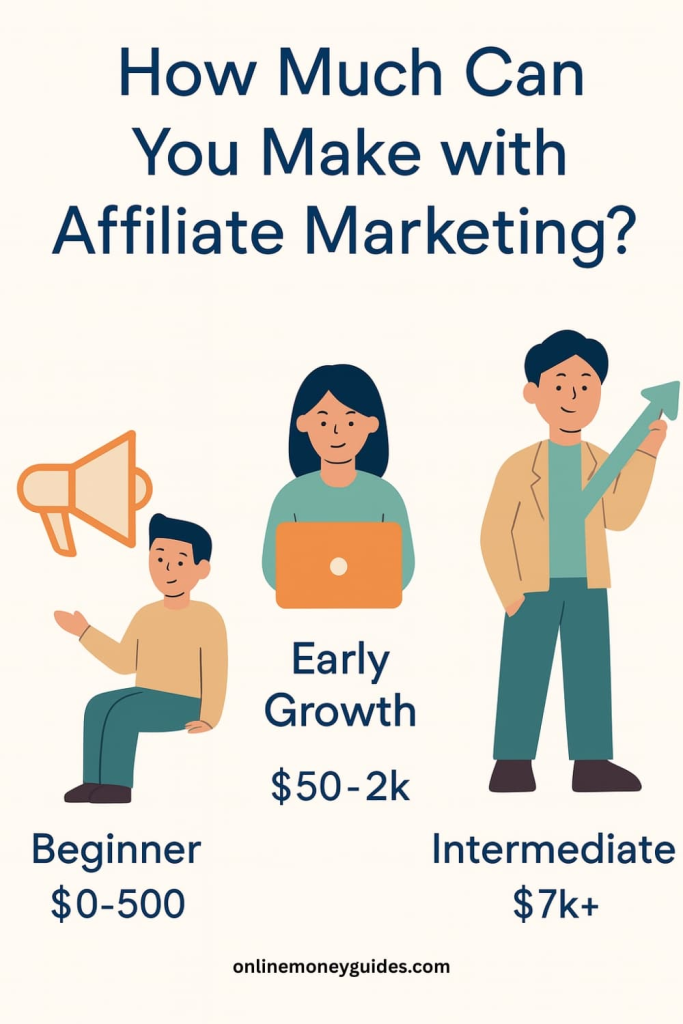
💡Spoiler: You don’t need millions of followers or a big budget to earn real income. Here’s a breakdown by stage:
| Stage | Audience Size | Platform | Monthly Income Range | Time to Reach |
| Beginner | 0–1,000 followers | TikTok, Instagram, Pinterest | $0–$300 | 0–3 months |
| Early Growth | 1,000–10,000 followers | YouTube, Blog, Email List | $300–$2,000 | 3–6 months |
| Intermediate | 10,000–100,000 audience | Niche blog, SEO, YouTube | $2,000–$10,000+ | 6–12 months |
| Advanced | 100k+ audience or SEO authority | Blog + Email + YouTube | $10k–$50k+/month | 12+ months |
These are real, attainable ranges — no Lambos, no beach mansions. Just consistent income from helpful content and strategic affiliate links.
Example 1:
A beginner blogger reviewing budget cameras adds affiliate links to Amazon. Each sale brings in $4–$15 in Amazon affiliate commission. With 20–30 sales a month? That’s an easy $200–$500 in side income.
Example 2:
A YouTuber recommends ConvertKit to beginner email marketers. ConvertKit pays recurring commissions up to 30% per user. With just 100 signups, that could turn into $1,000–$2,000/month in passive income.
How Long Does It Take to Start Making Money
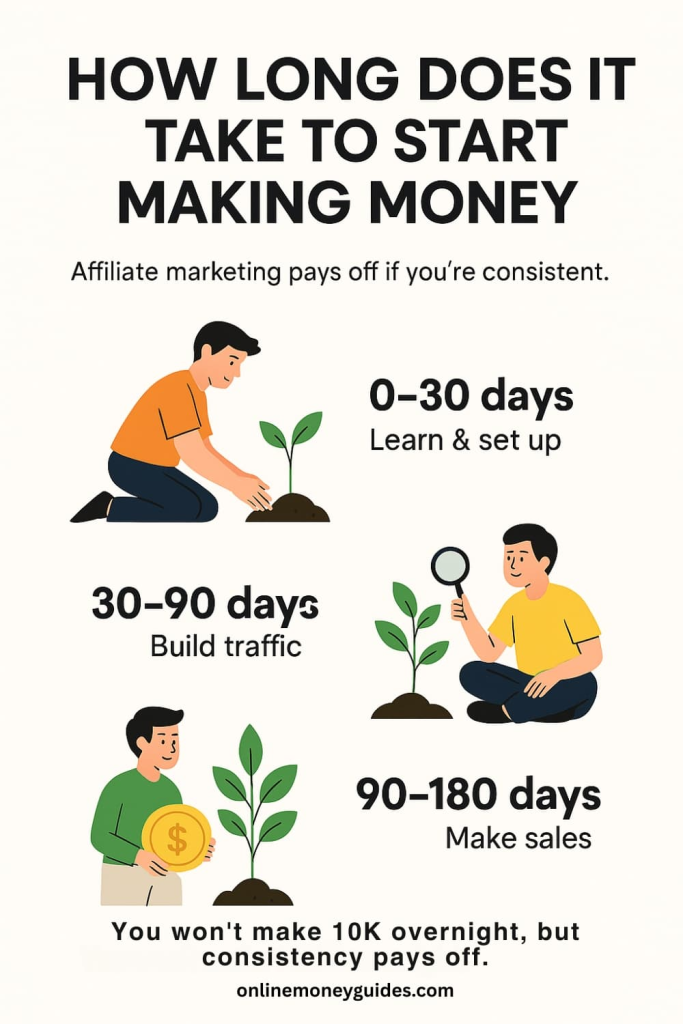
Here’s the honest answer: It takes longer than you want, but less time than you think.
Affiliate marketing is a long game, but it can pay off fast if you’re consistent.
- 0–30 days: You’re in learning mode. This is where you choose a niche, set up your content channels, and apply for affiliate programs.
- 30–90 days: You’re testing content, building traffic, and (maybe!) getting your first few sales.
- 90–180 days: You’re dialing in what works. Your content gets found more, you understand your audience, and affiliate sales become more predictable.
You won’t make $10K overnight. But could you make your first $100 in your first 60 days? Absolutely. And that first $100 changes everything.
Don’t treat affiliate marketing like a lottery ticket. Treat it like a seed. Nurture it weekly, and it can grow into something that earns for years.
How to Get Started with Affiliate Marketing (Step-by-Step)
Getting started doesn’t require fancy tools or a huge audience. What it does require is clarity, consistency, and the right foundation.
Here’s your 3-step beginner blueprint to launch your affiliate marketing journey without overwhelm or information overload.
Step 1 – Pick a Niche You Can Actually Stick With
Before you can start promoting products, you need to figure out who you’re talking to and what problems you’re solving.
Your niche is simply the topic area or audience segment you’ll focus on.
Ask yourself:
- What topics do I love learning about or talking about?
- What do people ask me for advice on?
- Is there a problem I can help solve with content + products?
High-Converting Affiliate Niches in 2026:
| Niche | Why It Works |
| Personal Finance | Evergreen + high ticket offers (credit cards, tools) |
| Health & Wellness | Supplements, courses, fitness gear |
| Digital Marketing & Tools | Recurring income from SaaS platforms |
| Home & Kitchen | Amazon affiliate friendly, search-heavy |
| Tech & Gadgets | High purchase intent, especially on YouTube |
| Travel & Remote Work | Digital nomad gear, courses, travel platforms |
| Self-Improvement | Courses, books, coaching programs |
Pro Tip: Don’t stress about picking “the perfect niche.” Just choose one you enjoy and commit to learning as you go. Clarity comes from action.
Step 2 – Join Beginner-Friendly Affiliate Programs
Once you’ve chosen your niche, it’s time to start joining affiliate marketing programs that offer products or services your audience would actually want.
Here are beginner-friendly affiliate programs with fast approval and trusted brands:
Here are beginner-friendly affiliate programs with fast approval and trusted brands:
| Program | Commission | Best For |
| Offerlab | 100% of referrals (during launch) | Course creators, ecommerce, freelancers, marketers |
| VidIQ | 15-20% per sale | Everyday products, trending gear |
| Travelpayouts | Up to 50% of referral earnings | Travel creators, bloggers, freelancers |
| ConvertKit | 30% recurring | Email marketing for creators |
| Fiverr Affiliates | 25% to 100% of the customer’s first order | Freelancers, service seekers |
| Getyourguide | 8% paid monthly | Travel creators, bloggers, small businesses |
| Amazon Associates | 1%–10% per sale | Everyday products, trending gear |
You can also go directly to a brand’s site and scroll to the footer. If they offer an affiliate program, you’ll usually find a “Become an Affiliate” or “Affiliate Program” link.
Pro Tip: Always read the terms. Some programs like Amazon Associates have cookie windows as short as 24 hours, while others last 30–90 days.
Step 3 – Choose Your Content Platform (No Website? No Problem)
You don’t need a blog to start affiliate marketing (though it helps long-term). You can promote your links through any of the following:
Top Platforms for Beginners in 2026:
- TikTok: Viral short-form content with product demos and tips
- YouTube: Tutorials, reviews, comparisons, and niche content
- Pinterest: Idea pins and SEO-driven traffic to blogs or product links
- Instagram: Reels + story links for product shares
- Blog: Long-form content like product reviews, how-tos, comparisons
- Email List: Promote to your subscribers (high-converting channel)
Don’t try to be everywhere at once. Start with one platform where you’re comfortable creating, and grow from there.
You don’t need to be an “influencer.” You just need to solve problems and earn trust through content.
How to Create Content That Actually Sells
Here’s the truth no one talks about:
You don’t make money in affiliate marketing just by throwing up links. You earn by building trust, solving real problems, and creating content that helps people make confident decisions.
And guess what? You don’t need to be a sales expert or content guru to do this. You just need to understand how to tell stories, share your perspective, and weave in affiliate products that make sense for your audience.
Let’s break it down.
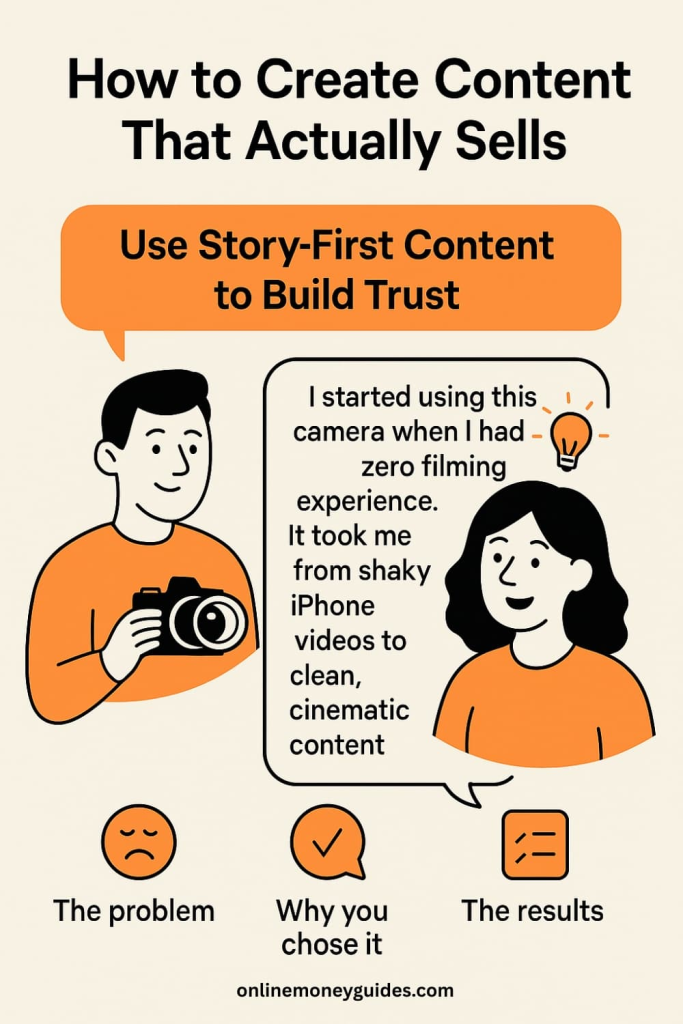
Use Story-First Content to Build Trust
People don’t want another product review. They want to know why you use something, how it helped you, and whether it’s worth it. That’s where storytelling becomes your superpower.
Imagine someone is searching for the best budget camera for beginners. Which do you think is more persuasive?
A) “This camera has 4K resolution, 1080p streaming, and a 1-inch sensor.”
B) “I started using this camera when I had zero filming experience. It took me from shaky iPhone videos to clean, cinematic content — without spending $1,000+.”
See the difference?
Your personal experience — even if you’re new — is valuable. It builds relatability. And relatability builds trust.
Talk about:
- The problems you were facing before using the product.
- What made you choose it over others?
- How it helped you achieve a goal.
- Who it’s not for (honesty goes a long way).
Your audience isn’t looking for perfection — they’re looking for real. When you lead with story, the affiliate sale becomes a natural side-effect.
Add Affiliate Links Naturally (Without Feeling “Salesy”)
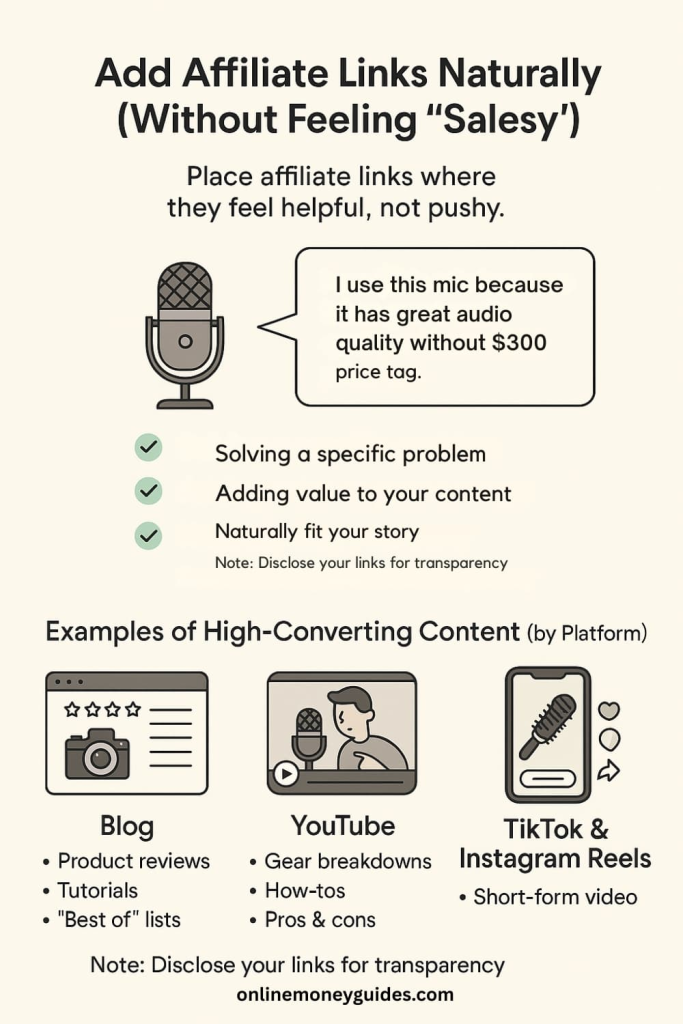
You don’t need to slap your link everywhere to make a commission. In fact, doing so can backfire. The secret is to make your affiliate links feel like helpful breadcrumbs — not a pushy pitch.
For example, if you’re writing a blog post about how to start a podcast, you might mention:
“I use [this mic] because it gives great audio quality without the $300 price tag. It’s plug-and-play, even for total beginners.”
That’s it. No pressure. No hard sell. Just a genuine recommendation based on your own use.
Use affiliate links:
- When you’re solving a specific problem.
- When the product adds value to your content.
- When it makes sense in the flow of your story.
You can also use buttons, text links, or visual callouts, depending on the platform. But always prioritize the reader’s experience over your commission. That’s how long-term trust is built.
And don’t forget to disclose your links. A simple note like “This post contains affiliate links, which means I may earn a commission if you purchase at no extra cost to you” keeps things transparent and FTC-compliant.
Examples of High-Converting Content (by Platform)
Different content types work better depending on where you’re sharing. Let’s look at examples that naturally lead to affiliate conversions even for small audiences.
Blog
Writing a blog post? Focus on topics where people are already in buying mode. These include:
- Product reviews: Share your personal experience with a product.
- Comparison posts: Help readers decide between two similar products.
- Tutorials or how-tos: Recommend tools inside your instructional content.
- “Best of” lists: Curate the top tools for a specific audience (e.g., “Best cameras for travel bloggers in 2026”).
These formats naturally attract high-intent traffic from Google and Pinterest. People come in already looking to buy. You just need to guide them.
YouTube
YouTube is a goldmine for affiliate marketing because it ranks in both Google and YouTube search. Plus, it builds deep trust fast.
Some of the best video styles for affiliate sales:
- Gear breakdowns
- Unboxings and walkthroughs
- Tutorials using a tool
- Honest pros & cons reviews
The key is to be helpful, honest, and clear about what the product actually does — and who it’s best for. Link your affiliate products in the description with a simple CTA like:
“Check out the mic I use here → [affiliate link].”
TikTok & Instagram Reels
Short-form video works best for impulse purchases or visually interesting tools. Think: beauty products, travel gear, gadgets, or SaaS features.
Hook your viewers in the first 3 seconds. Show the product in action. Then use a pinned comment or link-in-bio to direct to your affiliate offer.
You don’t need a huge following. You just need the right message in front of the right audience.
Great affiliate content doesn’t push people. It pulls them in through real stories, useful insights, and honest recommendations.

Affiliate Marketing Strategies That Actually Work in 2026
You don’t need to do everything. You just need to do the right things consistently.
One of the biggest mistakes beginners make is jumping into affiliate marketing without a clear strategy. They post a few links, get discouraged when nothing happens, and give up before the magic kicks in.
Here’s the truth: Affiliate marketing isn’t about luck — it’s about leverage.
And that means using repeatable strategies that match your strengths, niche, and audience.
Most affiliates begin by aiming for their first $100. It’s the toughest but most important step. Our Affiliate Marketing for Beginners guide walks you through the process.
Let’s walk through the top methods that work in 2026, even if you’re just getting started.
Choose Your Traffic Strategy (SEO, YouTube, Social)
At the heart of affiliate marketing is one simple goal: get the right eyeballs on the right content.
That means you need a traffic strategy, which is a way to bring people to your content where they’ll discover your affiliate links.
Here are three of the most effective strategies in 2026:
1. SEO Blogging (Search Engine Optimization)
This strategy is all about creating content people are already searching for and getting your articles to show up on Google.
It’s ideal for product comparisons, reviews, tutorials, and “best of” lists. Why? Because people using Google for these searches often already want to buy, they just need help deciding.
With smart keyword research, optimized content, and patience, SEO can become a passive traffic machine that brings in affiliate income long after you hit publish.
Bonus: Use affiliate marketing SEO techniques like internal linking, schema markup, and product review structure to increase click-through rates and rankings.
2. YouTube Videos (Search + Trust)
YouTube is like SEO with a personality. People search for answers, but they also get to see and hear you, which builds trust faster.
Whether you’re demoing a product, walking through a tutorial, or comparing two tools, video allows you to show the real use-case and drive people directly to your affiliate link in the description.
YouTube works well for everything from tech gear to digital tools to online courses.
3. Social Media (Fast Feedback Loop)
If you want quicker reach and more viral potential, platforms like TikTok, Instagram, and Pinterest can help you test content ideas and product recommendations fast.
Short-form videos, story content, and visual pins are all ways to highlight affiliate products naturally and direct users to your link-in-bio, landing page, or blog.
Choose the traffic source that fits your personality and resources. SEO is long-term. YouTube builds trust. Social can go viral. No wrong answers, just different timelines.
Short-form video has become one of the easiest ways to promote affiliate products without sounding salesy. TikTok, in particular, allows creators to earn commissions through content that feels organic. We break this down in our guide on TikTok affiliate marketing without selling hard.
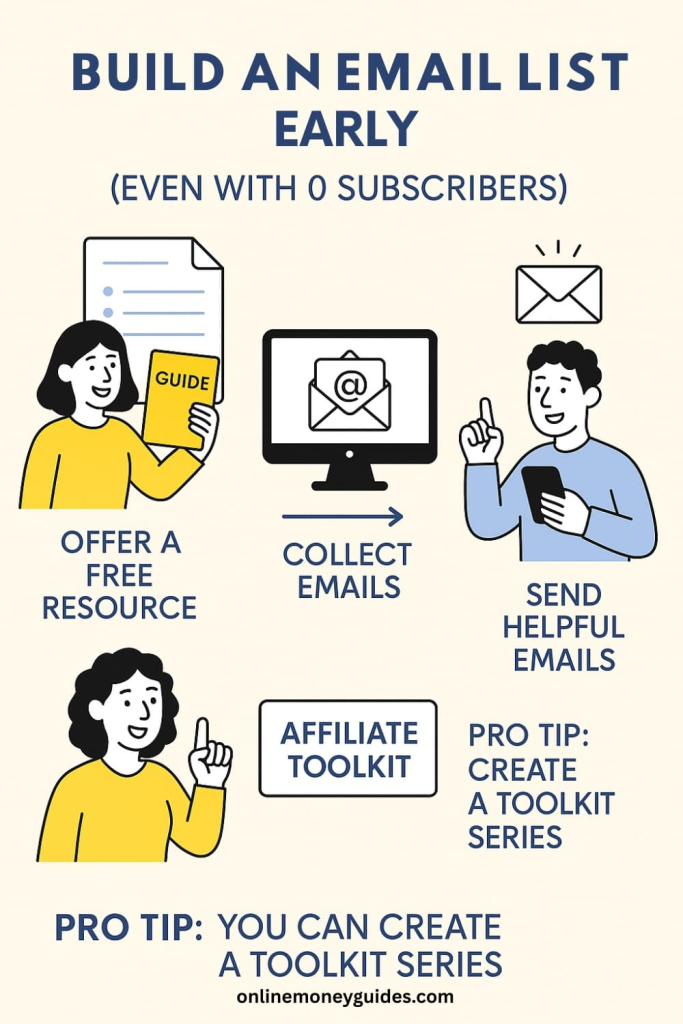
Build an Email List Early (Even with 0 Subscribers)
If there’s one affiliate strategy that almost every successful marketer swears by, it’s email.
Why? Because email is personal. It doesn’t rely on algorithms, and it reaches people who want to hear from you.
Even with a tiny list, your email subscribers are far more likely to click your links and buy your recommendations. It’s like having a direct line to your warmest audience.
Here’s how it works:
- Offer a free lead magnet or helpful resource (like a guide, checklist, or mini-course).
- Use an email platform like ConvertKit (a favorite for beginners) to collect emails.
- Send consistent, helpful emails that build trust and naturally include your affiliate links when relevant.
You don’t need to sell in every email. Just show up, provide value, and let your links do the work over time.
Pro Tip: You can even create a simple “Affiliate Toolkit” email series sharing the tools and products you personally use, with affiliate links baked in.
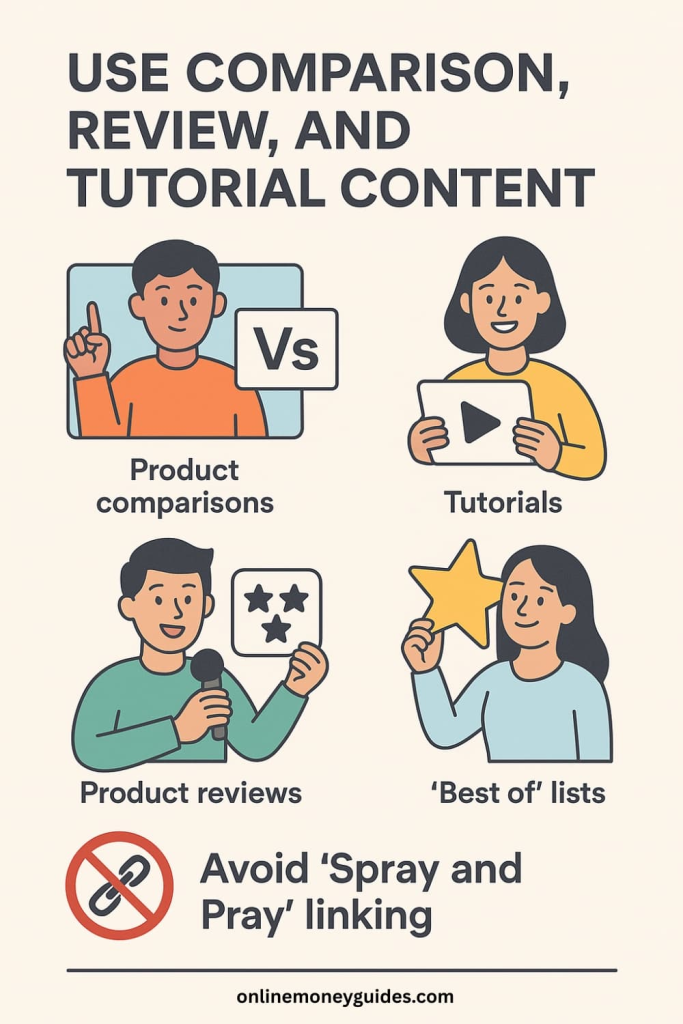
Use Comparison, Review, and Tutorial Content
Certain content formats convert better than others, especially when it comes to affiliate marketing. Why? Because they meet people right before they buy.
Let’s say someone is googling “ConvertKit vs Mailchimp.” That person is deep in the decision-making process. If they find your blog post or video comparing the two tools and you include your ConvertKit affiliate link, that’s a high-converting opportunity.
Here are the best types of content for affiliate success:
- Product comparisons (e.g., “Canva vs Adobe Express”)
- Tutorials (e.g., “How I use ConvertKit to grow my list”)
- Product reviews (e.g., “My honest review of the Rode Wireless GO II mic”)
- “Best of” lists (e.g., “Best beginner cameras for YouTube in 2026”)
These content types work because they offer value before asking for the click. You’re educating, not just selling, and that builds long-term trust and repeat visitors.
Avoid “Spray and Pray” Linking
Here’s the rookie mistake: signing up for 10 affiliate programs and slapping links everywhere.
That rarely works.
Instead, focus on a small handful of products or tools that you truly believe in. Promote them consistently across your best-performing content. Learn what resonates. Tweak your messaging. Double down.
One strong recommendation repeated in the right places is far more effective than a hundred links nobody clicks.
Think depth, not breadth.
Pro Tip: You’re not just adding links, you’re building a reputation. Protect it by only promoting what you stand behind.
The Best Tools and Platforms to Make Affiliate Marketing Easier
You don’t need fancy software to earn your first commission, but the right tools can save you hours of frustration and help you grow faster.
Let’s break down the essentials.
Affiliate Networks vs. Individual Programs
Before we talk tools, let’s clear up something that confuses a lot of beginners:
There are two ways to find affiliate offers:
Affiliate networks and individual programs.
Affiliate Networks
These are like online marketplaces that connect you to hundreds (or thousands) of affiliate programs in one place. You apply once and can promote many brands.
Popular affiliate networks include:
- Awin — Easy for bloggers and e-commerce products.
- Impact — Used by brands like Canva, Shopify, and Airbnb.
- CJ Affiliate (formerly Commission Junction) — Broad categories, including finance and tech.
- ClickBank — Best known for digital products and high commissions.
Networks are great because they give you:
- A dashboard to track all your offers in one place.
- Faster approvals with trusted brands.
- Access to creatives like banners and email swipes.
Individual Programs
These are affiliate programs run directly by the company. You’ll usually sign up on their website, get approved, and receive your custom links.
Examples include:
Individual programs often offer higher commissions and better support, but require separate logins and tracking.
Pro Tip: Start with 2–3 affiliate programs that align with your niche. Use a network, plus a few direct programs, to diversify.
Top Tools for Link Management, Tracking, and SEO
Affiliate marketing is part content creation, part data analysis. The right tools help you manage links, optimize traffic, and measure what’s working.
Here are the must-haves for beginners and growing affiliates:
Link Management Tools
You’ll want to shorten, organize, and cloak your affiliate links, especially if they look long or messy.
- Pretty Links (WordPress Plugin): Create clean, branded URLs (e.g., yourdomain.com/travelpayouts).
- ThirstyAffiliates: Another top WordPress option with auto-linking and reporting.
- Bit.ly or TinyURL: Simple, free tools for shortening links if you don’t have a website yet.
These tools not only make your links look better — they help you track clicks and performance.
Analytics & Tracking
To grow your affiliate income, you need to know what content drives clicks and conversions.
- Google Analytics + GA4: Track page views, user behavior, and traffic sources.
- Affiliate dashboard reports: Use built-in analytics from platforms like Travelpayouts or Impact.
- UTM parameters: Add tracking codes to your links to see which platform or post led to the click.
Don’t worry about getting perfect at this upfront; just start watching patterns over time.
SEO Tools for Growth
If you’re blogging or using YouTube, SEO is your long-term traffic secret weapon.
- Rank Math (WordPress plugin): Optimize blog posts for affiliate keywords.
- Ubersuggest or Ahrefs: Research affiliate marketing keywords with buyer intent.
- AnswerThePublic: Find real questions your audience is asking (great for blog ideas).
- VidIQ: If you’re on YouTube, these help you find tags, titles, and trends.
💡 Start with free versions. Most tools offer enough for beginners.
Free vs. Paid Tools (What’s Worth It?)
You might be wondering if you need to invest in paid tools upfront. The honest answer?
No.
You can absolutely start affiliate marketing using free tools and upgrade as your income grows.
Here’s a quick breakdown:
| Category | Free Tool (Start Here) | Paid Upgrade (Later On) |
| Website/Blog | WordPress.com or Blogger | WordPress.org with SiteGround or Bluehost |
| Email Marketing | MailerLite (free up to 1,000) | ConvertKit or ActiveCampaign |
| Link Management | Bit.ly or manual tracking | Pretty Links or ThirstyAffiliates |
| SEO & Research | Ubersuggest (free plan) | Ahrefs, SEMrush, or LowFruits.io |
| Graphics | Canva (free plan) | Canva Pro (for templates and branding) |
You don’t need to go pro overnight. But reinvesting part of your affiliate income into better tools is how you scale smartly.
Tools aren’t expenses, they’re multipliers. When used well, they save time and increase your earnings.
Common Mistakes That Kill Affiliate Income (and How to Avoid Them)
Affiliate marketing might seem simple: share a link, make a commission, but a lot of creators hit a wall early on because they fall into common traps. These aren’t moral failings. They’re just rookie missteps that almost everyone makes at some point.
The good news? Once you know what to look out for, you can sidestep these issues entirely and fast-track your growth.
Promoting Too Many Random Products
This is probably the biggest mistake new affiliate marketers make: chasing commissions over coherence.
When you promote anything and everything from VPNs to dog food to camera gear, your audience gets confused. And confused people don’t click.
Affiliate marketing works best when:
- You’re known for a specific type of content.
- You promote tools, products, and services that align naturally with your niche.
- You recommend solutions that you’ve actually used or vetted.
Imagine following someone for digital nomad travel tips, and suddenly they’re promoting keto supplements or car insurance. It breaks trust.
Instead, focus on a tight ecosystem of 3–5 affiliate products that:
- Genuinely help your audience solve a problem, and
- Fit within your content themes.
That focused alignment is what turns clicks into commissions.
You’re not a salesperson, you’re a trusted guide. Recommend only what you believe in, and your audience will feel that energy.
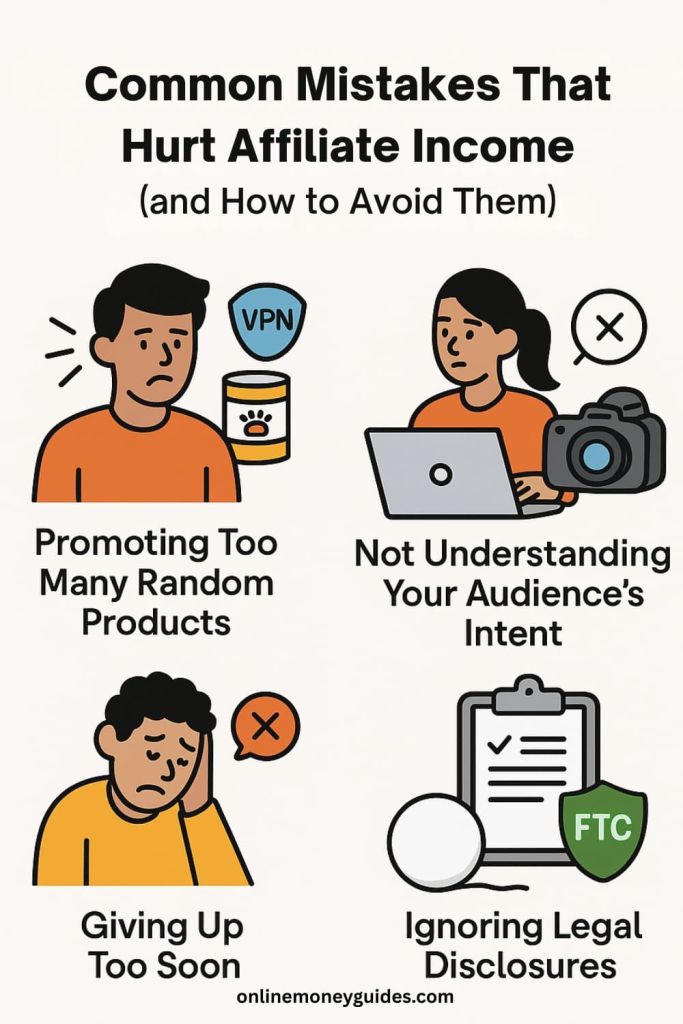
Not Understanding Your Audience’s Intent
Another common mistake is posting affiliate links without understanding what your audience is actually looking for.
Let’s say someone finds your blog post titled “Best Budget Cameras for Beginners.” That person probably has their credit card out. They want a recommendation.
But if you write a generic blog post about “How to Get Started with Filmmaking” and sprinkle in a bunch of product links without context, your readers won’t be in buying mode yet. They’re not ready, and that’s okay.
Different content matches different stages of your audience’s journey:
- Awareness: They’re just learning; no affiliate pitch yet.
- Consideration: They’re exploring options; this is your chance to compare.
- Decision: They’re ready to buy; give them a confident recommendation.
Your job is to meet them where they are. That’s how you earn trust and commissions.
Giving Up Too Soon
This one hurts the most. So many talented, creative people start strong, then quit after a few weeks or months when they don’t see results.
Here’s the truth most gurus won’t tell you:
Affiliate marketing is slow at first. But it’s exponential over time.
Your first blog post might get 7 views. Your first YouTube video might get 14. Your first affiliate link might sit there for weeks with zero clicks.
But over time, as you keep publishing, testing, and refining, you start to stack leverage. A single blog post could rank on Google for years. One YouTube video could keep earning every month. A tiny email list could turn into your most profitable traffic source.
Most people quit right before the curve bends upward.
So don’t fall into the trap of thinking “It’s not working.”
Ask instead: “What’s not working yet, and what can I improve?”
Affiliate marketing is like a snowball. It starts small, but if you keep rolling it, it becomes unstoppable.
Ignoring Legal Disclosures
This one’s boring… but essential. You must disclose your affiliate links.
Not only is it the ethical thing to do, it’s also legally required by the FTC in the U.S.
But don’t stress, it doesn’t have to be scary or complicated.
Here’s how to do it right:
- Place a short disclosure at the top of blog posts, in video descriptions, or next to links.
- Be clear and simple. Something like:
“This post contains affiliate links, which means I may earn a small commission at no extra cost to you. I only recommend products I genuinely use and love.”
It’s not just about avoiding fines, it’s about building transparency and trust with your audience. That trust is what fuels long-term success in affiliate marketing.
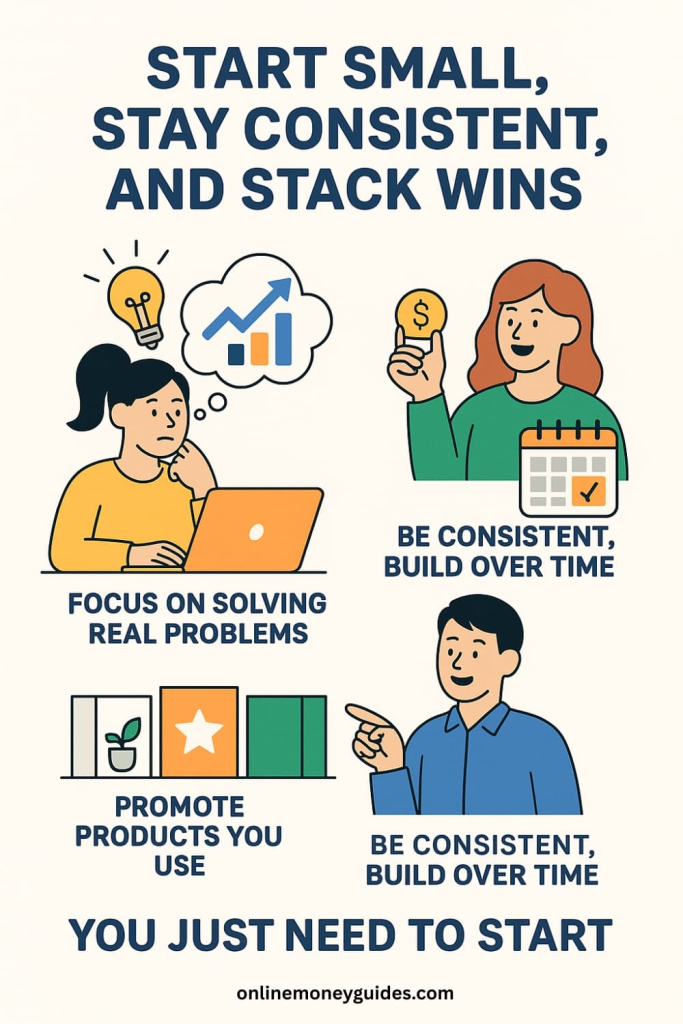
Start Small, Stay Consistent, and Stack Wins
If you’ve made it this far, you already have something that matters more than traffic or tools: commitment.
You’re not just here to chase a trend. You’re here to build something real, something that earns you money, freedom, and the confidence to own your work online.
That’s what affiliate marketing can do when you treat it like a long game.
So here’s what I want you to remember:
- You don’t need to be perfect to get started. You just need to start.
- Focus on solving real problems for real people. That’s where income comes from.
- Pick a niche you care about. Promote products you actually use. Share content that genuinely helps.
- Your first $100 is the hardest. After that, the process becomes clearer.
- Don’t measure success by how fast you grow; measure it by how consistent you stay.
It’s okay to be a beginner. In fact, it’s your advantage because you’re closer to the people you want to help.
Your story is the bridge. Your content is the delivery. Your affiliate links are just the reward for showing up.
So take the first step.
Pick your niche. Choose one platform. Join one affiliate program.
Create one helpful piece of content this week and build from there.
You’re not too late. You’re not too small. And you’re not doing it alone.
You’ve got the blueprint now. Let’s make it happen.
Here are clear, practical answers to the most common questions new affiliate marketers ask:
FAQs — Affiliate Marketing for Beginners in 2026
Ready to start earning with affiliate marketing?
Pick one platform. Join one affiliate program. Create one piece of content.
Your first commission is closer than you think.