Let’s be real for a second.
If you’ve ever thought, “I’d love to make money with online courses, but I have no clue what to sell…” — you’re not alone.
Or maybe you’ve wondered:
“Why would anyone pay me to teach something? I’m not an expert.”
Here’s the truth: you don’t need to be famous, certified, or have a huge following to build a profitable online course business in 2026. You just need a specific skill, a clear outcome, and the willingness to teach what you already know in a way that helps people.
The e-learning industry is booming. In fact, it’s projected to cross $400 billion globally by 2027, and platforms like Kajabi, Teachable, and Thinkific are making it easier than ever for regular people (yes, like you and me) to turn what we know into real income, even passive income over time.
And the best part?
Unlike freelancing, coaching, or even content creation on TikTok or YouTube, you can make money with online courses while you sleep. It’s one of the only digital income streams that’s scalable, evergreen, and totally customizable to your life.
Every successful course starts with a profitable idea. If you’re stuck at this stage, we’ve created a dedicated resource on how to find profitable online course ideas step by step.

In this guide, I’m going to walk you through everything.
From idea → to creation → to launch → to six-figure scale without hype, overwhelm, or tech burnout.
Whether you’re starting from scratch or you’ve dabbled in course creation before, this is your step-by-step blueprint to turn your knowledge into an income stream that actually lasts.
Let’s get into it.
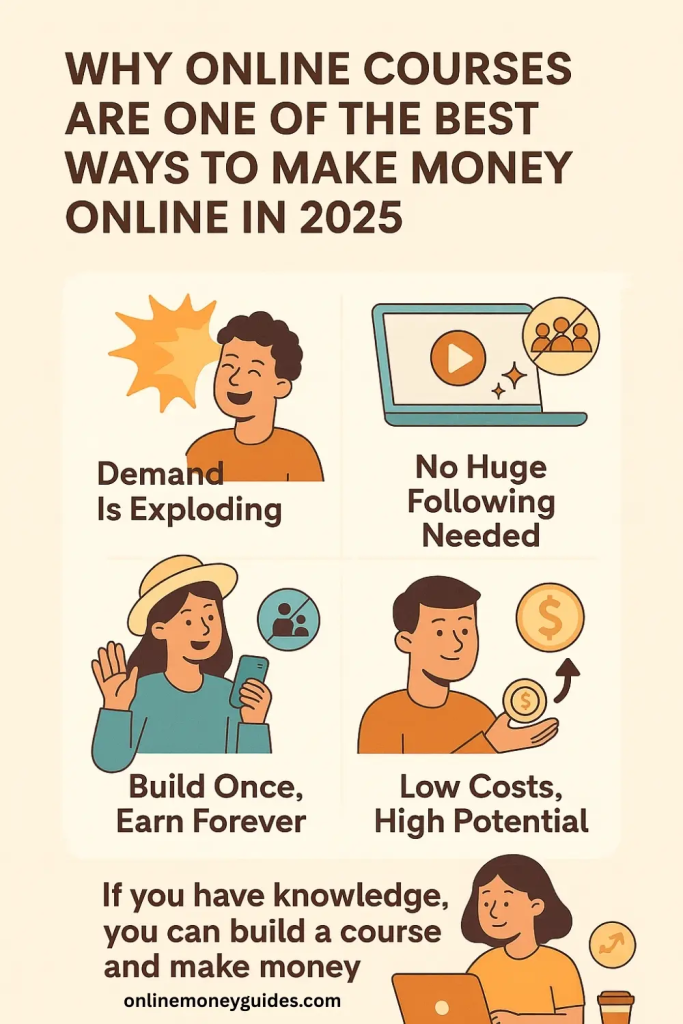
Why Online Courses Are Still One of the Best Ways to Make Money Online in 2026
There’s a reason everyone’s talking about digital products right now, and online courses are at the top of the list.
In a world where creators are getting burned out by the constant content grind and ad revenue feels unpredictable, online courses offer stability, ownership, and income that compounds over time.
Here’s why this model works especially in 2026:
1. The demand is exploding
People are always looking to learn new things faster, easier, and from people they actually relate to. That’s why:
- More than 70% of U.S. adults say they prefer self-paced online learning over traditional options
- Niches like AI, digital marketing, fitness, finance, and creative skills are surging
- Even micro-courses (think: 60 minutes or less) are generating serious income for creators
If you have a repeatable skill or even just a transformation you’ve personally gone through, there’s someone out there who wants to learn from you.
2. You don’t need a huge following
One of the biggest myths about selling online courses is that you need thousands of followers or a massive email list.
The truth? You can launch a small, focused course and start making money with:
- Just 100–200 people on an email list
- A niche audience of loyal Instagram, TikTok, or blog readers
- A high-converting free lead magnet tied to your course topic
We’ve seen creators earn $1,000+ from a first launch with 150 email subscribers. It’s not about size, it’s about alignment and value.
3. You build once, earn forever (almost)
This is where online courses really shine.
Unlike services or coaching (which trade time for money), a well-designed course can become:
- A passive income stream that you make money from weekly
- A launchable offer that you can cycle every 60–90 days
- A gateway product into higher-ticket offers (like group coaching or memberships)
Many creators are now building entire online course businesses around a single core course and expanding from there. This gives you a digital asset that keeps paying off even when you’re not working.
4. Low startup costs, high earning potential
You don’t need a studio, employees, or a ton of money to start. In fact, most creators launch with:
- A free Zoom or Loom account
- Google Docs for course outlines
- Canva for slides
- And a course platform like Thinkific, Podia, or Teachable (free or low-cost tiers)
Compare that to starting a YouTube channel (editing + gear) or an ecommerce store (inventory + shipping), and online courses are one of the most beginner-friendly online income streams out there.
Some course creators hit $5K months within their first year, while others grow to six figures or more with the right systems in place.
If you’ve got knowledge, experience, or a perspective that helps someone get from A to B…
You can build a course.
And you can make real money with it without needing to be a tech wizard, influencer, or genius marketer.

How to Come Up with a Profitable Online Course Idea (Even If You’re Not an “Expert”)
One of the biggest blocks people hit is at the very beginning:
“What would I even teach?”
Here’s the thing most gurus won’t tell you:
You don’t need to be a certified expert. You don’t need 10 years of experience.
You just need to be one or two steps ahead of the person you’re helping.
If you’ve figured out how to do something that others struggle with, no matter how “basic” it feels to you, that’s your ticket.
Think of yourself as a guide, not a guru.
Let’s break down how to find and validate your profitable online course idea.
Your course topic determines everything else—from your audience to your marketing strategy. Our course idea guide will walk you through brainstorming, validating, and picking the right niche.
Niche First, Course Second — What Do People Actually Pay to Learn?
Before you start outlining modules or naming your course, zoom out.
The money is in the niche, not just the topic.
You want to build in a space where people are already spending time, attention, and money.
Here’s a framework to help you brainstorm profitable course niches:
| Broad Category | Profitable Niches (Examples) | Real Course Ideas |
| Health & Wellness | Hormone health, mobility, and meal prepping | “Fix Your Gut in 14 Days” |
| Personal Finance | Side hustles, budgeting, and credit repair | “How I Paid Off $10K in 6 Months” |
| Career & Business | Freelancing, email marketing, Etsy | “Pitch & Land Your First 5 Clients” |
| Creativity | Photography, journaling, music theory | “Cinematic iPhone Editing Basics” |
| Tech & AI | ChatGPT prompts, Notion workflows, web dev | “Build a No-Code AI App” |
Ask yourself:
- What do people ask me for help with?
- What problem have I solved for myself?
- What do I wish existed when I was just starting out?
If you can identify a real pain point or desire, you can build a course around solving it.
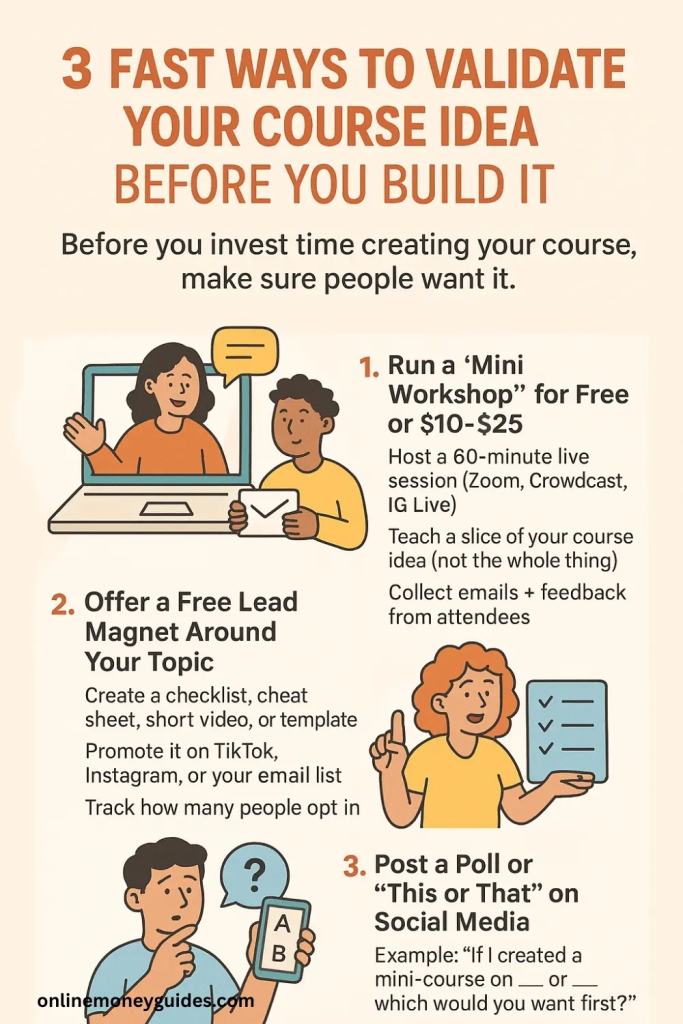
3 Fast Ways to Validate Your Course Idea Before You Build It
Before you invest time creating your course, make sure people want it.
You’re not looking for compliments, you’re looking for commitment.
Here’s how to test that, fast:
1. Run a “Mini Workshop” for Free or $10–$25
- Host a 60-minute live session (Zoom, Crowdcast, IG Live)
- Teach a slice of your course idea (not the whole thing)
- Collect emails + feedback from attendees
If people show up, engage, and thank you, that’s a great sign.
If they pay, even better. That’s proof of willingness to invest.
2. Offer a Free Lead Magnet Around Your Topic
- Create a checklist, cheat sheet, short video, or template
- Promote it on TikTok, Instagram, or your email list
- Track how many people opt in
High opt-in rates = high interest.
This also gives you a ready-made waitlist for your course.
3. Post a Poll or “This or That” on Social Media
- Example: “If I created a mini-course on ___ or ___, which would you want first?”
- Use Instagram Stories, Facebook groups, Twitter/X, or LinkedIn
- Bonus points: invite people to DM you why
This creates low-pressure interaction and can help you find surprising angles or pain points in your audience.
Before spending weeks recording lessons or building your course site, it’s crucial to confirm that people actually want what you’re creating. Our step-by-step guide on validating your online course idea shows you exactly how to do it.
Planning & Outlining Your Course: Keep It Simple, Keep It Sellable
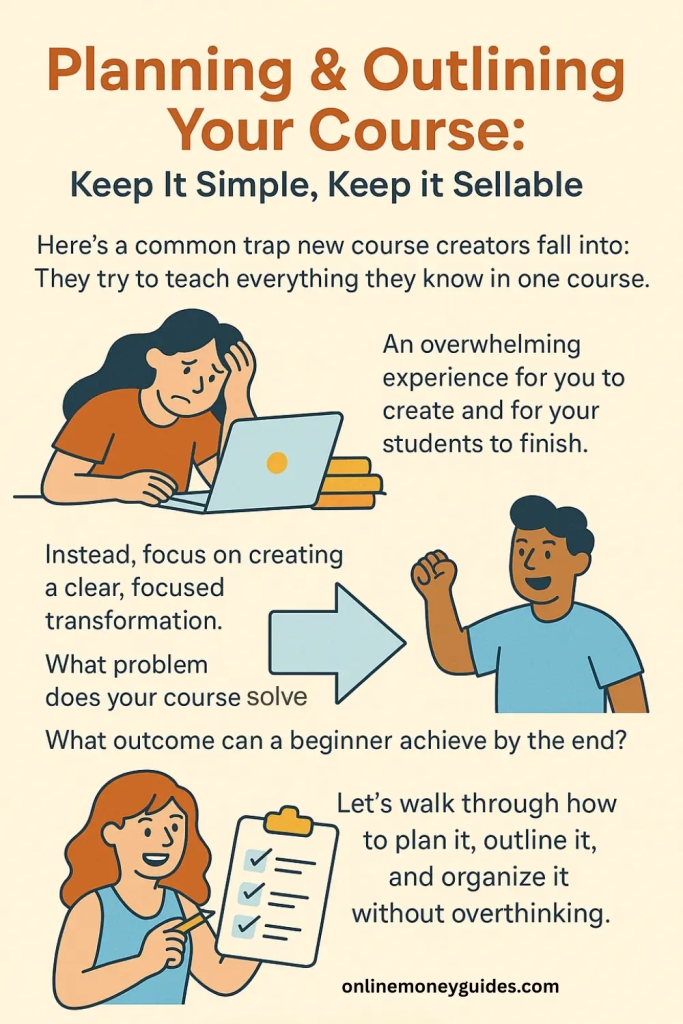
Here’s a common trap new course creators fall into:
They try to teach everything they know in one course.
The result?
An overwhelming experience for you to create and for your students to finish.
Instead, focus on creating a clear, focused transformation.
What problem does your course solve? What outcome can a beginner achieve by the end?
Let’s walk through how to plan it, outline it, and organize it without overthinking.
What Should You Actually Teach? Create a Clear Transformation
Before you write a single lesson title, get clear on this one sentence:
“By the end of this course, you will be able to ___.”
That’s your transformation statement, and it becomes the north star for everything you teach.
For example:
- “By the end of this course, you’ll be able to launch your first Etsy store and make your first sale.”
- “By the end of this course, you’ll be able to edit short-form videos using CapCut, even with no prior experience.”
- “By the end of this course, you’ll be able to budget, save, and pay off your first $1,000 in debt.”
Keep the scope tight and specific. Your course doesn’t need 8 modules and 57 lessons. Some of the highest-converting digital courses in 2026 are:
- 1–3 hours long
- Delivered over 3–5 core modules
- Focused on one clear win
Students don’t want more information.
They want transformation in the shortest, clearest path possible.
Tools to Organize & Plan Your Curriculum
You don’t need fancy course builder software to start.
Some of the best outlines come from the humble Google Doc.
Here are a few tools that can help you structure your content before you ever hit “record”:
- Google Docs or Notion – for outlining your modules and lessons
- Miro – to visually map your course flow (great for mind mapping)
- Canva – to design slide decks, handouts, or lesson visuals
- Trello or ClickUp – to keep track of tasks like scripting, recording, and editing
Your outline can be as simple as this:
| Module | Lesson Title | Key Takeaway | Format |
| Module 1 | Finding Your Niche | Clarity on who you serve | Video + worksheet |
| Module 2 | Creating an MVP Course | Build your course fast | Screen recording |
| Module 3 | Launch Your Beta | Start making sales | Email script + PDF |
Remember, this is a living document, not something you have to perfect right away. You can build as you go.
Next Steps:
Start a Google Doc and write just 3 modules with 2–3 lessons each.
That’s your minimum viable course, and it’s more than enough to start.
Recording Your Course: You Don’t Need Fancy Equipment
If the idea of filming yourself makes you want to crawl under a desk, you’re not alone.
But here’s the truth: your course doesn’t have to look like a Netflix documentary to sell.
People care far more about what you’re teaching and how clearly you deliver it than whether you have a $2,000 camera or a teleprompter.
Let’s demystify the tech and help you build a setup that’s affordable, simple, and gets the job done without sacrificing quality.
Beginner-Friendly Setup That Looks Professional
Here’s what you really need to get started:
| Gear | Budget Option | Pro Tip |
| Camera | Your smartphone or laptop webcam | Clean your lens + record near natural light |
| Microphone | $30 lavalier mic (like Boya BY-M1) or USB mic (Blue Snowball) | Audio quality matters more than video |
| Lighting | $20 ring light or desk lamp | Face a window if possible |
| Background | Clean wall, bookshelf, or digital background | Avoid clutter or distractions |
Software options:
- Zoom or Loom – record yourself + slides
- OBS Studio – free, pro-level screen recording
- ScreenPal or Camtasia – for walkthroughs and tutorials
- CapCut or Descript – easy, beginner-friendly editing
If you’re teaching something visual (design, spreadsheets, tutorials), screen recordings + slides work great.
If your face adds trust and connection, go on camera, but you don’t have to do both.
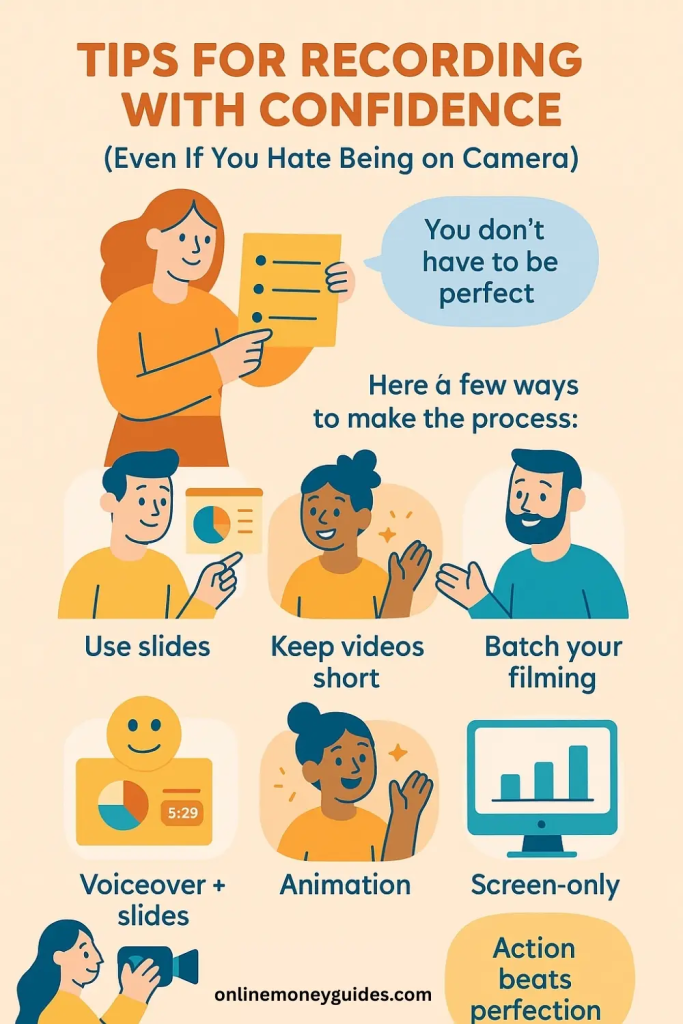
Tips for Recording with Confidence (Even If You Hate Being on Camera)
You don’t have to be charismatic.
You don’t have to be perfect.
You just have to be clear, helpful, and human.
Here are a few ways to make the process smoother:
- Use slides as a crutch – If you’re nervous, talk to your slides, not the lens
- Keep videos short – 5–10 minutes per lesson is plenty (and easier to re-record if needed)
- Batch your filming – Record 2–3 lessons per session instead of all at once
- Talk like you’re helping a friend – Not performing. Just sharing.
And hey, you can always go “faceless.”
Some top-selling creators in 2026 teach entire courses using:
- Voiceover + slides
- Animated visuals (via Canva or Animaker)
- Screen-only walkthroughs
The point isn’t to impress people. It’s to help them get results.
Authenticity > polish.
Next steps:
Pick one lesson from your outline and record a draft version today, even if you never publish it.
That’s how the fear starts to fade. Action beats perfection.

Where to Host and Sell Your Online Course in 2026
Here’s where many new creators freeze:
“Should I use Teachable? Kajabi? Just upload to YouTube? What if I pick the wrong platform?”
Truth is, there’s no perfect tool, but there is a best fit depending on:
- Your budget
- Your tech comfort level
- How much control do you want over your brand and revenue
Best Platforms to Sell Online Courses: Kajabi vs Teachable vs Thinkific vs Podia
These are the most popular course hosting platforms in 2026. They let you upload videos, create modules, accept payments, and deliver your course in a polished way.
Here’s a quick comparison:
| Platform | Best For | Monthly Cost (starting) | What Makes It Stand Out |
| Teachable | Beginners & budget creators | $39 | Simple UI, fast to set up, clean student experience |
| Thinkific | Creators who want a free plan | $0–$49 | Flexible pricing, free tier available |
| Kajabi | All-in-one business builders | $149 | Includes email, funnels, and landing pages |
| Podia | Digital product sellers | $33 | Great for courses + memberships + downloads |
| Skool | Community-first course builders | $99 | Blends courses + community + group coaching |
Pro Tips:
- If you’re just starting out, Thinkific or Teachable are easiest
- If you want to scale into a full online business, Kajabi or Podia will grow with you
- If you want built-in community + no modules: Skool is fresh, simple, and growing fast
Marketplace vs. Self-Hosted vs. Hybrid — What’s Right for You?
There are 3 main ways to sell your online course in 2026. Each has its pros and cons:
1. Marketplace (Udemy, Skillshare)
Pros:
- Built-in traffic
- No audience required
- Set-it-and-forget-it potential
Cons:
- You don’t own your audience
- Lower payouts (Udemy takes up to 75%)
- You can’t control pricing or branding
Best for: New creators who just want to test the waters without building a website.
2. Self-Hosted (Teachable, Kajabi, Thinkific)
Pros:
- Full control over pricing, branding, and customer experience
- Higher profit margins
- Better long-term scalability
Cons:
- Requires some audience-building (no built-in traffic)
- Slight learning curve with setup
Best for: Creators who want to build a real online course business and keep their profits.
3. Hybrid (Use both)
Start by listing a mini-course on Udemy or Skillshare to build confidence → Then direct students to your self-hosted signature course.
This strategy is gaining popularity in 2026 as more creators realize they can use marketplaces as lead generators, not just income sources.
There’s no wrong choice — just start simple, and grow into complexity.
Pick a platform that supports your next step, not your final form.
Next Steps:
Set up a free trial on Thinkific, Teachable, or Podia today. Upload a draft module. Play with the builder. Momentum starts by clicking a button.
Pricing Your Online Course for Profit Without Scaring People Away
If you’ve ever felt awkward trying to price your course, you’re not alone.
This is where imposter syndrome creeps in fast:
- “Is this even worth money?”
- “What if no one buys it at this price?”
- “Should I just make it $27 so people don’t judge me?”
People aren’t just paying for content. They’re paying for clarity, results, and confidence.
The right pricing makes people take your course more seriously and helps you build a real business, not just a side hustle.
Let’s unpack how to price your course the smart way.
Common Pricing Tiers: $29, $99, $297, $497+
Your pricing should reflect:
- The value of the transformation you’re offering
- The depth of the content and support
- Your business goals (starter product or full offer?)
Here are some common price points for online courses in 2026:
| Price Point | Best For | Examples |
| $29–$49 | Mini-courses, templates, quick wins | “Instagram Reels Starter Kit” |
| $99–$149 | Entry-level full courses | “Beginner’s Guide to Budgeting” |
| $297–$497 | Signature courses with full frameworks | “Launch Your First Etsy Shop in 30 Days” |
| $997+ | High-touch offers with coaching or community | “AI Creator Academy + Weekly Coaching” |
Tips:
- If it takes someone from confusion to clarity, it’s worth at least $99
- Don’t underprice just because you’re new
- Offer a lower-tier product, not discounts, if you’re afraid to go premium
And remember: People who pay, pay attention.
Simple Pricing Psychology That Works
You don’t need a psychology degree to use proven pricing strategies.
Here are a few you can implement right away:
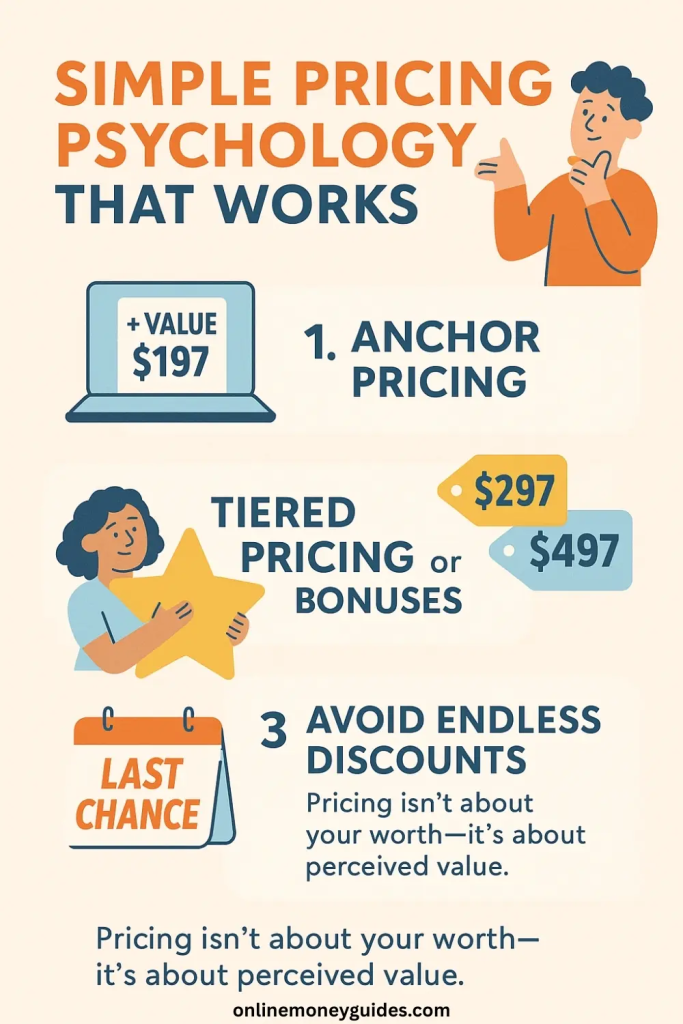
1. Anchor pricing
Show the full value before the price.
Ex: “This course includes 3+ hours of content, checklists, swipe files, and bonuses worth over $700 — yours for just $197.”
2. Tiered pricing or bonuses
Offer a basic version + a VIP tier.
Ex:
- Core course: $197
- Course + 1:1 call: $297
- Course + group coaching + bonuses: $497
This gives people options and increases perceived value.
3. Avoid endless discounts
Instead of constantly running sales, try:
- Time-sensitive bonuses
- “Early bird” pricing
- Limited enrollment windows
This keeps your course brand strong — not “bargain bin.”
Pricing isn’t about your worth; it’s about the value of the result you’re offering.
People will pay to shortcut pain and reach their goals faster.
Next Steps:
Write out 3 bullet points that describe what someone will gain by completing your course.
Then ask: “What would I pay to get this result, without wasting time, trial-and-error, or stress?”
Your number might surprise you.
How to Build an Audience That Actually Buys Your Course
Let’s clear something up:
You don’t need a huge following.
But you do need the right people, with the right problem, who trust you to help them solve it.
In 2026, attention is scattered. Algorithms are noisy.
But trust? That still converts.
Let’s talk about how to build a small but mighty audience that’s primed to buy your online course.
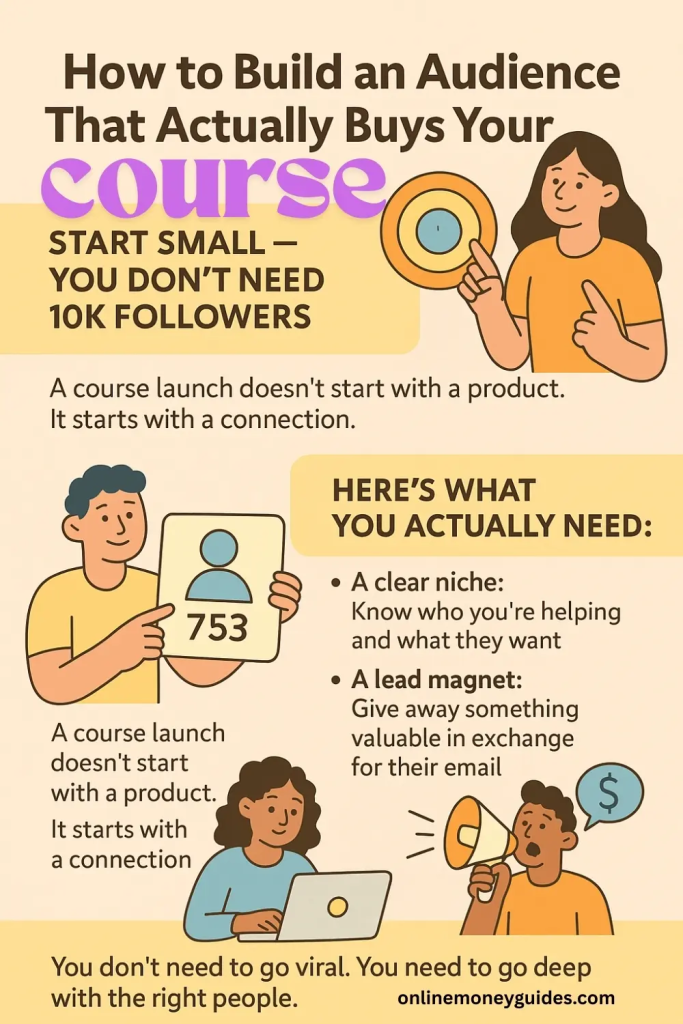
Start Small — You Don’t Need 10K Followers
A course launch doesn’t start with a product.
It starts with a connection.
Many successful course creators earn $1,000 to $5,000+ from audiences under 1,000 people — as long as the content and messaging align.
Here’s what you actually need:
- A clear niche: Know who you’re helping and what they want
- A lead magnet: Give away something valuable in exchange for their email
- A way to communicate: Email list, private DM group, Discord, etc.
Example: A creator with 300 people on her email list launched a $147 course and made $4,400 in her first 7 days — just from nurture emails and IG Stories.
You don’t need to go viral. You need to go deep with the right people.
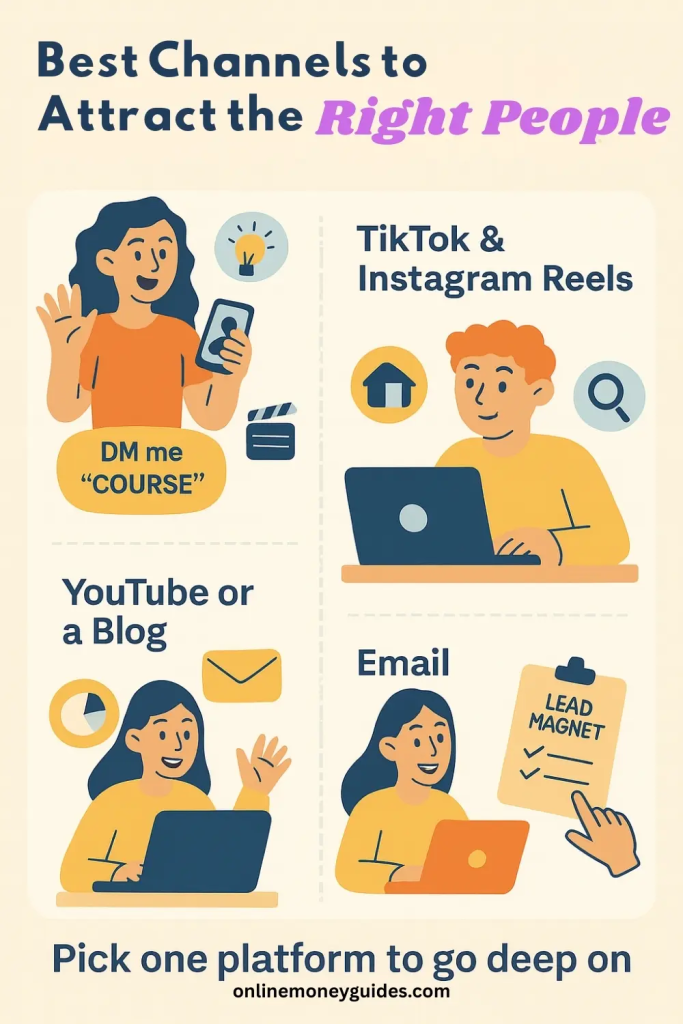
Best Channels to Attract the Right People
Every audience-builder has a different skillset. The key is to pick one or two channels and go all in instead of half-committing to everything.
Here’s what’s working in 2026:
TikTok & Instagram Reels
- Bite-sized tips related to your course topic
- Behind the scenes of your creation process
- “Mini-teach” videos to build trust
Use CTA’s like:
“DM me ‘COURSE’ if you’d join something like this.”
YouTube or a Blog
- Longer-form content builds authority
- Great for SEO and organic discovery
- Can link directly to your course or lead magnet
Use keywords from your course title (e.g., “how to create a budget as a single mom”) to attract problem-aware searchers.
Email (Your Secret Weapon)
If social media is dating, email is the relationship.
Platforms like ConvertKit, MailerLite, or Beehiiv make it easy to:
- Build a list with a lead magnet
- Send welcome sequences
- Warm up your audience for a course launch
- Segment your most engaged buyers
Lead Magnet Ideas That Convert:
- Free PDF checklist
- “Cheat Sheet” of your top tools
- Mini video tutorial
- Free Notion template
- Quiz with personalized result (use Interact or TryInteract)
These attract your ideal student before you ever ask them to buy.
Next Steps:
Pick one platform to go deep on this month.
Set up your lead magnet, link it in your bio, and start growing your email list even if it’s just one subscriber a day.

Launching Your Online Course: Fast, Imperfect, Profitable
You don’t need a massive email list, webinar funnel, or two-month runway to launch your first online course.
In fact, the longer you wait for it to be “perfect,” the more likely you’ll overthink it into oblivion.
What you really need is a clear promise, a warm audience, and a simple 3-phase plan to guide them toward buying. That’s it.
Let’s walk through how to launch your course in a way that feels light, focused, and real, even if this is your very first one.
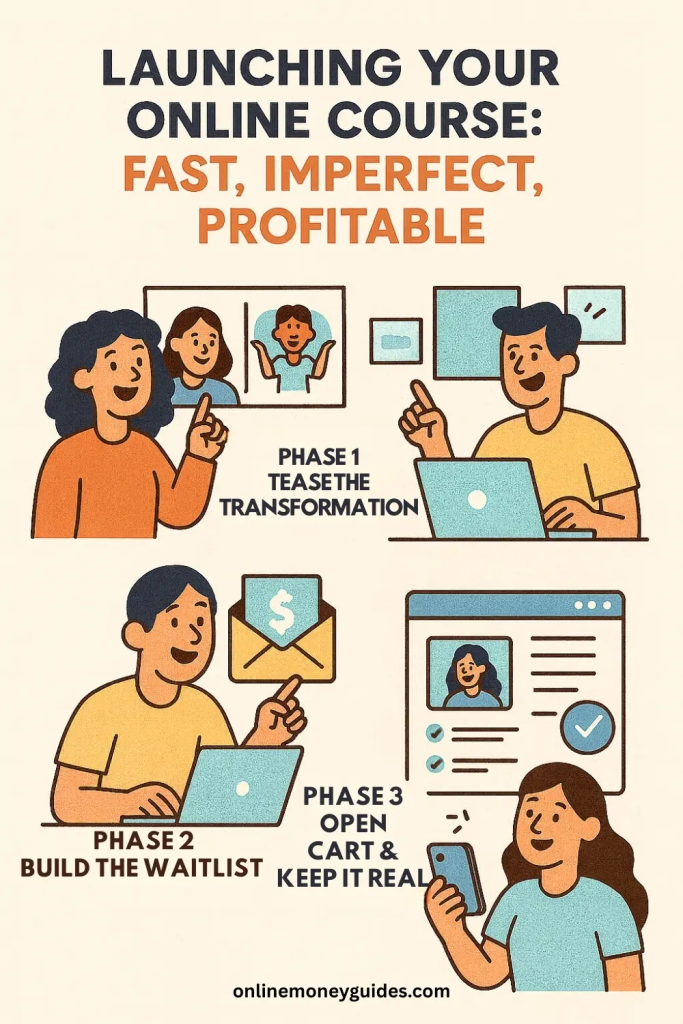
The 3-Phase Launch Plan
The most effective launches in 2026 don’t feel like high-pressure sales events. They feel like an invitation to something helpful.
Here’s a simple structure to follow:
Phase 1: Tease the Transformation
Before you ever mention a course, start seeding the idea. Share wins, before-and-afters, personal stories, or a free tip tied to the topic. This helps people start seeing you as the guide who can help them get results.
Phase 2: Build the Waitlist
Now that you’ve got curiosity, give people a low-commitment way to say “I’m interested.” A simple email opt-in or DM list is enough. Use this phase to keep sharing micro-wins, answer objections, and get feedback on what people want most.
Phase 3: Open Cart and Keep It Real
When it’s time to open the course for enrollment, be clear and direct. Let people know what’s inside, how it works, and who it’s for. Don’t be afraid to show your face, talk to the camera, or send personal messages. People buy from people.
Keep your open cart window short. Usually, 3 to 7 days is plenty. Remind people of what’s possible, not just what’s inside.
Tools to Automate Your Launch (and Keep It Simple)
If the idea of sending 10 launch emails or setting up a full funnel makes your head spin, breathe.
You can automate the basics with beginner-friendly tools.
ConvertKit or MailerLite can handle your welcome sequences and launch emails.
ThriveCart or SamCart are great for checkout pages and handling payments, especially if you want order bumps or upsells.
Platforms like Kajabi and Podia even come with their own launch templates and built-in email tools.
Start simple. You can always optimize later.
And if you want to create urgency without feeling spammy, a tool like Deadline Funnel can help you offer time-based bonuses or limited-time pricing without sending ten “last chance” emails.
Here’s the bottom line: you don’t need to be loud, pushy, or complicated. You just need to show up consistently and clearly explain how your course helps someone get what they want faster.
That’s enough.
And once you’ve launched it once, you can turn it into an evergreen offer, which is exactly what we’ll cover next.

How to Make Passive Income with Online Courses After Launch
So you’ve launched. You’ve made your first sales. Maybe you’ve proven to yourself that this thing actually works.
Now the question becomes:
Can I keep earning without constantly promoting it?
The answer is yes, but passive doesn’t mean zero effort. It means systems that keep selling for you, long after you’ve created the content.
This is where you shift from being a “course creator” to building a scalable online course business.
Let’s break down two of the most effective ways to create long-term, low-effort revenue.
Evergreen Sales Funnels That Work While You Sleep
An evergreen funnel is just a fancy way of saying: you’ve built a repeatable system that brings in leads, nurtures them, and makes the offer without you having to be live every time.
For example, someone finds your free lead magnet on TikTok or Google. They sign up and get a few welcome emails that teach, inspire, and build trust. Then, a few days later, they get a time-sensitive offer to join your course.
You’re not launching. You’re not selling live.
The system is doing the heavy lifting for you.
Tools like ConvertKit, Beehiiv, or MailerLite can run these sequences automatically. And platforms like Kajabi or Podia let you connect everything inside one dashboard, landing page, email flow, course access, and payments.
Want to go even simpler? Add your course link to your Instagram bio, TikTok profile, or blog footer. If your content attracts the right people, the sales will follow.
And no, it doesn’t have to feel salesy.
If your course solves a real problem and your funnel builds real trust, people want to buy from you even if you’re not “launching.
Affiliate Marketing to Boost Course Sales
Another way to earn passively is by letting other people promote your course in exchange for a cut of the sale. That’s affiliate marketing, and it’s a smart move once you’ve proven your course sells.
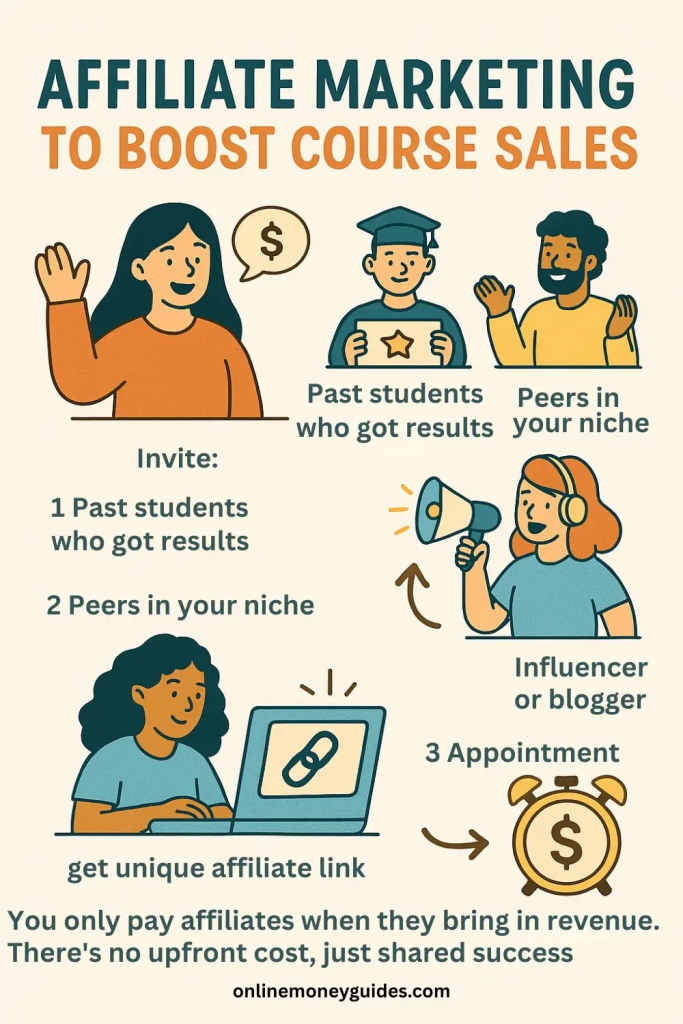
You can invite:
- Past students who got results
- Peers in your niche who share your audience
- Influencers or bloggers who align with your message
Set up an affiliate program using a tool like Rewardful, PartnerStack, or the built-in tools inside Podia or Teachable.
This allows your affiliates to get a unique link. When someone buys through their link, they earn a percentage, and you get a customer you didn’t have to work for.
The best part? You only pay affiliates when they bring in revenue. There’s no upfront cost, just shared success.
In 2026, more creators are turning their students into ambassadors, building referral networks that keep their course profitable without paid ads or daily posting.
Here’s your reminder:
Passive income isn’t about doing nothing. It’s about setting up systems that continue to work in the background while you focus on creating, helping, or just living your life.
You’ve already done the hardest part by building the course.
Now it’s time to let it work for you.

Scaling to Six Figures: Your Online Course as a Business
Once you’ve launched your course, made your first few sales, and set up evergreen systems, it’s easy to think: “Okay… now what?”
This is where many creators plateau, not because their course isn’t valuable, but because they never shift from a single product to a business model.
Scaling doesn’t mean working harder. It means thinking smarter about how your course fits into the bigger picture.
Here’s how to take what you’ve built and grow it to consistent, scalable revenue.
When to Add Coaching, Memberships, or Upsells
One of the fastest ways to increase your income without creating an entirely new course is to add a layer of support or access.
If your course helps people get from A to B, some of your students will want help getting from B to C, and they’ll happily pay for it.
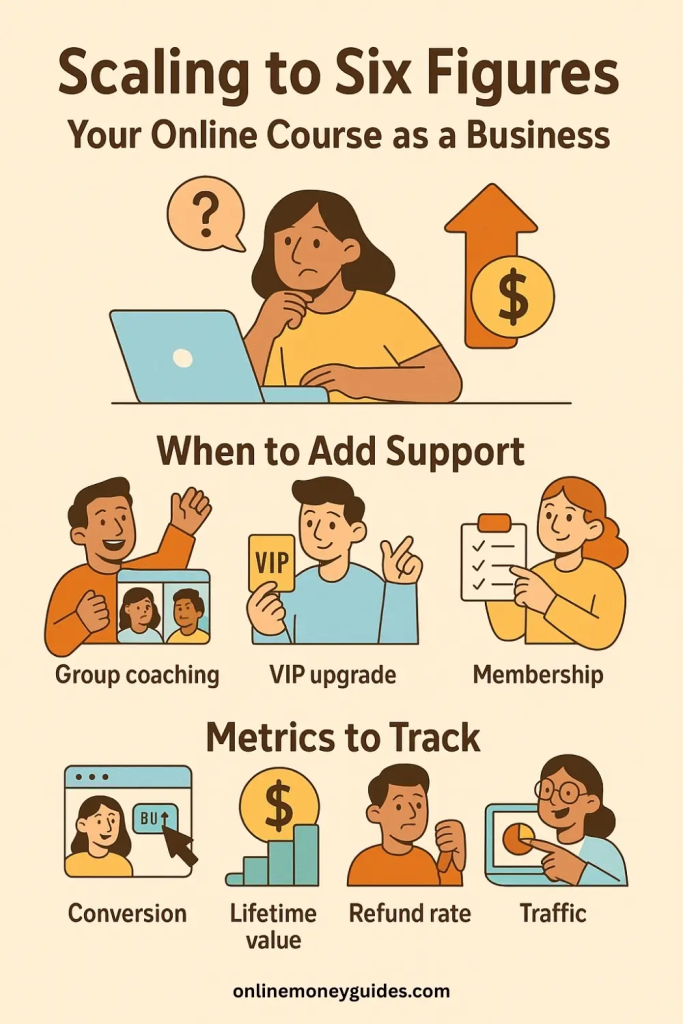
You could offer:
- Group coaching to answer questions and deepen results
- A VIP upgrade during checkout (e.g., add a 1:1 call or bonus training)
- A monthly membership for ongoing support, Q&As, and new lessons
- A community hub on platforms like Circle, Skool, or Discord
The key is to avoid turning yourself into a full-time coach unless you want to. These extras can be offered in limited batches, pre-recorded formats, or with minimal live time required.
When done right, they increase both income and student success, which feeds more word-of-mouth and referrals.
Metrics to Track and Optimize
Let’s be real: you don’t need to obsess over spreadsheets.
But a few simple metrics will help you scale with intention instead of guesswork.
Here’s what matters:
- Conversion Rate – What percentage of leads buy your course?
(Industry average: 1–5% for cold traffic, 10%+ for warm lists) - LTV (Lifetime Value) – How much does one customer bring in over time?
(This goes up if you offer coaching, bundles, or upsells) - Refund Rate – How often do people ask for their money back?
(If it’s high, something’s off with your messaging or delivery) - Traffic Sources – Where are your leads coming from?
(Track what’s working — is it TikTok, SEO, a podcast appearance?)
You can use built-in tools on Kajabi, Thinkific, or Teachable to track all of this.
Google Analytics and ConvertKit also offer dashboards that show where buyers come from and how they behave.
Even checking these once a month is enough to spot opportunities and fix leaks in your funnel.
Scaling isn’t about doing more. It’s about doing the right things, in the right order, and trusting the process.
What started as one small course can become a product suite.
And what started as a side hustle can absolutely grow into a six-figure business.
You don’t need to rush. But you do need to keep moving forward.
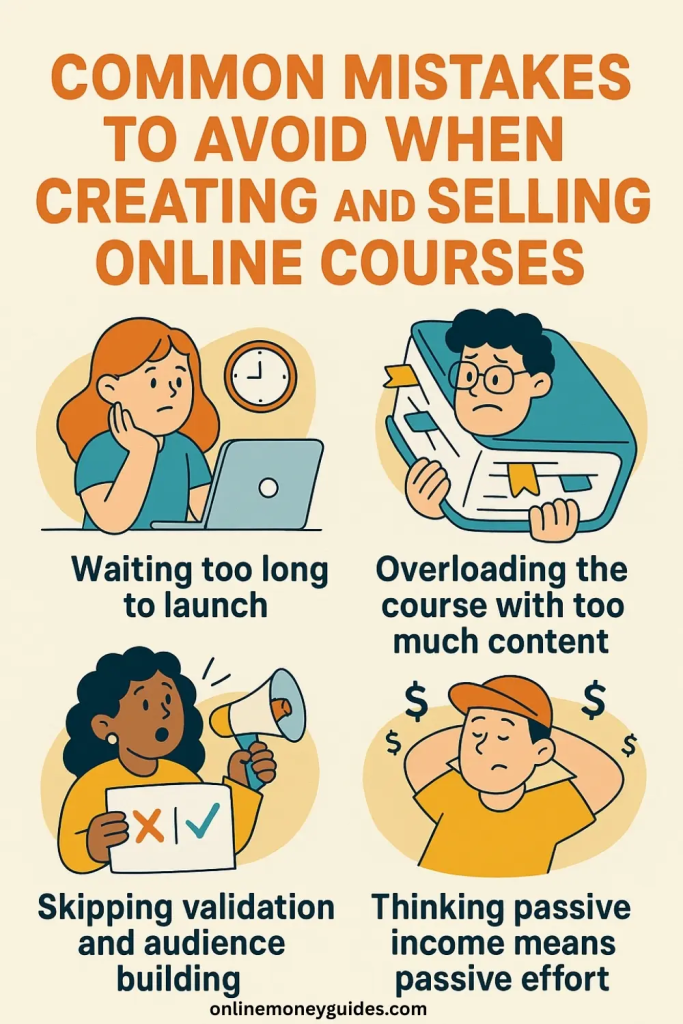
Common Mistakes to Avoid When Creating and Selling Online Courses
No one builds their first course perfectly. That’s not the goal.
But there are some patterns that consistently lead to burnout, frustration, or zero sales.
If you know what to watch out for, you can avoid the mistakes that keep most courses stuck in “draft” forever or worse, launched to crickets.
Here are the biggest traps to steer clear of, especially when you’re starting out.
Waiting too long to launch
Many people spend months (or even years) tweaking their course behind the scenes, thinking they’re “just not ready yet.”
In reality, they’re stalling because they’re scared it won’t be good enough.
The truth? You won’t know what works until you put it in front of real people.
Courses don’t need to be perfect; they need to be live.
Start with a minimum viable version, test it, then improve based on feedback.
Real growth comes from iteration, not isolation.
Overloading the course with too much content
A common mistake is trying to cram every bit of knowledge into one product. You think it adds value, but to your students, it just adds overwhelm.
The most effective courses are focused, clear, and easy to complete.
It’s better to solve one specific problem really well than to try and teach everything someone might ever need.
Skipping validation and audience building
You might have the most brilliant course idea in the world, but if you haven’t tested it, or if no one knows who you are, sales will be slow.
Validation can be as simple as posting a poll, running a workshop, or offering a lead magnet. And audience building doesn’t require 10K followers; it requires showing up consistently and helping.
Don’t wait until your course is done to start talking about it.
Involve your audience early, and they’ll be more excited (and ready) to buy.
Thinking passive income means passive effort
Yes, online courses can make money while you sleep. But if you disappear completely, so will your sales.
You’ll still need to nurture your audience, tweak your funnel, share testimonials, and stay in conversation with your niche.
Passive income is real, but it’s built on systems, not silence.
The Path from “Idea” to “Income” Is Clear. You Just Have to Start
You don’t need to be famous.
You don’t need a million followers.
And you definitely don’t need to know everything about funnels, platforms, or pricing before you begin.
What you do need is the courage to start with what you already know.
Because here’s the truth:
Every six-figure course business starts with one imperfect first course.
If you’ve made it this far, you already know more than 90% of people who say, “I want to make money online.”
You’ve seen how online courses let you:
- Turn what you know into real income
- Help people get results
- Build something scalable and sustainable
- Create passive income streams that work long after the launch
You don’t have to do all of it this week. But you can take the next small step.
Start with your course idea. Write your transformation sentence. Talk about it publicly. Record a rough version of your first lesson.
The momentum will build.
And if you stick with it, your online course won’t just be a digital product — it’ll become a living asset that earns income, builds impact, and gives you freedom.