If you’re eyeing online coaching and consulting in 2026, you’re probably juggling a few doubts: “Who am I to charge for advice?” “What if I don’t have a certification?” “How do I even get my first client?” Totally normal. You don’t need to be perfect, famous, or have a 10-page resume. You need a clear promise, a simple offer, and a repeatable way to meet people who already want the result you deliver.
Here’s what this guide will help you do: choose a niche that plays to your strengths, package your work into outcomes people easily say yes to, price with real numbers (no guesswork), set up a lean tech stack in under a day, and run a simple marketing engine that turns conversations into paid clients. We’ll also stack multiple revenue streams, so one slow month doesn’t tank your confidence or your bank account.
One of the first steps in launching your coaching or consulting business is deciding who you serve. If you’re struggling with this, we have a detailed resource on choosing your coaching or consulting niche.
Think of coaching online as structured change: you’re the guide, the mirror, and the accountability partner. Think of being an online consultant as targeted problem-solving: you analyze, recommend, and when appropriate, help implement. Many successful businesses blend both. You’ll learn exactly how to do that.

What you will not find here: corporate jargon, bro-marketing hype, or 47 to-dos that keep you “busy” but broke. We’re going to focus on clarity and motion, the two ingredients that create momentum. By the end, you’ll have a tight offer, a booking link, a payment flow, and a weekly rhythm that gets you in front of buyers.
Small mindset reframe before we dive in: clarity follows action. Not the other way around. You don’t earn confidence by thinking; you earn it by helping one person, then another, and another. Ready?
Next Steps: Commit to imperfect action, your first (or next) client is closer than you think.
What Is Online Coaching and Consulting? (And Which Path Fits You)
When you zoom out, online coaching and consulting are two sides of the same transformation coin. Clients don’t actually buy “sessions” or “deliverables,” they buy relief from a problem and movement toward a meaningful goal. Your job is to guide that movement in the most effective way for the person in front of you.
Coaching vs. Consulting
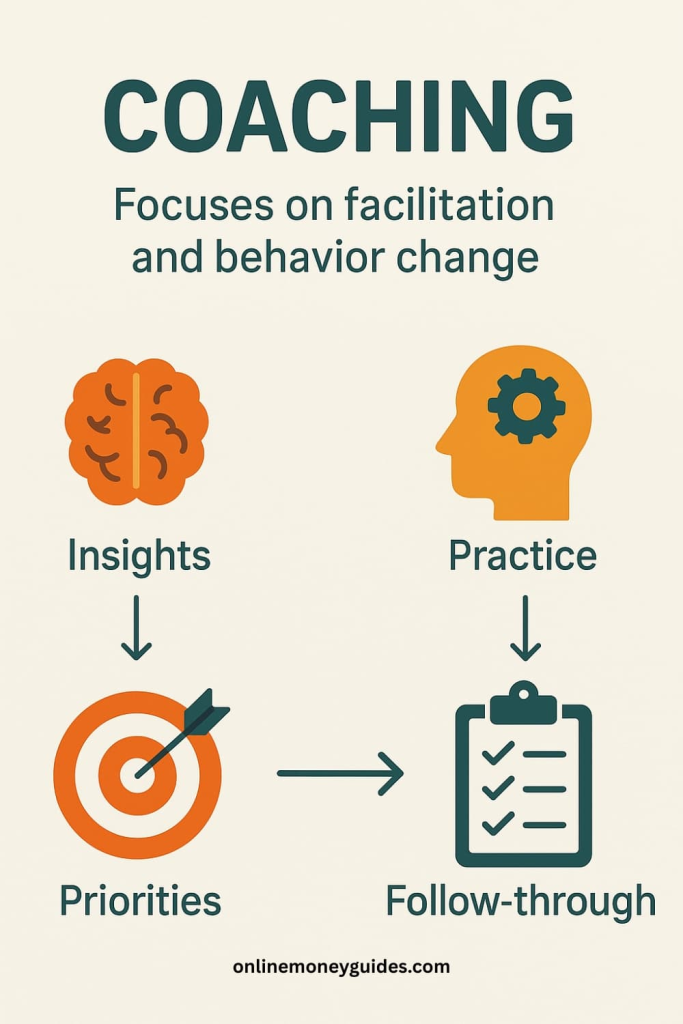
- Coaching focuses on facilitation and behavior change. You help the client surface insights, set priorities, practice new skills, and follow through. Think structured conversations, frameworks, and accountability that move someone from stuck to consistent action.
- Consulting focuses on diagnosis and recommendations. You audit the situation, identify root causes, and provide a plan, sometimes with hands-on support. Think specialized knowledge, analysis, and clear “do this next” directives.
In real life, these overlap. A business client might need your consultant brain to fix their funnel and your coach brain to help them execute consistently. A career client may need your strategy for a narrative resume, plus your coaching to actually reach out and interview.
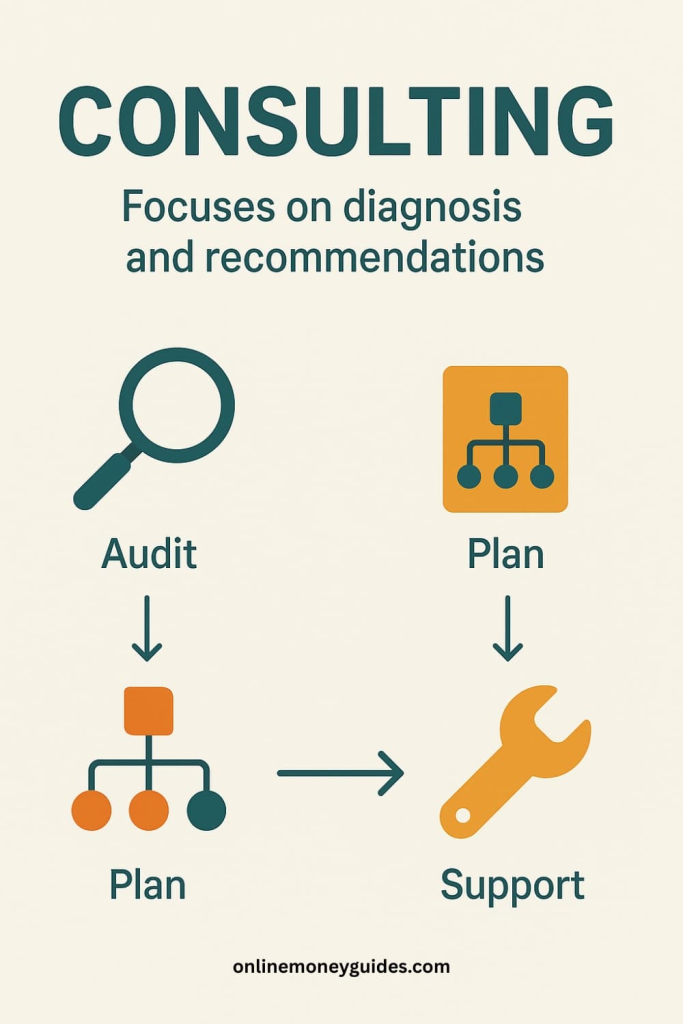
If you love asking powerful questions and witnessing lightbulb moments, start with a coaching-forward offer. If you love tearing down processes and rebuilding better systems, start with a consulting-forward offer. If you love both, you’re a great fit for a hybrid.
How a Hybrid Model Works in 2026 (Why It’s Often Best for Beginners)
Hybrid = targeted strategy + human accountability. You bring a concrete plan and the weekly structure that ensures it actually gets done. In a 4–8 week engagement, you might:
- Assess the situation (brief intake form + baseline metrics).
- Prescribe a focused plan (3–5 high-leverage actions, not 37).
- Support execution (weekly calls + async check-ins).
- Measure progress (simple dashboard or checklist).
- Adjust quickly (tight feedback loops).
This approach protects you from two traps:
- Pure coaching with no direction (can feel vague to clients).
- Pure consulting with no follow-through (plans die on the vine).
A hybrid gives clients clarity and momentum.
Some coaching niches are far more profitable than others. If you’re wondering which markets are booming this year, check out our list of 10 high-demand online coaching niches that pay well.
Examples That Make It Real (Across Popular Niches)
- Business & Marketing: You help a solo creator streamline a messy content pipeline. Consulting hat: audit their workflow, propose a 2-step batching system, and set up a Notion board. Coaching hat: weekly check-ins to keep the system running, troubleshoot bottlenecks, and celebrate early wins.
- Career & Leadership: You guide a mid-level professional through a pivot into product management. Consulting hat: skills gap analysis, resume narrative, portfolio plan. Coaching hat: interview practice, weekly outreach goals, and mindset support.
- Wellness & Habits: You help a client build a sustainable energy routine. Consulting hat: simple, evidence-informed protocol (sleep basics, movement triggers, meal prep). Coaching hat: weekly experimentation, habit tracking, and course-correction when life gets chaotic.
- Money & Operations for Creators: You help a freelancer stop feast/famine cycles. Consulting hat: pricing review, packages, invoicing flow. Coaching hat: pipeline habits, follow-up cadence, and “say no” boundaries.
Notice the throughline: a clear before → after and a structured path that gets them there.
Scope, Boundaries, and Ethics (What You Do—and What You Don’t)
Great online coaching and consulting start with clarity on scope. You are responsible for a process and a plan; the client is responsible for participation and implementation. You are not a therapist, doctor, or lawyer unless you’re licensed. Even then, you keep the right service lines distinct. Good boundaries speed up results because everyone understands who’s doing what, by when, and how success is measured.
Set expectations upfront using plain language:
- What’s included: number of calls, duration, async support, and resources.
- What’s not included: complex rebuilds, 24/7 access, out-of-scope deliverables.
- What success looks like: 2–3 measurable outcomes appropriate for the timeframe.
- How we’ll measure: simple metrics (e.g., booked interviews/week, content pieces delivered, weekly steps completed).
Where You Fit: Online Coach, Online Consultant, or Hybrid
You don’t need to pick an identity for life; pick a lane for your first offer. Here’s a simple way to decide:
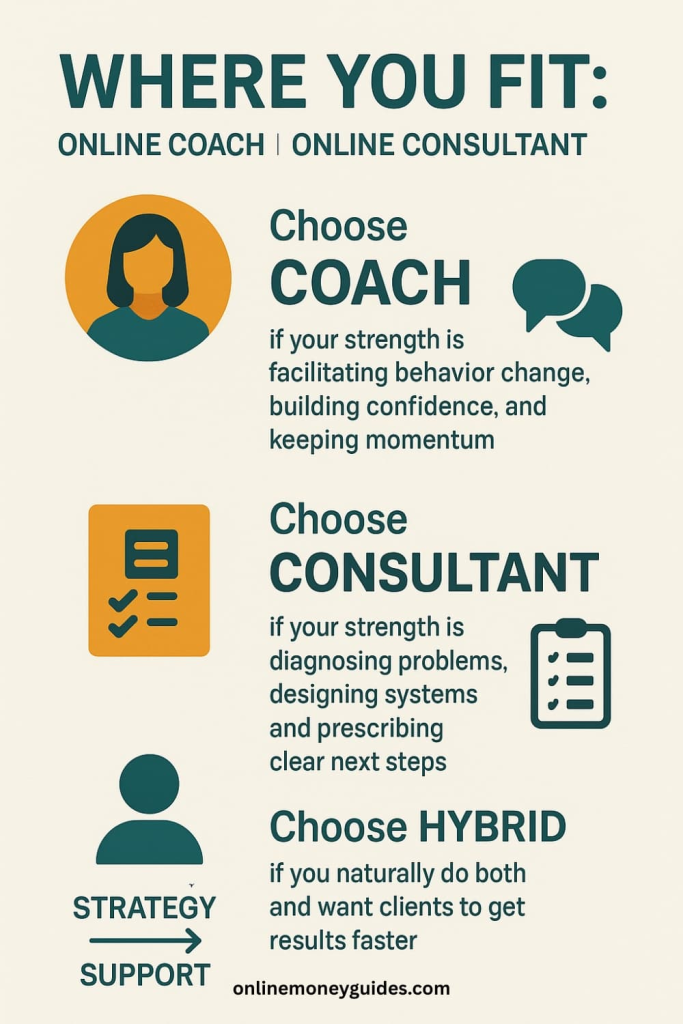
- Choose Coach if your strength is facilitating behavior change, building confidence, and keeping momentum. Your sessions will feel like structured conversations with tools and practice.
- Choose Consultant if your strength is diagnosing problems, designing systems, and prescribing clear next steps. Your sessions will feel like walk-throughs of a plan with concrete checklists.
- Choose Hybrid if you naturally do both and want clients to get results faster. Your sessions will alternate between strategy and support.
If you’re unsure, start with a hybrid approach for 4–6 clients. After a month, you’ll know where you shine and what your market values most.
What Coaching Online Actually Looks Like Week to Week
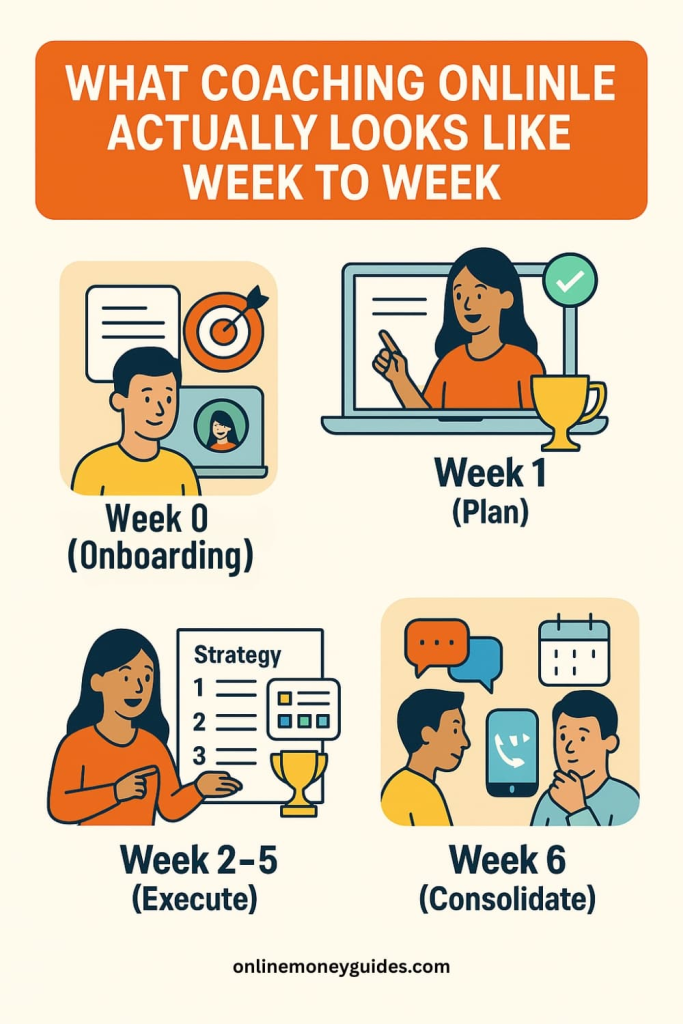
Let’s make it tangible. A typical 6-week hybrid engagement might run like this:
- Week 0 (Onboarding): intake form (10 minutes), goals, baseline metrics, expectations, and a quick tech check (Zoom/Meet + Calendly + payment link).
- Week 1 (Plan): You present a focused strategy: 3–5 actions, a small dashboard, and “win #1” for momentum.
- Weeks 2–5 (Execute): weekly 45-minute calls to review progress, remove blockers, and assign next steps; async nudges via Voxer/Slack/Email for accountability.
- Week 6 (Consolidate): review outcomes, document what worked, set a maintenance rhythm, and discuss renewal or next phase.
That’s it—simple, human, and effective. You can run this container with a lean stack under $100/month (we’ll detail it in the next sections), and you can deliver it from anywhere with a stable internet connection.
Money Talk: Realistic Numbers for Beginners
Clarity beats vagueness, so let’s anchor to ranges you can adapt:
- Starter package (4–6 weeks): $600–$1,200 if you’re newer, rising to $1,500–$2,500 with proof.
- Monthly advisory/retainer: $500–$2,000/month depending on scope and access.
- VIP Day/Intensive: $1,500–$5,000 for a focused build/implementation.
These are not ceilings; they’re honest starting points. Your pricing should reflect the value of the result, not how many hours you spend. If your process typically creates a $3,000–$10,000+ improvement for the client (revenue increased, time saved, costs reduced), pricing at 10–30% of that value is fair and sustainable.
Why Clients Buy (So You Can Sell Without Feeling “Salesy”)
Clients don’t buy sessions; they buy progress with less friction. They want a shorter path, fewer mistakes, and someone they trust in their corner. Your job is to articulate a before/after they recognize, and to show enough proof that they believe it’s possible for them. When your website copy, DMs, and discovery calls all point to a single transformation, selling feels like inviting and convincing.
Next Steps: Pick a lane (coach, consultant, or hybrid) and write your one-sentence promise: “I help [who] go from [before] to [after] in [timeframe] without [big fear].”
Find Your Profitable Niche & Promise (2026 Edition)
You don’t need the “perfect” niche to start online coaching and consulting. You need a useful one with a clear outcome and people willing to pay to reach it. Think of this section as a fast filter: we’ll narrow from “things you could do” to “an outcome you can confidently promise in 4–12 weeks.”
Where You Win: Align Skills, Demand, and Willingness to Pay
Start with three overlapping circles:
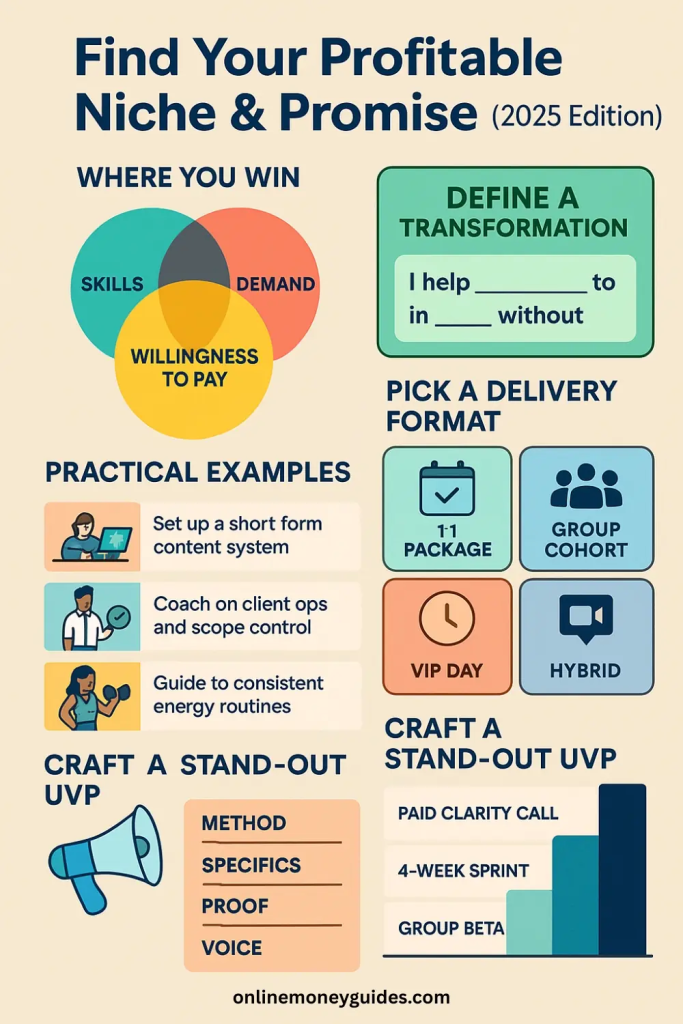
(1) Skills you can deliver today, (2) problems people already search for, and (3) budgets that match the stakes. If you’ve delivered results at work or for yourself, you can translate that into a niche.
Practical examples you can adapt:
- A content creator who has created 100+ TikToks can help small businesses set up a 30-day short-form content system.
- A former project manager can coach freelancers on client ops and scope control to stop scope creep.
- A fitness enthusiast who maintained a 20-lb weight loss can guide busy professionals to consistent energy routines.
For demand, skim search results, Reddit threads, LinkedIn groups, and product reviews to see what people actually ask. If the problem appears in multiple places and people swap templates, scripts, or checklists, there’s usually room for coaching online or a consulting solution. Willingness to pay is tied to stakes: career moves, revenue growth, time savings, health, and confidence—all have clear value, which supports healthy pricing.
Clarity around your niche not only makes marketing easier but also helps you stand out from competitors. Our niche selection guide breaks this down step by step.

Define a Clear Transformation Statement
Move from “I help with marketing” to “I help one-person businesses publish 2 short videos per week and book 3 discovery calls within 30 days without spending on ads.” Use this fill-in-the-blank and speak directly to the after state:
I help [who] go from [frustrating before] to [specific after] in [timeframe] without [big fear].
Keep it on your site, your booking page, and your DMs. It’s the North Star of your online coaching and consulting offer.
Pick Your Delivery Format
Format is the container around your promise. Choose the one that best fits the result:
- 1:1 package (4–8 weeks): fastest way to proof. Great for career pivots, content systems, and habit change.
- Group cohort (4–6 weeks): your method + peer momentum; ideal when steps are repeatable.
- VIP Day/Intensive (4–6 hours): a focused build, e.g., revamp a LinkedIn profile, set up an analytics dashboard, or create a weekly content pipeline.
- Hybrid: strategy call + weekly execution check-ins; terrific for beginners and busy clients.
Craft a Stand-Out UVP (Unique Value Proposition)
Two people can offer “lead gen coaching,” but your UVP separates you:
- Method: a three-step framework with names clients remember.
- Specifics: “No cold calls,” “Async only,” “Content in 60 minutes/week.”
- Proof: case snippets, numbers, screenshots (blurred as needed).
- Voice: empathetic, plain-spoken copy that makes people exhale.
The best UVPs are true and visible. Don’t bury your differentiators three scrolls down; front-load them.
Beginner-Friendly Offer Ladder
Start small, deliver big, and climb steadily:
- Paid Clarity Call ($49–$149): 30–60 minutes to diagnose and outline next steps. Credibility builder and low-risk entry.
- 4-Week Sprint ($600–$1,200): one promise, weekly calls, async support, results tracked on a one-page dashboard.
- Group Beta ($197–$497 per seat): 4–8 participants running the same playbook. Gather testimonials and refine your curriculum.
Validation can be as simple as 10 quick interviews with your target audience, 10 warm DMs offering the Clarity Call, and 3 paid clients in your first month. No fancy funnel needed.
Next Steps: Write your one-sentence promise and pick the first container you’ll sell it in.
Lean Tech Stack to Start Coaching Online (Under $100/Month)
You can launch online coaching this week with a handful of reliable tools. Skip shiny-object syndrome, choose the easiest path you’ll actually use. Below is a lean stack that keeps you under ~$100/month to begin, with room to upgrade once revenue is consistent.
Website & Booking (Simple > Fancy)
- Landing/Website: Carrd (Pro from ~$19/year) or WordPress on affordable hosting. One page is enough: promise, proof, process, pricing hints, and a “Book a Call” button.
- Scheduling: Calendly (from ~$10–$16/month) or TidyCal (often a low one-time). Embed it on your page so booking is frictionless.
- Forms: Tally or Typeform (free tiers available) for intake and pre-work.
Set it up once and let your content, emails, and DMs point to one booking link.
Video & Communication (Synchronous + Async)
- Calls: Zoom (free for short sessions) or Google Meet (via Gmail/Workspace).
- Async check-ins: Voxer, Loom, or Slack. Loom lets you record 2–5 minute feedback videos that clients can rewatch.
- Notes: Notion or Google Docs creates a shared hub for goals, session notes, and action items.
Clients love consistent rhythm: a weekly call + a mid-week async nudge keeps momentum high without blowing up your calendar.
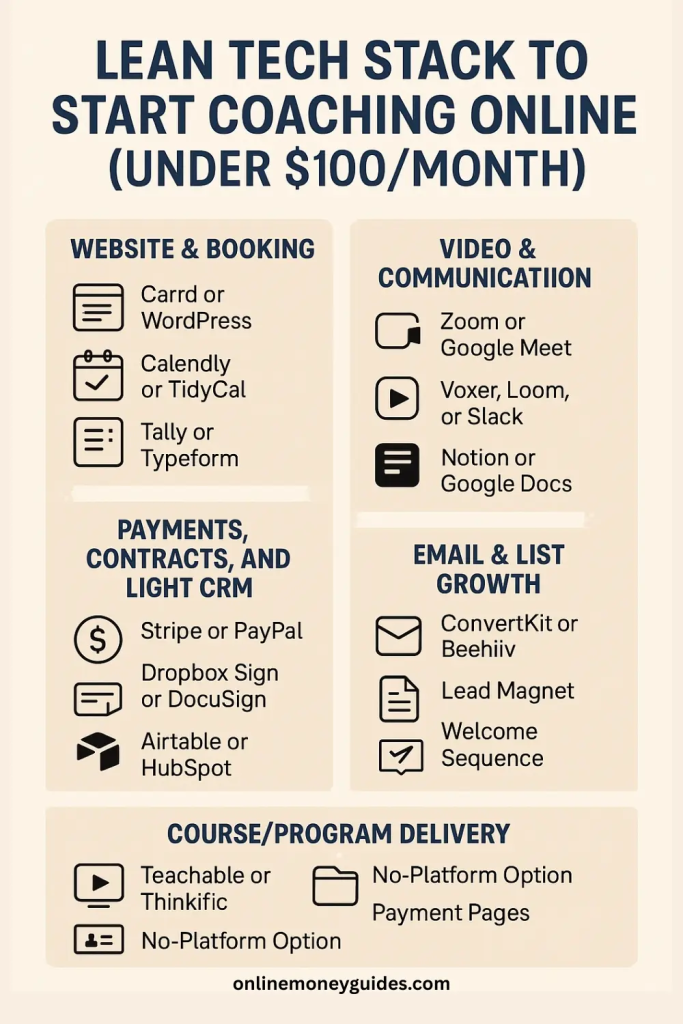

Payments, Contracts, and Light CRM
- Payments: Stripe or PayPal (typical ~2.9% + $0.30 fee in the U.S.). Offer pay-in-full and 2–3 monthly payments.
- Contracts & e-sign: Dropbox Sign/HelloSign or DocuSign (starter tiers). Use plain-English contracts: scope, schedule, refund, reschedule, and IP clauses.
- CRM/Tracking: Airtable, Notion, or HubSpot Free for pipeline and client status. You don’t need a heavyweight CRM to start.
Add a simple “checkout + contract + scheduler” flow: client pays, signs, and books in one sitting.
Email & List Growth (Own Your Audience)
- Email Service: ConvertKit or Beehiiv both have free or low-cost starter tiers.
- Lead Magnet: pick something that shortens time-to-value: a scorecard, an audit checklist, or a one-page playbook.
- Welcome Sequence (5 emails): (1) Your story + promise, (2) Small win, (3) Case snippet, (4) How to work with you, (5) Invitation to book a call.
Aim for 30–100 subscribers in your first month simply by linking your lead magnet in your bio, posts, and DMs.
Course/Program Delivery (Only If Needed)
- Platforms: Teachable, Thinkific (entry tiers around $39–$59/month); Kajabi if you want an all-in-one later.
- No-platform option: deliver your materials in a clean Notion portal or Google Drive folder and keep live sessions on Zoom.
- Payment pages: ThriveCart (often lifetime deals), Lemon Squeezy, or Gumroad if you prefer “paywall + download” simplicity.
Start with live delivery. If clients get results and ask for more, then turn it into a course or membership.
A Tiny Cost Map (Starter Options)
| Category | Tool | Typical Starter Cost |
| Site | Carrd Pro | ~$19/year |
| Booking | Calendly | ~$10–$16/month |
| Video | Zoom/Meet | Free–$15/month |
| Payments | Stripe/PayPal | Per-transaction |
| ConvertKit/Beehiiv | Free–$29/month | |
| E-sign | Dropbox Sign | ~$15–$20/month |
| CRM | Notion/Airtable | Free–$12/month |
You can stay under $75–$100/month comfortably by mixing free tiers and one-time tools, then upgrade as revenue grows.
60-Minute Setup Checklist
- Buy a simple domain and connect it to a one-page site (promise, proof, process, button).
- Embed your Calendly or TidyCal link and set 2–3 time windows per week.
- Create a Stripe payment link for your starter package and add it to your confirmation email.
- Paste a 3-question intake form in the booking confirmation (goal, current state, biggest obstacle).
- Draft your welcome email with Zoom link + a brief “how to prepare”.
- Create a shared Notion or Google Doc template for session notes and action items.
Next Steps: Set up your one-page site + scheduler today so every post and DM can point to a real booking.
Pricing & Packaging With Real Numbers (No Guessing)
Pricing is not a personality test; it’s a strategy. In online coaching and consulting, your number should reflect the value of the outcome, not how long Zoom is open. The easiest way to stop second-guessing is to anchor to clear packages and tie them to specific results.
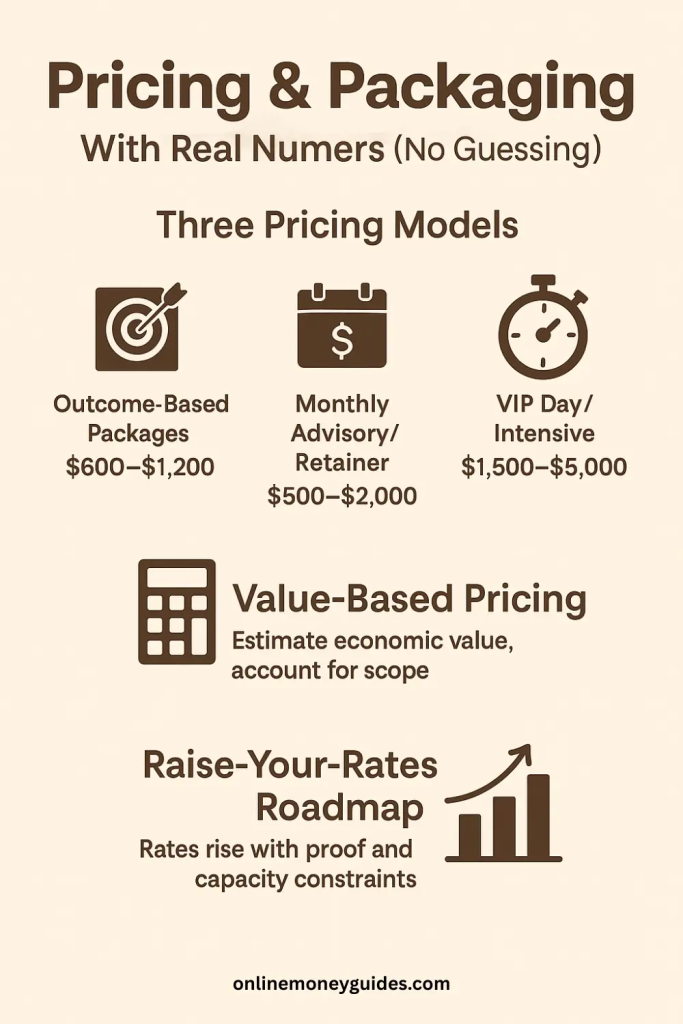
Three Pricing Models You Can Use Today
Start with one model and add others as demand grows.
Outcome-Based Packages
Bundle your work around a single promise with a defined timeline. A common beginner range is $600–$1,200 for 4–6 weeks when you’re newer and still collecting proof. As you stack testimonials and refine your process, $1,500–$2,500 for 6–8 weeks becomes realistic for a focused transformation (e.g., “From inconsistent posting to 8 short videos published and 3 discovery calls booked in 30 days”).
Monthly Advisory/Retainer
When clients want ongoing access and accountability after the initial lift, a retainer of $500–$2,000/month makes sense depending on cadence (biweekly vs weekly calls), async support, and complexity. Retainers work well if you’re an online consultant helping with systems, analytics, or recurring planning.
VIP Day/Intensive
If you excel at fast implementation, offer a 4–6 hour sprint for $1,500–$5,000. You’ll prepare beforehand, deliver a concrete deliverable (e.g., revamp LinkedIn profile and outreach plan, stand up a Notion-based content pipeline), and include a short follow-up window.
Think of these like different containers for the same value: clarity + plan + execution support. Pick the one that fits your promise and your energy.
Value-Based Pricing Without Overthinking
A quick method to sanity-check your price:
- Estimate the economic value of the outcome (revenue gained, time saved, costs avoided). Example: if your funnel audit commonly adds $1,500–$6,000 over 90 days, a package at $750–$1,800 (roughly 12–30% of the expected gain) is reasonable.
- Account for scope (calls, async support, templates, done-with-you build).
- Consider risk reversal (milestone-based refunds, or a “continue free for 2 weeks if we miss [a fair leading indicator]”). You don’t need guarantees to sell, but a thoughtful policy can increase conversions early on.
Avoid hourly pricing; it subconsciously incentivizes inefficiency. Your clients don’t want hours; they want outcomes.
Raise-Your-Rates Roadmap
Rates rise with repeatable proof and capacity constraints:
- Phase 1 (First 5 clients): keep scope tight, collect results and testimonials, and document your framework.
- Phase 2 (Clients 6–15): raise package price by 20–30%, add a VIP Day, and test a light retainer.
- Phase 3 (Booked out 2–4 weeks): Raise another 15–25% and introduce a small group program to increase leverage without burning time.
A practical rule: when you’re closing >50% of qualified discovery calls and your calendar is full for two weeks, it’s time to bump your price.
Pricing is one of the hardest parts of building a coaching business. Charge too little and burn out; charge too much and stall growth. If you want clear benchmarks, formulas, and examples, see our full breakdown on how to price your online coaching services in 2026.
Next Steps: Choose a package price today and stick with it for your next 5 sales. Refine the offer, not the number between calls.
Credibility Fast-Track: Proof Without Years of Experience
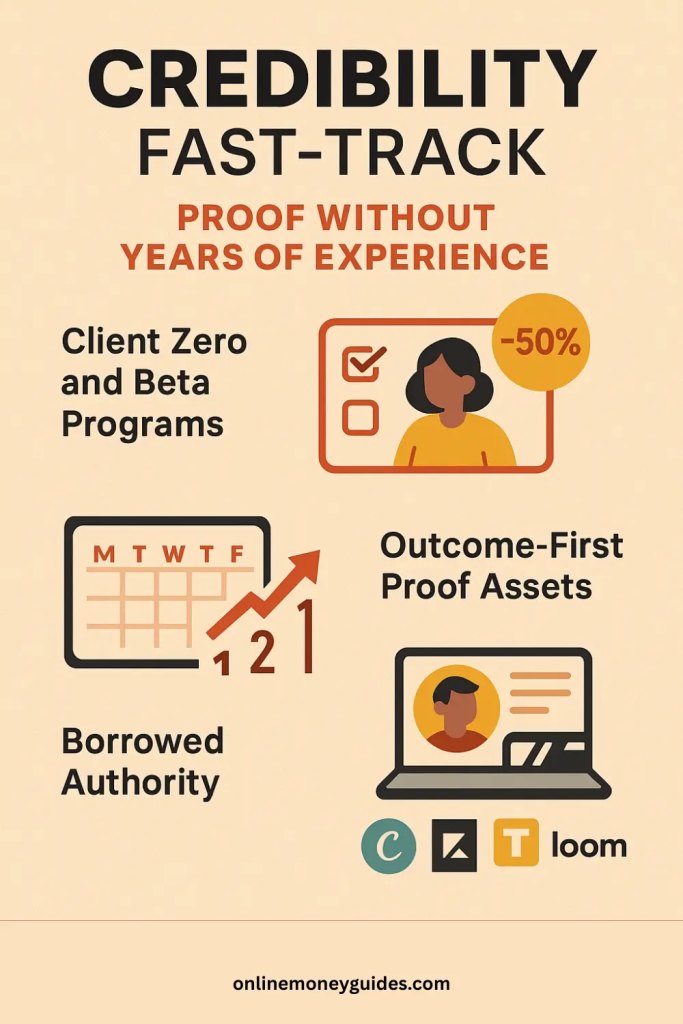
You don’t need a wall of certificates to win trust. You need evidence that your process works and a handful of people saying, “Yes, that helped.” Here’s how to earn that quickly and ethically when you’re new to coaching online.
“Client Zero” and Beta Programs
Start with a paid beta (not free) to ensure buy-in. Offer a reduced rate in exchange for honest feedback and permission to share anonymized results. Make the promise specific and the scope tight: one problem, one method, one clear metric. Aim for 3–5 beta clients over 30–45 days so you can iterate fast.
How to fill your beta: DM previous colleagues, warm contacts, or people who engage with your content. Your message can be as simple as, “I’m running a focused 4-week sprint to help [who] go from [before] to [after]. I have 3 discounted spots while I formalize the framework, curious?”
Outcome-First Proof Assets
Proof isn’t only testimonials. It’s any artifact that shows movement from before to after:
- A screenshot of a calendar going from zero to “3 discovery calls booked.”
- A content dashboard showing “8 videos published” in 30 days.
- A budget sheet reducing monthly expenses by $350.
- A portfolio update resulting in “2 interviews scheduled” this week.
Turn these into mini case snapshots: 3–5 bullet lines with context, action, and results. Place them above the fold on your site and inside your discovery call deck.
Borrowed Authority, Ethically
You can “borrow trust” without faking it:
- Guest sessions for a creator’s audience or a community your clients already follow.
- Co-branded workshops where you teach one step of your method.
- Platform endorsements: list tools you’re proficient with (Canva, ConvertKit, Teachable, Notion, Calendly, Loom). If you’re an online consultant who specializes in a platform, showcase that niche clearly.
Don’t overcomplicate. Two strong testimonials + two tangible snapshots + one guest session can carry your first 90 days.
Next Steps: Run a 4-week paid beta with 3–5 clients and collect one proof asset per person.
Your Simple Marketing Engine: Audience → Assets → Appointments
Marketing feels complex because we try to do everything at once. Your online coaching and consulting business needs a simple engine that moves strangers into appointments consistently. Think of three parts: where people find you (Audience), what proves you can help (Assets), and how they book (Appointments).
Searchable Content That Attracts Ready Buyers
You don’t need a content empire. You need one pillar piece that ranks for a buyer-intent topic and 3–5 support pieces that answer adjacent questions. If you prefer video, the same applies to YouTube; if you’re on TikTok or Reels, think of a 5-part series that solves a single problem start to finish.
Examples of high-intent topics:
- “How to create a 30-day content system” (for creators and small businesses).
- “How to switch careers into [role] without going back to school.”
- “How to build a weekly energy routine for busy professionals.”
Within each, show a bit of your method, one quick win, and a clear CTA: Book a Clarity Call. Link your Calendly in the first screenful or the video description. If you use WordPress, add a sticky button. If you use Carrd, repeat the button at the top and bottom.
A basic target to validate the channel: 1–3 discovery calls per 100–200 targeted visitors or 2–5% of warm viewers. If you’re far below that, tighten the topic and make the transformation more concrete.
Social That Sells (TikTok, Instagram, LinkedIn)
Choose one primary platform where your buyers already hang out. Use a simple rotation so your feed builds trust over time:
- Story posts that show you understand the problem (the “exhale” moment).
- Proof posts (mini case snapshots, behind-the-scenes of client wins).
- Teaching posts (one step from your method with a small exercise).
- Offer posts (clear invitation to book, with who-it’s-for and outcome).
On LinkedIn, aim for 3 posts/week and 10 comments/day on ideal client posts. On TikTok/IG, aim for 3–5 short videos/week with one clear hook and one call-to-action. Use Canva for clean carousels and CapCut or Instagram’s Edits app native editors for video.
Email List That Warms Leads
Your list is where strangers become clients over a few weeks. Use ConvertKit or Beehiiv and deliver a 5-email welcome sequence:
- Your story + the big promise,
- A tiny quick win,
- A case snapshot,
- Your method explained simply,
- An invitation to book a call.
Email weekly after that with one story, one lesson, and one link to your scheduler. A healthy early metric is 20–35% open rates and 1–3% click-through to your booking page on invitation emails.
Partnerships & Light Outbound
Not every client will “find” you. Meet them halfway:
- Offer a free 20-minute training to a small community that already serves your target (e.g., a coworking space, Slack, a niche newsletter).
- Start value-first DMs: share a relevant resource you made (checklist, template), ask a context-aware question, and invite a call only if the problem is present.
Outbound works best when you’ve posted useful content recently for people to check your profile.
Marketplaces for Early Momentum
If you want conversations quickly, list on Clarity.fm, Contra, or Upwork (Expert-Vetted or niche categories). Craft a tight profile headline using your transformation statement. Send proposals that address the brief line-by-line and suggest a short paid diagnostic as the first step.
Don’t build your entire business on platforms, but they can jump-start proof and cash flow in month one.
Next Steps: Publish one pillar piece this week, rotate 3 social posts, and add your booking link in every bio and description.
Lead Generation Playbooks You Can Run This Week
You don’t need complicated funnels to get clients for online coaching and consulting. You need a way to start helpful conversations with the right people and a simple path to book a call. Run one of these playbooks for five straight days, and you’ll learn more than a month of passive tweaking.
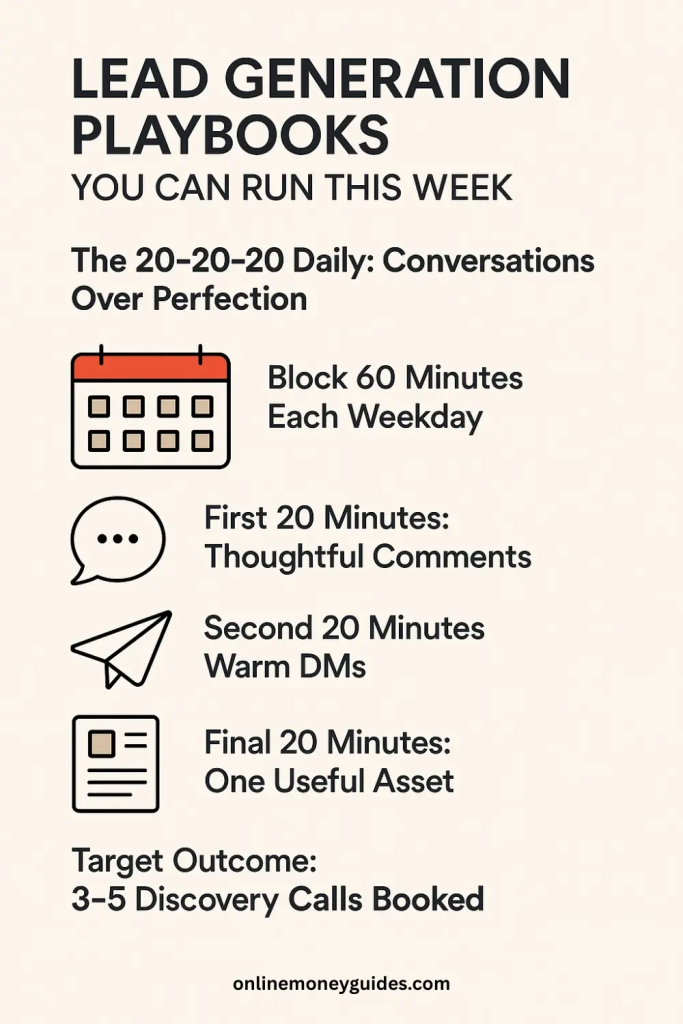
The 20-20-20 Daily: Conversations Over Perfection
Block 60 minutes each weekday and run this rhythm:
First 20 minutes: thoughtful comments.
Find ten relevant posts from your niche (LinkedIn, Instagram, X, Reddit). Leave comments that add substance: a quick framework, a clarifying question, or a tiny case example. The goal isn’t visibility; it’s credibility, so others click through to your profile and booking link.
Second 20 minutes: warm DMs.
Send 5–10 messages to people who engaged with your comment or content. Reference their situation specifically and share a small resource you made (a checklist, a 2-minute Loom). Don’t pitch out of the gate. Create value and ask one context-aware question.
Final 20 minutes: one useful asset.
Deliver something that helps your exact buyer: a 400–700-word post, a one-page Notion template, or a short video solving a micro-problem. Add a soft CTA: “If you want help implementing this in 4 weeks, book a Clarity Call here.”
Target outcome: 3–5 discovery calls booked in your first two weeks, even with a small audience, because you’re focusing on depth, not volume.

The 5-Message DM Framework (From Stranger to Call)
Use this when a prospect engages with your content or asks a question in public. Keep sentences short and human.
- Micro-value:
“Loved your post about inconsistent content. Here’s a 1-page weekly checklist my clients use to publish in ~90 minutes, want it?” - Relevance bridge:
“Curious, are you trying to book more discovery calls, or is this more about brand consistency right now?” - Soft ask:
“If you want, I can peek at your last 10 posts and share 2 fixes that usually boost calls without posting more.” - Proof drop:
“Did this with a solo creator last month. Eight short videos in 30 days, 3 calls booked. Takes about 20 minutes to review.” - Invite to book:
“If a quick audit would help, here’s my calendar. We’ll map 3 steps you can implement this week.”
This is permission-based selling. You’re not pushing; you’re guiding. For coaching online, this respectful tone matters, and people remember how you made them feel before they buy.
Discovery Call That Converts (Outline + Questions)
Your goal isn’t to “close at all costs.” It’s to decide together if your online coaching and consulting container can create the outcome they want. Here’s a clean 25–35 minute flow you can copy:
1) Align (3 minutes)
“Here’s how we’ll use the time: understand your goal, clarify roadblocks, and map next steps. If it’s a fit, I’ll share how I can help; if not, I’ll point you to a resource.”
2) Outcome (5 minutes)
“What does success look like in 4–8 weeks?”
“What would change day to day if we solved this?”
3) Current state (7 minutes)
“What have you tried? What worked a little? What got in the way?”
“If we did nothing for 60 days, what’s the cost?”
4) Gaps + plan (10 minutes)
Reflect on their words and outline three steps to move forward. Keep it simple: “Based on what you shared, I’d focus on X, Y, Z.” This is valuable even if they don’t hire you.
5) Invitation (5 minutes)
“I run a 4-week sprint where we implement exactly this: weekly 45-minute calls, async check-ins, and a shared dashboard. Most clients see [leading indicator] by week two. It’s $1,200 or 2 payments of $650. Want me to walk through details?”
Handle objections calmly: timelines, price, bandwidth. Offer two options (start now, or start next month with a prep checklist). Send a same-day recap with your Stripe link, contract, scheduler, and a gentle deadline to claim the current price.
Next Steps: Block one hour tomorrow, run the 20-20-20, and send 5 micro-value DMs using the framework above.
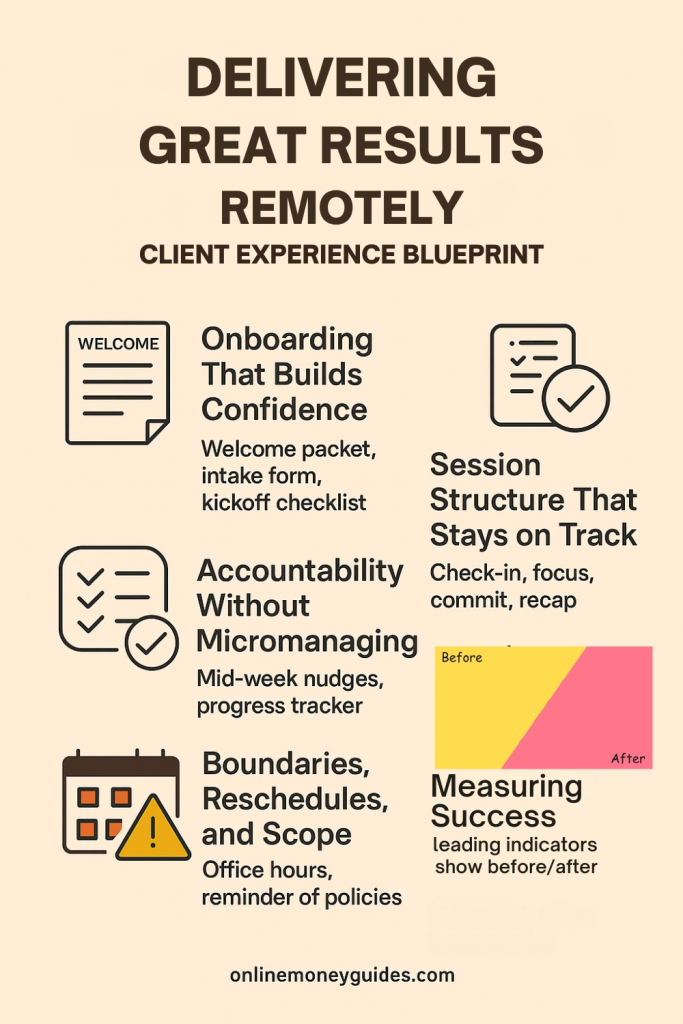
Delivering Great Results Remotely (Client Experience Blueprint)
Retention and referrals come from a predictable client experience that feels personal. Think of your service like a small product: clear onboarding, consistent sessions, light accountability, and respectful boundaries. This is where your online coaching and consulting business becomes sustainable.
Onboarding That Builds Confidence
Right after payment, send a warm welcome and make the next steps unavoidable:
- Welcome packet (one page): what’s included, what’s not, how to get the most from coaching online.
- Intake form (3–6 questions): goal in one sentence, current baseline, top obstacles, preferred communication style.
- Kickoff checklist: book first two calls, join the shared workspace (Notion/Drive), skim a 2-minute Loom on how you’ll work together.
Add a baseline metric on day one: content delivered/week, outreach done, hours slept, steps walked—whatever matches the promise. It primes the brain to look for improvement.
Session Structure That Stays on Track
A reliable rhythm beats “inspiring” but chaotic sessions. Use the same outline every time:
- Open (5 min): quick check-in and wins.
- Focus (30 min): one obstacle or decision; teach a tool if needed.
- Commit (5–7 min): define 2–3 concrete actions and a confidence rating (1–10).
- Recap (2 min): you summarize, they confirm, you log actions in the shared doc.
Short, focused, repeatable. Your clients know what to expect and can feel progress weekly. That’s addictive in the best way.
Accountability Without Micromanaging
Accountability is the “secret spice” of a great online consultant or coach. Keep it lightweight:
- Mid-week nudge: a templated message—“What’s the one thing you’ll deliver by Friday?”
- Progress tracker: a simple checkbox table in Notion or a Google Sheet with dates and outcomes.
- Review cadence: every 2 weeks, look at the dashboard together and adjust. Momentum > perfection.
When a client stalls, don’t shame. Shrink the step, remove friction, and celebrate completion.
Boundaries, Reschedules, and Scope
Clear policies protect the relationship:
- Office hours & response time: e.g., replies within 24 business hours, no weekends.
- Reschedule window: 24–48 hours’ notice; missed sessions are forfeited unless an emergency.
- Scope clarity: If they ask for something big (a full rebuild), either fold it into a VIP Day or schedule a new phase.
Put policies in the contract and restate them kindly in the welcome packet. Clients respect what you model.
Measuring Success (So Results Are Undeniable)
Define leading indicators you can influence quickly (outputs), not just end results (outcomes). For example:
- Career: number of targeted reach-outs, interviews scheduled.
- Business: videos published, discovery calls booked, proposals sent.
- Wellness: workouts completed, average nightly sleep, steps.
Show the before/after in a single screenshot at the end. This becomes a mini case study (with permission) and fuels your marketing flywheel.
Next steps: Template your onboarding email, intake form, and session outline today. Future you will thank you.
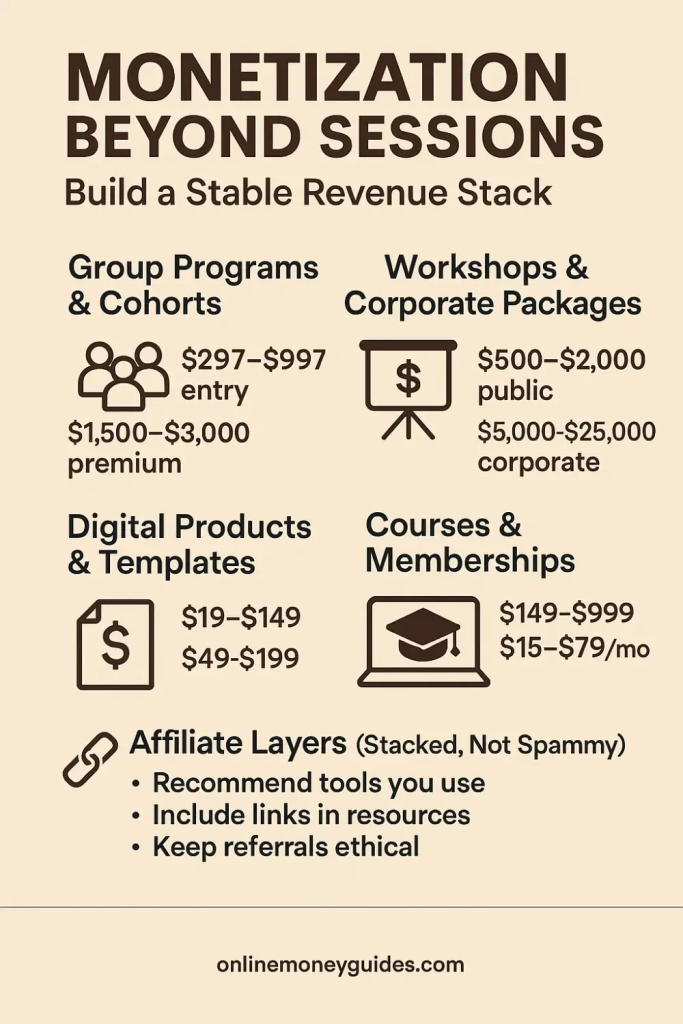
Monetization Beyond Sessions: Build a Stable Revenue Stack
Sessions are a great start, but the safest online coaching and consulting businesses aren’t dependent on one-on-one hours. Think like a product manager: which containers deliver the same transformation with less scheduling friction and more scalability? Layer two or three of the options below so one slow month doesn’t derail your income.
Group Programs & Cohorts
Group containers deliver your method once to many people while preserving a live, human experience. Start small with 4–8 participants so you can personalize without drowning in logistics.
- Entry-level cohorts: $297–$997 per seat for 4–6 weeks, one weekly call, and a simple workbook or Notion hub.
- Premium cohorts: $1,500–$3,000 per seat when you’ve proven outcomes and added elements like hot seats, async feedback, and a light alumni community.
When to use: your steps are repeatable, peers can learn from each other, and you want to leverage without building a course yet.
Workshops & Corporate Packages
Workshops give you “burst” revenue and exposure. Corporate buys reduce sales effort per seat.
- Public workshops: $500–$2,000 for a 90–120 minute session (includes slides, templates, and a Q&A).
- Corporate bundles: $5,000–$25,000 for a tailored series (e.g., 3 workshops + office hours + manager debrief). Price by scope and expected impact, not by minutes on Zoom.
When to use: your topic has team-wide value (content systems, leadership habits, sales enablement, wellness basics), and you can map ROI to business outcomes.
Digital Products & Templates
Small, focused tools that accelerate the win. Zero scheduling required.
- Checklists, swipe files, calculators, Notion/Google Sheet templates: $19–$149.
- Mini playbooks (20–40 pages or 45–90 min video): $49–$199.
Pair each product with a “next step” offer—book a Clarity Call, join a sprint, or upgrade to a group program. This is a powerful way to qualify leads who already value your approach.
Courses & Memberships
Courses package a repeatable method; memberships package ongoing support and community.
- Courses: $149–$999 depending on depth, support, and assets (templates, live Q&A).
- Memberships: $15–$79/month for a community with monthly live “implementation hours,” a library of resources, and office hours.
Pro Tip: Build the course after you’ve run the cohort 1–2 times. You’ll know what people actually need.
Affiliate Layers (Stacked, Not Spammy)
Recommend tools you genuinely use while you’re coaching online or consulting. Place links in your onboarding docs, templates, and workshop resources, not just blog posts.
Starter-friendly affiliate programs to consider:
- Amazon Associates: books, webcams, mics, lighting, whiteboards.
- Canva: design templates your clients will duplicate.
- ConvertKit/Beehiiv: email service for lead magnets and newsletters.
- Teachable/Thinkific/Kajabi: course delivery if clients decide to productize.
- Loom: async video walkthroughs.
- Notion/Calendly: client hubs and scheduling.
- Web hosting/WordPress themes: if you help solo businesses get visible.
Expect modest $4–$10 per referral on low-ticket items and 10–30% recurring on SaaS, depending on the program. Keep it ethical: disclose, recommend only what you trust, and prioritize the client’s best fit over commission.
Quick Monetization Map
| Stream | Typical Price | Pros | Best Use Case |
| 1:1 Package | $600–$2,500 | Fastest to start, highest personalization | First proof and testimonials |
| VIP Day | $1,500–$5,000 | Cash infusions, clear deliverables | System build or deep audit |
| Group Cohort | $297–$3,000/seat | Leverage + community | Repeatable steps, peer learning |
| Workshop (Public) | $500–$2,000 | List growth + revenue | Topic with a clear 90-min win |
| Corporate Bundle | $5,000–$25,000 | Larger contracts | Team outcomes tied to KPIs |
| Templates/Playbooks | $19–$199 | Passive, lead qualifier | Micro problems with DIY energy |
| Course | $149–$999 | Scalable education | Battle-tested method |
| Membership | $15–$79/mo | Predictable MRR | Ongoing support + updates |
| Affiliate | % varies | Layered, low effort | Tools you truly use |
Next Steps: Add one leveraged offer (group, workshop, or template) alongside your 1:1 this month.
Legal, Ethics, and Safety (Keep It Clean and Clear)
Boring? Maybe. Essential? Absolutely. Clear boundaries and light legal hygiene protect you, your clients, and your reputation. You don’t need to be a lawyer to run online coaching and consulting safely. You need simple, written agreements and a habit of staying in your lane.
Scope of Practice & Disclaimers
Define what you do and what you don’t.
- Coaching: facilitation, tools, and accountability for behavior change.
- Consulting: analysis, recommendations, and sometimes implementation.
- Not included: medical, legal, or mental health treatment unless you’re licensed; even then, keep services separate.
Add a short disclaimer to your site and contract clarifying this scope and encouraging clients to seek licensed support when appropriate.
Contracts, Payments, and Refunds
Use plain-English agreements that cover:
- Scope & deliverables: what’s included (calls, async support, assets).
- Schedule & rescheduling: how to book, time zones, no-show policy.
- Payment terms: pay-in-full or installment plan, late fees, and what triggers work to begin.
- Refunds: milestone-based (e.g., before week 2) or “no refunds after access,” depending on your offer. Clarity beats case-by-case haggling.
- IP & confidentiality: who owns what and how information is stored.
Tools: Dropbox Sign/HelloSign, DocuSign for signatures; Stripe/PayPal for payments. Keep receipts and contracts in a client folder (Drive/Notion).
Business Basics
- Entity & EIN: Many U.S. solopreneurs start as sole proprietors and later form an LLC for liability protection and cleaner separation.
- Banking & bookkeeping: use a separate bank account; track income/expenses with QuickBooks, Wave, or Xero (starter tiers work fine).
- Insurance: Look into professional liability (errors & omissions) coverage if your advice materially affects revenue or operations.
None of this needs to be fancy on day one. Start simple and professionalize as revenue grows.
Data & Privacy
Your clients trust you with personal info. Honor that.
- Store notes in secure tools (Google Drive, Notion) with 2FA enabled.
- Collect the minimum necessary data—only what supports the engagement.
- Avoid sharing client stories without permission; anonymize details in case studies and screenshots.
- If you record calls, ask first and state how the recordings will be used/stored.
Next Steps: Create a 1-page “Working Together” policy (scope, schedule, payments, data) and link it in your welcome email.
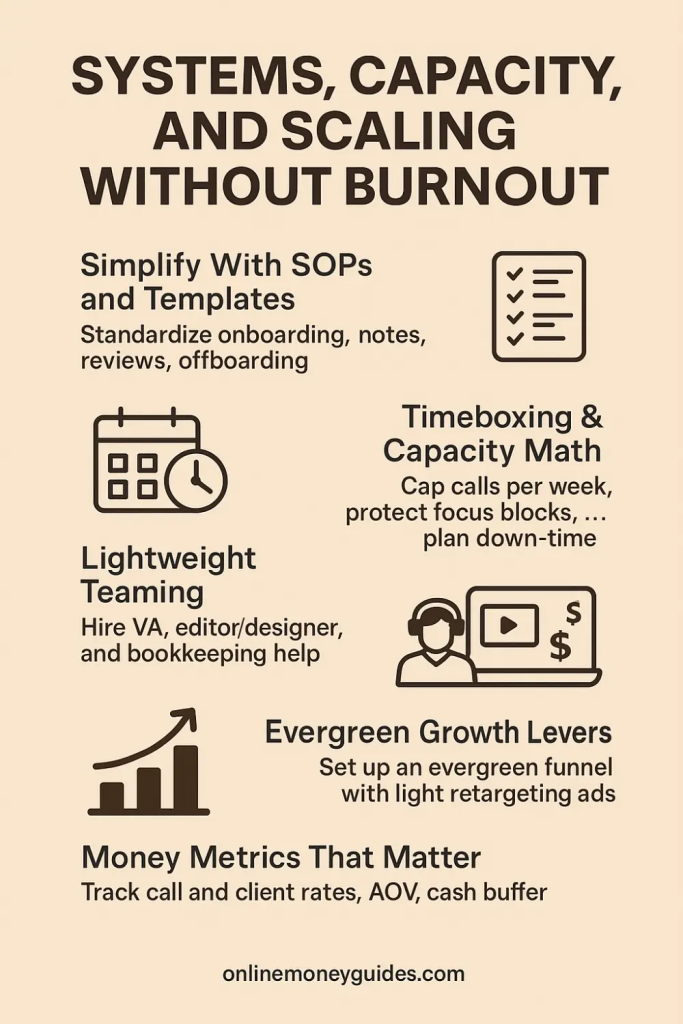
Systems, Capacity, and Scaling Without Burnout
More clients shouldn’t mean more chaos. The best online coaching and consulting businesses feel calm inside because the owner runs simple systems and knows their capacity. Build the machine before you pump more leads into it.
Simplify With SOPs and Templates
Document once, reuse forever. Start with:
- Onboarding SOP: invoice → contract → intake → scheduler → welcome email.
- Session notes template: agenda, decisions, commitments, follow-ups.
- Weekly review: pipeline, active clients, progress snapshots, and content delivered.
- Offboarding checklist: outcomes, testimonial request, renewal options.
House these in Notion or Google Docs and link them to every client workspace so nothing lives only in your head.
Timeboxing & Capacity Math
Capacity isn’t a feeling; it’s math. Try this baseline:
- Deep work blocks: 2 × 90 minutes/day (content, assets, strategy).
- Client calls: max 8–12 45-minute calls/week if you want breathing room.
- Admin & marketing: 1–2 hours/day combined (DMs, email, comments, bookkeeping).
If your average client needs 4–6 calls across a 6-week container, you can comfortably serve 6–10 active clients without running hot, depending on your other commitments. Protect two meeting-free half-days weekly for creative work and recovery.
Lightweight Teaming (When to Hire Help)
Hire for tasks you can document and work you avoid:
- Virtual Assistant (5–10 hrs/week): inbox triage, scheduling, slide formatting, file organization.
- Editor/Designer (project-based): polish course materials, carousels, and templates (hello Canva brand kit).
- Fractional Ops/Bookkeeper: monthly reconciliations, simple dashboards, and reporting.
Start with a contractor trial month and one clear outcome (e.g., “build and maintain the client portal template”). Good help pays for itself by returning your focus to revenue and results.
Evergreen Growth Levers
Once your offer converts, pour gentle fuel:
- Evergreen email sequence: a 6–10 email path from lead magnet to discovery call, sprinkled with case snapshots.
- Webinar mini: a 30–45 minute training that ends with an invite to your sprint or VIP Day. Run it live twice, then automate.
- Retargeting ads (light): when your site converts, send $5–$15/day retargeting traffic to your booking page or webinar replay. Ads amplify a working system; they don’t fix a broken one.
Money Metrics That Matter
Track a few numbers you’ll actually use:
- Lead → Call rate: calls booked per 100 targeted visitors.
- Call → Client rate: qualified discovery calls that become paying clients.
- Average order value (AOV): typical revenue per new client (including add-ons).
- Lifetime value (LTV): what a client spends over 12–18 months (renewals, upgrades).
- Cash buffer: aim for 2–3 months of business expenses; breathe easier and make smarter decisions.
Review monthly; adjust one bottleneck at a time. Your business is a set of small dials, not a mystery.
Next Steps: Block two meeting-free half-days next week to document your onboarding SOP and set your weekly review ritual.
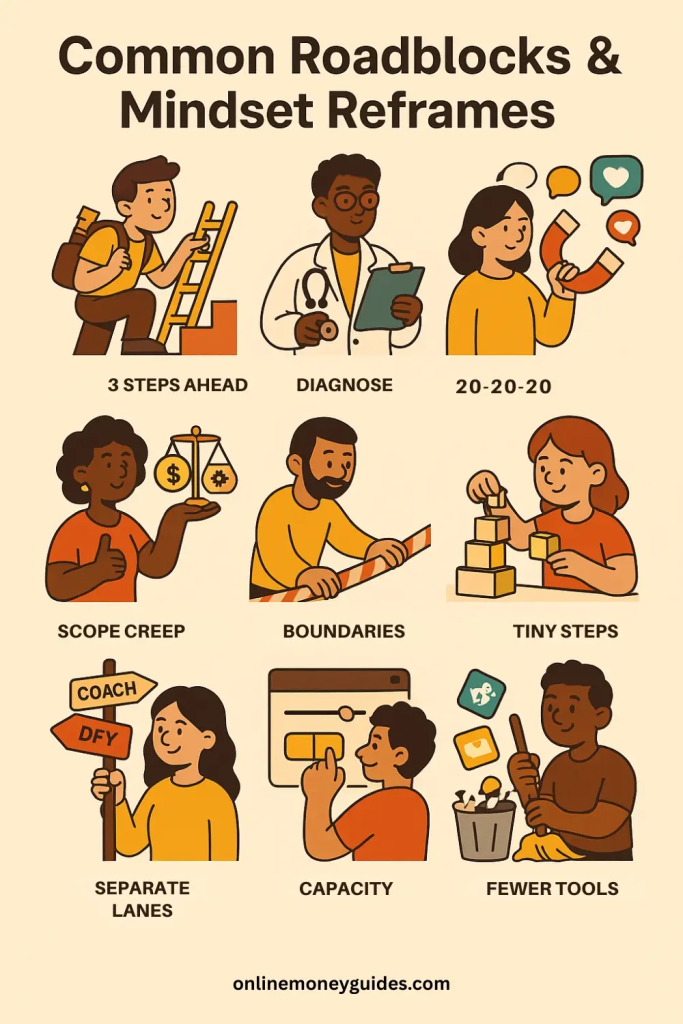
Common Roadblocks & Mindset Reframes
You’re not broken. You’re building a new skill set. Most stalls in online coaching and consulting come from the same handful of friction points. Here are practical fixes and gentle reframes so you keep moving.
“I’m not experienced enough.”
Reframe: You don’t need to be the world’s top expert. You need to be three steps ahead of the person you’re helping. That’s plenty to create value. Start with a narrow, verifiable promise (e.g., “Publish 8 short videos in 30 days and book 3 calls”). Run a paid beta with 3–5 clients, track before/after metrics, and turn each micro-win into a case snapshot. Evidence stacks fast when you define and measure small outcomes.
“I hate selling.”
You probably hate pressure, not selling. Reframe sales as a diagnosis: you and the prospect are deciding if your container can deliver their result. On calls, spend 80% asking about goals, constraints, and past attempts; summarize back what you heard and outline three steps you would take together. If it’s a fit, invite them in. If not, share a resource and say no kindly. Permission-based DMs and clear, outcome-first pages make this feel like helping, not hustling.
“I don’t have an audience.”
You don’t need a big following; you need the right conversations. Run the 20-20-20 rhythm for two weeks: thoughtful comments, value-first DMs, one tiny asset per day. Offer a Clarity Call and host a 30-minute micro-workshop for a partner community. A realistic early target is 3–5 calls/week without any viral posts because you’re showing up where buyers already hang out.
Pricing panic (“What if it’s too expensive?”)
Price the result, not your hours. Anchor your number to a believable fraction of the value you create (often 10–30% of the gain or savings). Use payment plans (2–3 installments) to reduce friction. If you’re still unsure, commit to a number for your next 5 sales while you tighten scope and proof. Raise 15–20% once you’re booked 2–4 weeks out.
Scope creep & boundary drift
Most scope creep is a clarity problem. Fix it at onboarding: one-page scope, what’s included, response times, reschedule rules. When a new request appears, acknowledge it and offer a VIP Day or a Phase 2. Boundaries protect the outcome by keeping your time focused on the promise they bought.
No-shows and low follow-through
Make commitments visible and tiny. End each session with 2–3 actions and a confidence rating (1–10). Add a mid-week nudge (“What’s the one thing you’ll deliver by Friday?”) and keep a simple tracker in Notion or Google Sheets. If a client no-shows, apply your written policy, then reset expectations with warmth and firmness in the next call.
Clients who want you to do it all
If you’re primarily a coach, remember: coaching is not done-for-you. Offer clear language: “I’ll provide the plan, tools, and accountability; you’ll implement and practice.” If you’re acting as an online consultant, package implementation as a separate VIP Day or mini-retainer. Clear lanes keep results clean and resentment low.
Burnout and calendar overload
Capacity is math. Cap weekly calls (often 8–12 max), block two meeting-free half-days, and batch admin. Replace endless custom proposals with one core offer plus two optional add-ons (VIP Day, retainer). When demand rises, raise your rate or shift to a small group cohort before adding more hours.
Tech overwhelm
Pick the fewest tools you’ll use weekly: a one-page site (Carrd/WordPress), scheduling (Calendly/TidyCal), video (Zoom/Meet), payments (Stripe/PayPal), email (ConvertKit/Beehiiv). Learn them once. Everything else is optional. Tools exist to serve your offer and conversations, not the other way around.
Bold next step: Choose one friction point above, apply the fix for 7 days, and re-evaluate—progress beats perfection.
Your Next Three Steps
If you’ve read this far, you already have what you need to start online coaching and consulting this month: a clear promise, a lean stack, and a simple path to clients. Confidence will follow your first few reps—so let’s lock in the next moves.
- Write your transformation statement and pick one container. Keep it narrow and winnable in 4–8 weeks. Put it at the top of your page and in your bio. If you naturally operate as a coach and an online consultant, name your hybrid: “Strategy + weekly execution support.”
- Stand up your booking flow and publish one pillar asset. One page, one scheduler, one payment link. Publish a single helpful post or a 5-part short video series that solves a problem your buyers feel today. Link your booking page in the first screenful. Done is better than dazzling.
- Run the 20-20-20 for five weekdays. Thoughtful comments, value-first DMs, and one small asset daily. Track results. Book 3–5 discovery calls, enroll 2–3 clients (or a tiny group beta), and screenshot micro-wins for proof. That’s your flywheel.
Your business will grow in layers—1:1, then a VIP Day, then a group or template, then an evergreen email or webinar. Keep the promise tight and the experience kind. You’ll be surprised how quickly trust and referrals compound when clients feel seen and supported.
Bold next step: Open your calendar and block 60 minutes tomorrow for 20-20-20—conversations create clients.