Pricing your coaching can feel heavier than building the offer itself. You care about helping people. You want to be fair. You also want this to actually work as a real income stream, not a hobby that quietly drains your time.
This guide is here to remove the guesswork.
We’re going to walk through how to price online coaching services in a way that feels grounded, ethical, and sustainable in 2026.
You don’t need a massive audience. You don’t need certifications stacked a mile high. You do need a pricing approach that matches how online coaching actually works today, not how it worked five or ten years ago.
By the end of this article, you’ll understand:
- Which online coaching pricing models make sense at different stages
- What online coaching rates clients already expect to see
- How to use simple math and psychology to price confidently
- How to stop undercharging without feeling awkward or greedy
Pricing is just one piece of building a sustainable coaching business. This article fits into our broader Ultimate 2026 Guide to Online Coaching and Consulting, where we cover how to start, market, and grow your income long-term.
Let’s start with why pricing feels so confusing in the first place.

Why Pricing Online Coaching Feels So Confusing at First
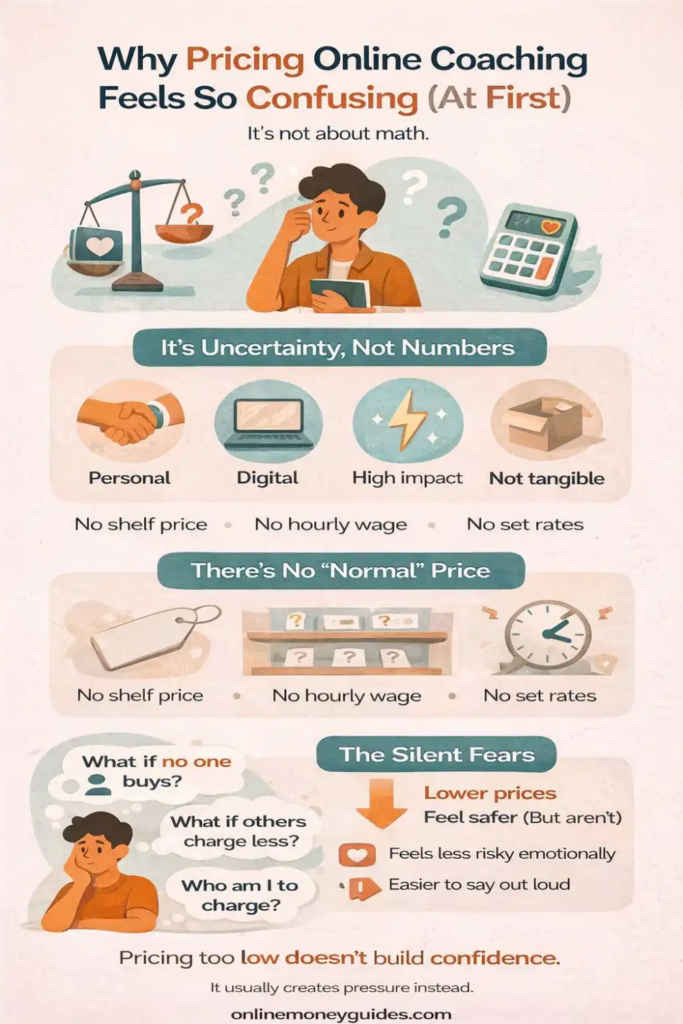
Pricing confusion usually isn’t about math. It’s about uncertainty.
Online coaching sits in a strange middle ground. It’s personal, but digital. It’s high-impact, but not tangible. There’s no shelf price to copy, and no hourly wage handed to you by an employer.
That’s why learning how to price online coaching services often feels like guessing in the dark.
The biggest fears new coaches have around charging money
Most new coaches are quietly dealing with the same worries, even if they don’t say them out loud.
You might be thinking:
- “What if no one buys at this price?”
- “What if someone more experienced charges less than me?”
- “Who am I to charge for this?”
Those thoughts push people toward safer-feeling prices. Lower numbers feel less risky emotionally, even when they’re riskier financially.
The problem is that pricing too low rarely builds confidence. It usually creates resentment, burnout, or constant second-guessing.
Why Googling ‘what should I charge’ rarely gives a straight answer
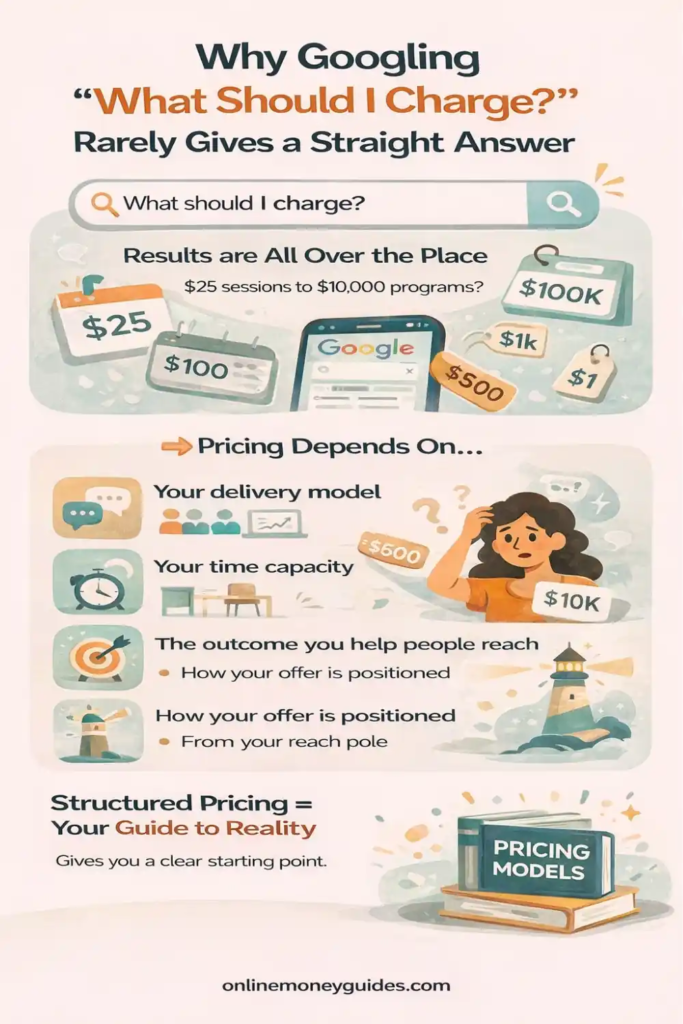
When you search for pricing advice, you’ll see everything from $25 sessions to $10,000 programs. None of it feels anchored to your situation.
That’s because pricing depends on:
- Your delivery model
- Your time capacity
- The outcome you help people reach
- How your offer is positioned
This is where structured pricing models for online coaching matter. They give you a starting point that’s based on reality, not random comparison.
Why Most People Undercharge Their Online Coaching Services
Underpricing is one of the most common mistakes in online coaching, and it usually happens with good intentions.
People think lower prices mean:
- Easier yeses
- Faster clients
- Less pressure to perform
In practice, the opposite often happens.
Undercharging doesn’t make you more attractive, it makes you invisible
Low prices can actually create friction instead of removing it.
When coaching is priced too low, potential clients may:
- Question the quality or seriousness of the offer
- Assume it’s more casual than transformative
- Delay taking action because it feels optional
Healthy online coaching rates signal commitment on both sides. Clients who pay a meaningful amount are more likely to show up, do the work, and get results.
The long-term cost of low online coaching rates
Undercharging creates hidden costs that don’t show up on a spreadsheet right away.
It often leads to:
- Overbooking your calendar to compensate
- Feeling pressure to “overdeliver” to justify the price
- Hesitating to raise rates later because existing clients are anchored low
This is why pricing right from the start matters. Even beginner-friendly prices should respect your time, energy, and expertise.
The 4 Core Online Coaching Pricing Models That Work in 2026
Before we talk about numbers, we need to talk about structure. Pricing problems usually start with the wrong model, not the wrong price.
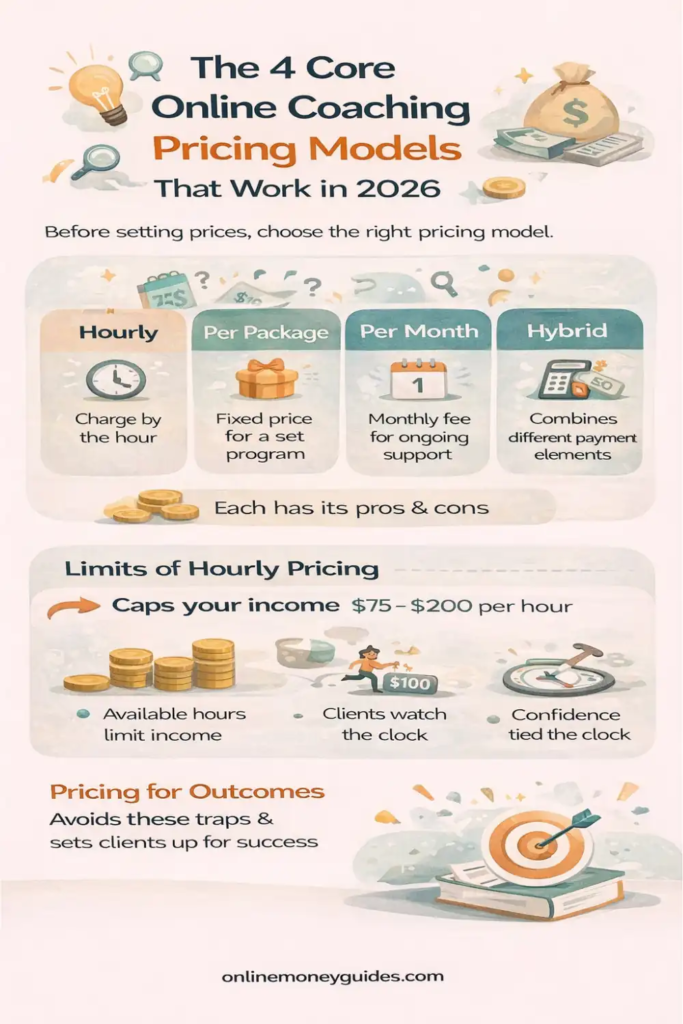
Choosing the right structure makes how to price online coaching services feel clearer and far less emotional. In 2026, these four models show up again and again because they align with how people buy, learn, and commit online.
Hourly pricing and why it limits your income
Hourly pricing feels familiar because it mirrors traditional work. You trade time for money, and the math feels simple.
For online coaching, hourly rates typically land between $75 and $200 per hour depending on niche and experience. While that might sound decent, hourly pricing has real limits.
It:
- Caps your income at available hours
- Encourages clients to “save time” instead of doing deeper work
- Ties your confidence directly to the clock
Hourly pricing can work for short-term clarity sessions or audits. As a long-term strategy, it usually becomes frustrating fast. This is why most sustainable coaches eventually move away from it.
Package-based pricing for online coaching services
Packages are the most common and flexible option today.
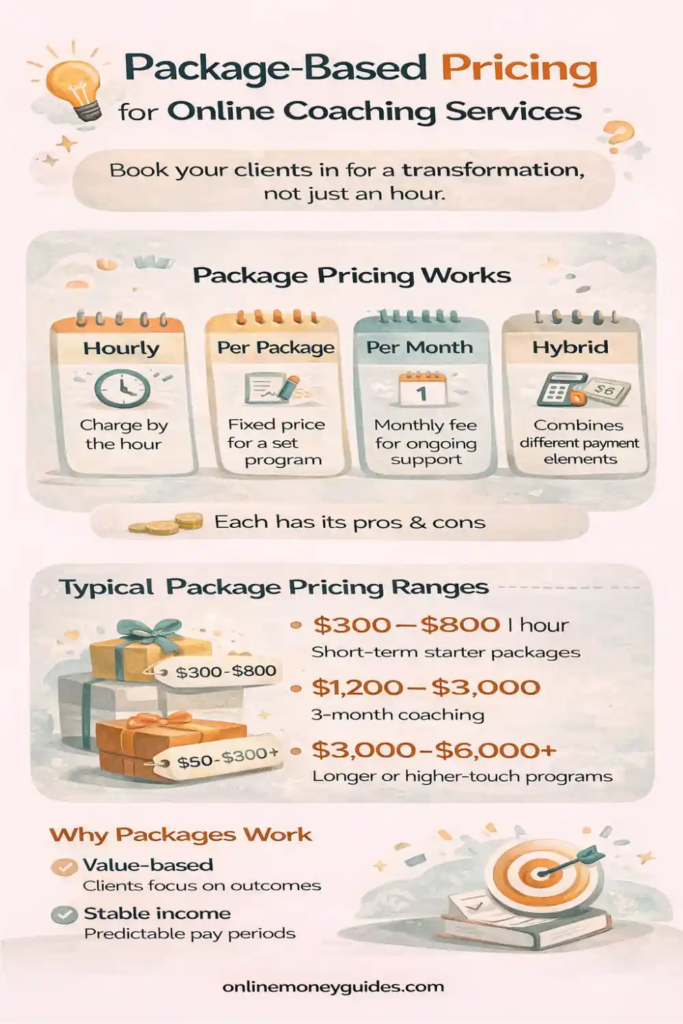
Instead of selling time, you sell a transformation over a defined period. This could be a 4-week reset, a 12-week program, or a 6-month container.
Typical beginner-friendly package ranges in 2026 look like:
- $300–$800 for short-term starter packages
- $1,200–$3,000 for 3-month coaching
- $3,000–$6,000+ for longer or higher-touch programs
Package pricing makes it easier to apply pricing psychology for coaching offers because clients focus on outcomes, not minutes. It also stabilizes your income and simplifies scheduling.
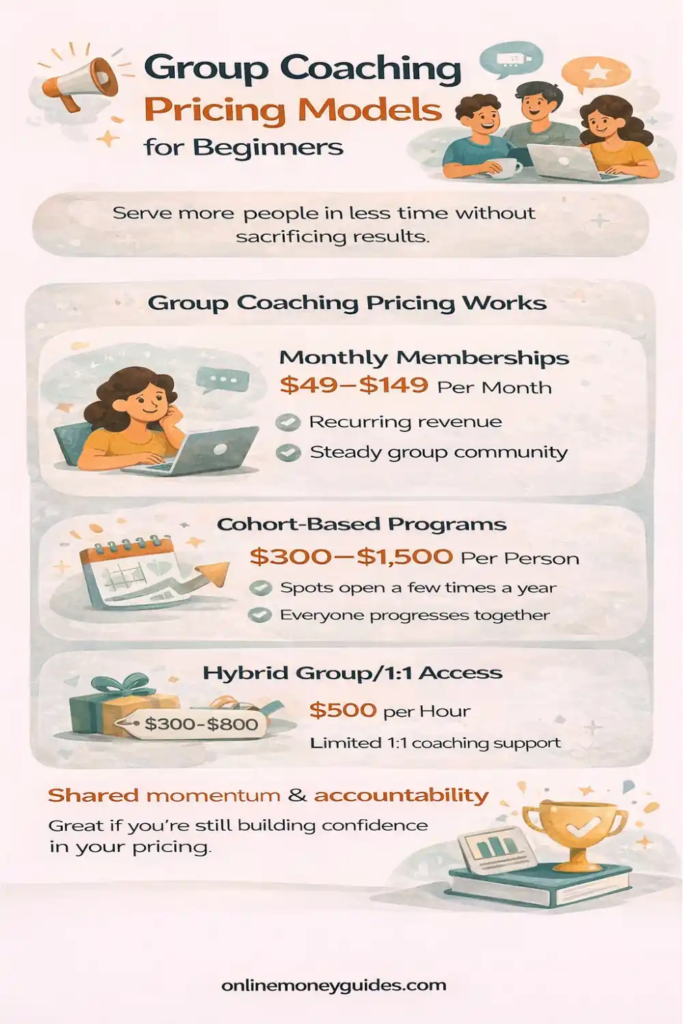
Group coaching pricing models for beginners
Group coaching is often overlooked, but it’s one of the healthiest online coaching pricing models when you want scale without burning out.
Group programs usually price lower per person, but higher overall per hour of your time.
Common structures include:
- Monthly memberships at $49–$149
- Cohort-based programs at $300–$1,500 per person
- Hybrid group plus limited 1:1 access at higher tiers
Group coaching works best when clients benefit from shared momentum and accountability. It’s also a strong option if you’re still building confidence in your pricing.
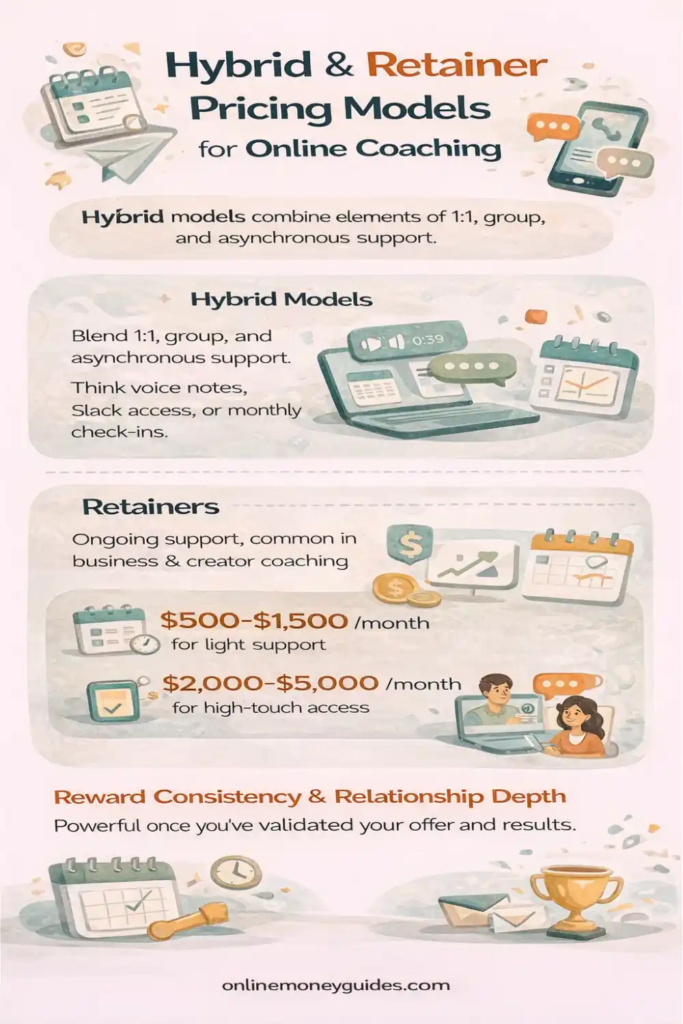
Hybrid and retainer pricing models for online coaching
Hybrid models combine elements of 1:1, group, and asynchronous support. Think voice notes, Slack access, or monthly check-ins.
Retainers are common in business or creator coaching, where clients want ongoing guidance rather than a fixed program.
Typical retainers range from:
- $500–$1,500 per month for light support
- $2,000–$5,000 per month for high-touch access
These pricing models for online coaching reward consistency and relationship depth. They’re especially powerful once you’ve validated your offer and results.
How Much Should You Charge for Online Coaching in 2026
This is the question most people want answered right away. It’s also the one that gets the most vague advice.
There is no single “correct” price. There are realistic ranges that align with how buyers behave and what the market already supports. Knowing those ranges makes how to price online coaching services feel grounded instead of intimidating.
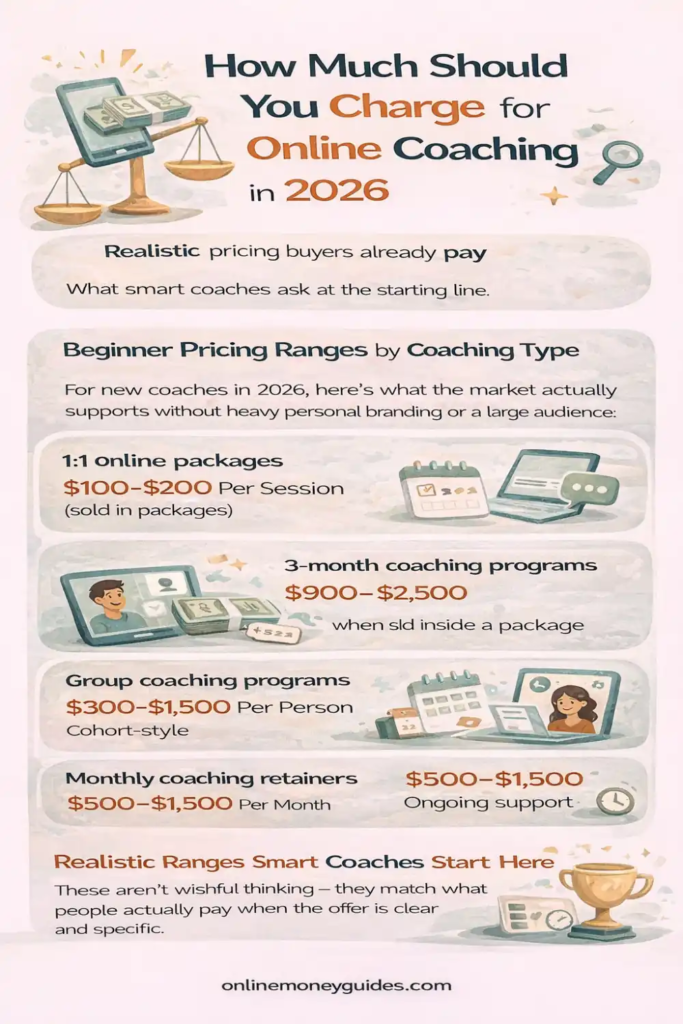
Realistic beginner pricing ranges by coaching type
For beginner to intermediate coaches in 2026, here’s what the market commonly supports without heavy personal branding or a large audience:
- 1:1 online coaching packages:
$100–$200 per session when sold inside a package, not hourly - 3-month coaching programs:
$900–$2,500 depending on access level and niche - Group coaching programs:
$300–$1,500 per person for cohort-style programs - Monthly coaching retainers:
$500–$1,500 per month for ongoing support
These ranges aren’t aspirational. They reflect what people already pay when the offer is clear and the outcome is specific.
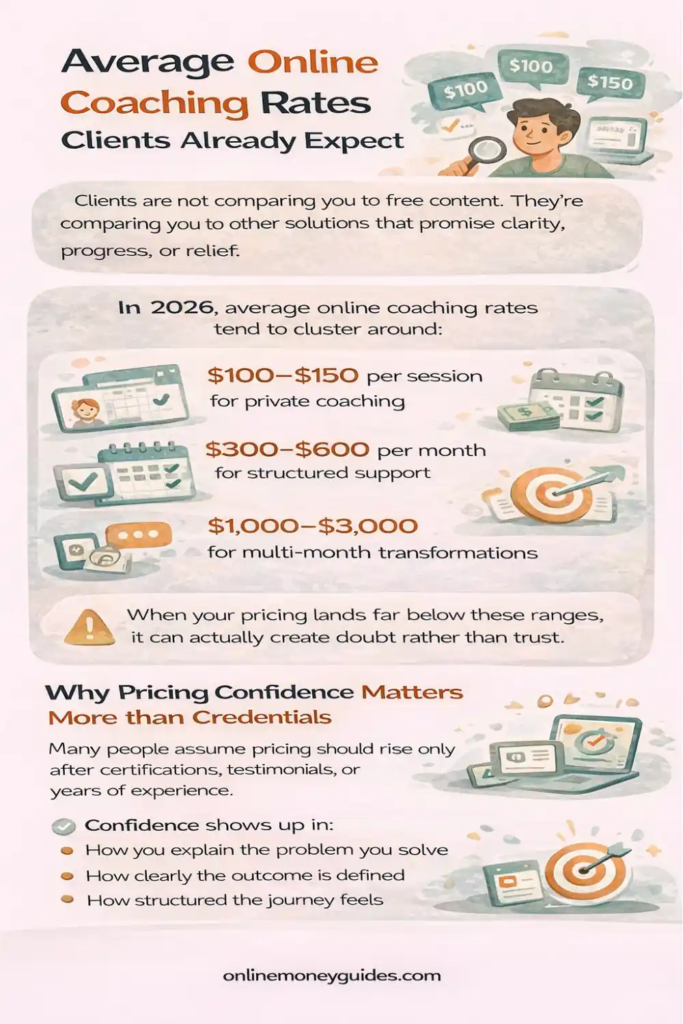
Average online coaching rates clients already expect
Clients are not comparing you to free content. They’re comparing you to other solutions that promise clarity, progress, or relief.
In 2026, average online coaching rates tend to cluster around:
- $100–$150 per session for private coaching
- $300–$600 per month for structured support
- $1,000–$3,000 for multi-month transformations
When your pricing lands far below these ranges, it can actually create doubt rather than trust.
Why pricing confidence matters more than credentials
Many people assume pricing should rise only after certifications, testimonials, or years of experience. In practice, buyers care more about clarity than credentials.
Confidence shows up in:
- How you explain the problem you solve
- How clearly the outcome is defined
- How structured the journey feels
This is where understanding pricing psychology for coaching offers helps. People buy certainty, not resumes.
A Simple Formula to Price Your Online Coaching Services
You don’t need a complex calculator to set a solid price. You need a way to connect time, value, and sustainability.
Here are two formulas that make how to price online coaching services much easier to approach.
The time-based pricing formula explained simply
This formula helps you avoid undercharging when you’re starting out.
Start by answering three questions:
- How many hours per week can you realistically coach?
- How much monthly income do you want from coaching?
- How many clients can you support well at once?
Example:
- Desired monthly income: $4,000
- Available coaching hours per month: 40
- Target hourly value: $100
Instead of selling single sessions, you package that time into a program that reflects the total value delivered.
This keeps your pricing aligned with reality, not guesswork.
The value-based pricing formula for coaching offers
Value-based pricing flips the question from “What is my time worth?” to “What is this outcome worth to the client?”
Ask:
- What problem is being solved?
- What happens if the client does nothing?
- What changes if they succeed?
If your coaching helps someone:
- Change careers
- Grow income
- Improve health
- Regain confidence or direction
Then the value often far exceeds the hours spent together. This is why package pricing works so well within modern online coaching pricing models.
How to sanity-check your numbers before launching
Before publishing a price, pressure-test it gently.
A good sanity check sounds like:
- “Would I feel motivated to show up fully at this price?”
- “Could I deliver this consistently without resentment?”
- “Would the right client take this seriously?”
If the answer is yes, you’re likely in a healthy range.
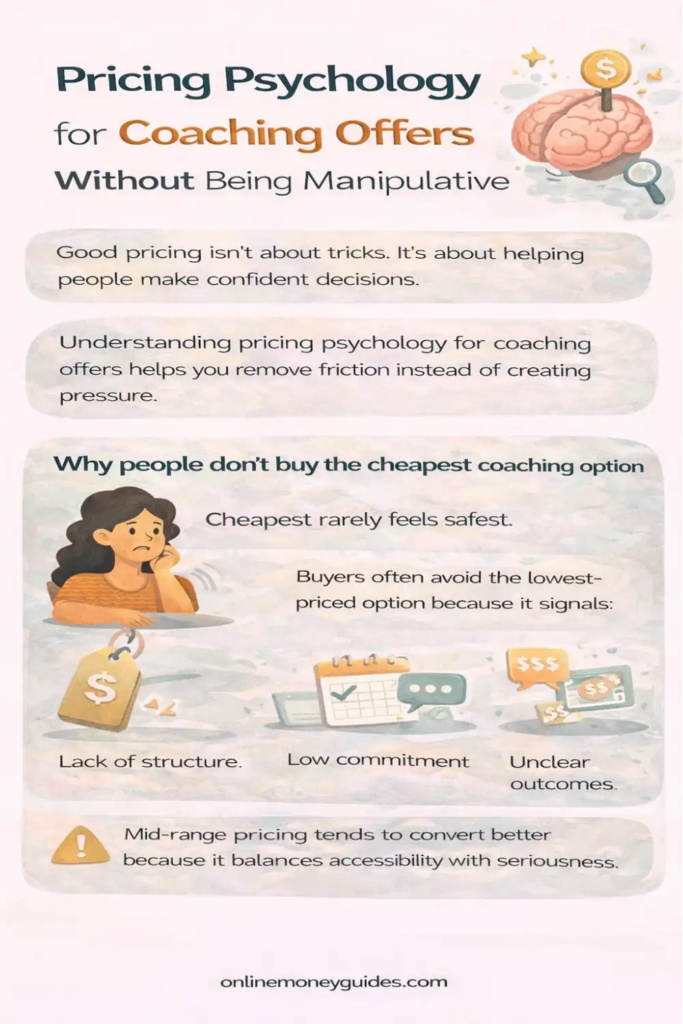
Pricing Psychology for Coaching Offers Without Being Manipulative
Good pricing isn’t about tricks. It’s about helping people make confident decisions.
Understanding pricing psychology for coaching offers helps you remove friction instead of creating pressure.
Why people don’t buy the cheapest coaching option
Cheapest rarely feels safest.
Buyers often avoid the lowest-priced option because it signals:
- Lack of structure
- Low commitment
- Unclear outcomes
Mid-range pricing tends to convert better because it balances accessibility with seriousness.
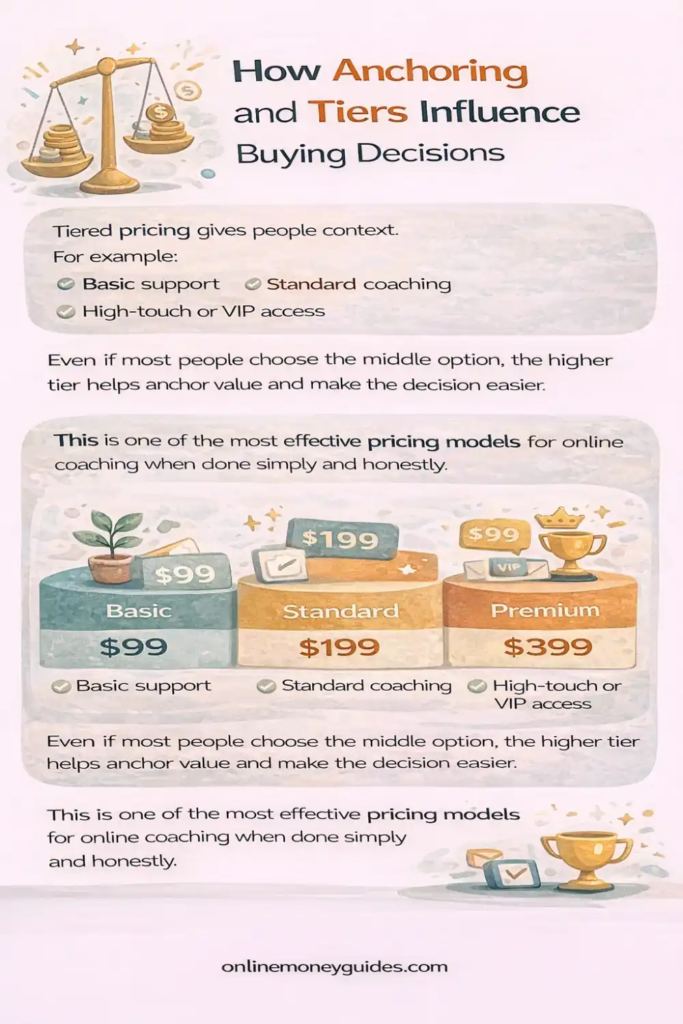
How anchoring and tiers influence buying decisions
Tiered pricing gives people context.
For example:
- Basic support
- Standard coaching
- High-touch or VIP access
Even if most people choose the middle option, the higher tier helps anchor value and make the decision easier.
This is one of the most effective pricing models for online coaching when done simply and honestly.
Small pricing tweaks that increase perceived value
Value is often communicated through structure, not discounts.
Clear start dates, defined milestones, and visible boundaries all increase perceived value without changing your rates.
How to Price 1:1 Coaching vs Group Coaching Programs
Both models work. The key is choosing the one that matches your energy, schedule, and goals.
When 1:1 coaching pricing makes sense
1:1 coaching works best when:
- The problem is deeply personal
- Clients need customized support
- You want fewer clients at higher online coaching rates
It’s often the fastest path to early income.
How to price group coaching programs without undercutting yourself
Group coaching should never feel like a cheaper version of 1:1. It’s a different experience.
Price it based on:
- Access to you
- Group size
- Program length
- Level of structure
When done well, group programs deliver strong results and protect your time.
Which model is better when you’re starting out
Many coaches start with 1:1 to learn quickly, then transition into group or hybrid models. There’s no wrong order, only alignment.
Tools That Make Pricing, Payments, and Delivery Easier
Tools won’t fix bad pricing, but the right setup removes friction and supports confidence.
You don’t need a complex tech stack to implement solid pricing models for online coaching. Simple is often better.
Simple checkout and payment tools for coaching packages
Clear pricing deserves a clean checkout.
ThriveCart allows you to:
- Offer one-time payments or plans
- Anchor value with tiered options
- Reduce payment-related drop-off
For beginners who want everything in one place, Systeme.io can handle pages, payments, and follow-ups without overwhelming setup.
Email and follow-up tools that support higher pricing
Pricing conversations don’t always happen in one moment. Email helps warm people up before they decide.
ConvertKit works well for:
- Pre-coaching education
- Answering objections at scale
- Building trust before discovery calls
When people understand the journey, pricing feels safer to them.

Why fewer tools often lead to better pricing clarity
Too many tools can blur responsibility. When your offer, messaging, and checkout live in a few clear places, it’s easier to stand behind your prices.
Clarity builds confidence, and confidence supports healthier online coaching pricing models.
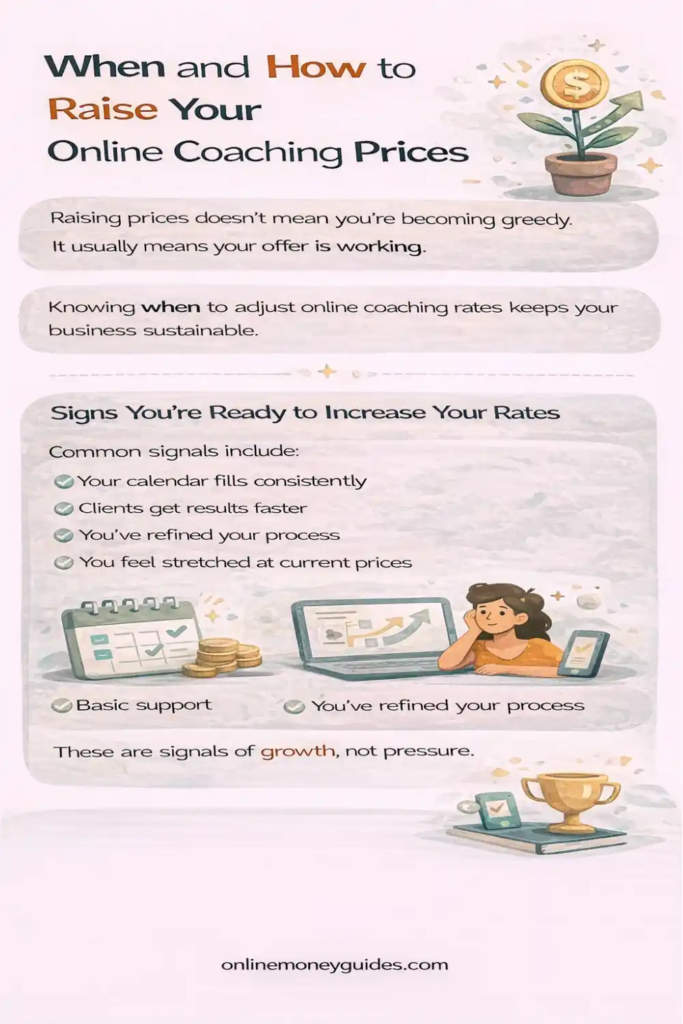
When and How to Raise Your Online Coaching Prices
Raising prices doesn’t mean you’re becoming greedy. It usually means your offer is working.
Knowing when to adjust online coaching rates keeps your business sustainable.
Signs you’re ready to increase your rates
Common signals include:
- Your calendar fills consistently
- Clients get results faster
- You’ve refined your process
- You feel stretched at current prices
These are signals of growth, not pressure.
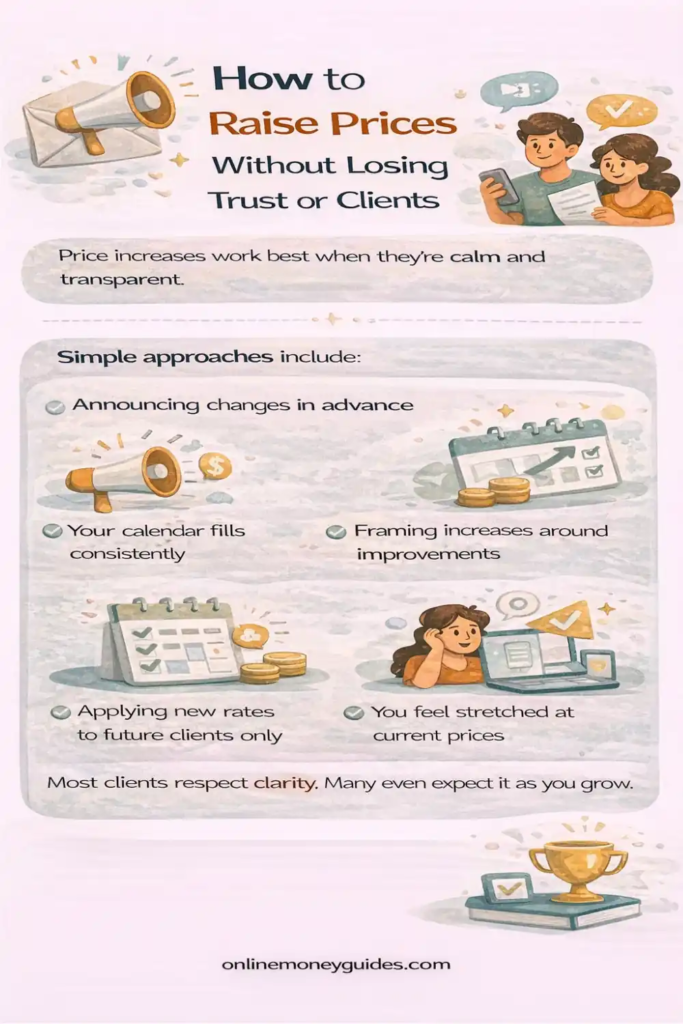
How to raise prices without losing trust or clients
Price increases work best when they’re calm and transparent.
Simple approaches include:
- Announcing changes in advance
- Framing increases around improvements
- Applying new rates to future clients only
Most clients respect clarity. Many even expect it as you grow.
You’re Not Charging for Time, You’re Charging for Outcomes
Pricing isn’t a one-time decision. It’s a skill you refine as you learn.
Learning how to price online coaching services is really about understanding the value you create, the boundaries you need, and the kind of clients you want to serve.
You don’t need to get it perfect on day one. You do need to start somewhere that feels honest, sustainable, and aligned.
Take action with the information you have now. Adjust as you grow. Confidence comes from movement, not waiting.
Once your pricing is dialed in, the next step is attracting the right clients and scaling your offers. For the full roadmap, explore our Ultimate Guide to Online Coaching and Consulting in 2026.