You’ve probably been circling the idea of creating an online course for a while. The thought keeps coming back during your commute, while you scroll on your phone, or when you’re watching someone else teach online and thinking, “I could do that.” But then the doubts hit: What topic should I teach? Will anyone pay for it? How do I know if it will actually sell?
You’re not alone in that. Every successful course creator, whether they’re teaching photography, coding, or yoga, once sat in front of a blank page, wondering where to begin. The good news is that finding profitable online course ideas doesn’t need to feel like guesswork. With the right process, you can identify topics that align with your strengths, tap into real market demand, and give you the best shot at earning income while helping others learn.
This guide will walk you through that process, step by step. By the end, you’ll not only have clarity on how to generate course ideas, but also how to validate them before you invest your time in creating a full course.
This guide is part of our full series on How to Build and Scale Online Courses in 2025. If you’re just starting, you’ll want to see the entire roadmap—from choosing your idea to building a six-figure business.

Why Finding Profitable Online Course Ideas Matters
Before we dive into the how-to, it’s worth pausing to understand why choosing the right course topic is the make-or-break decision in your journey.
Think of your course idea as the foundation of a house. Build on shaky ground, and the walls eventually crack. Choose a solid foundation, something people want and need, and the rest of your course-building process becomes smoother: easier marketing, higher enrollment, and better student results.
A profitable course idea matters because:
- It ensures you’re solving a real problem for your audience, not just teaching something you hope they want.
- It maximizes your earning potential by targeting topics with strong demand.
- It reduces the risk of spending weeks (or months) creating content that struggles to sell.
Platforms like Udemy and Skillshare show this clearly. The most successful courses aren’t always taught by the biggest names; they’re taught by people who identified a gap in the market and filled it with practical, easy-to-understand training.
So, our mission isn’t just to brainstorm what you could teach. It’s to uncover the best online course ideas—those that check the boxes of being profitable, in-demand, and sustainable for you to teach with confidence.
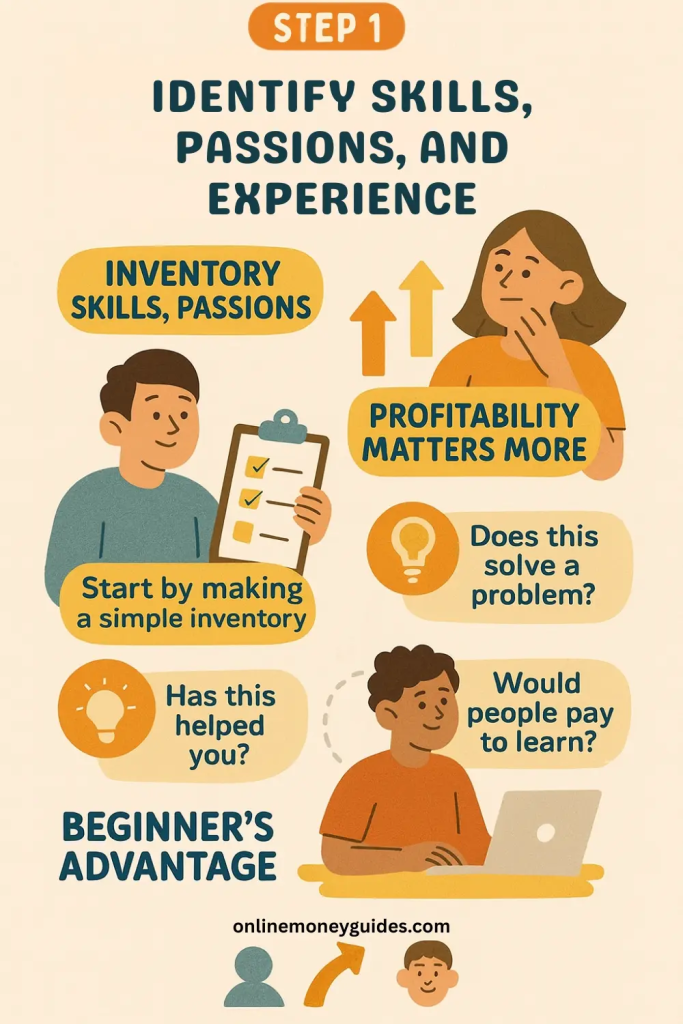
Step 1: Identify Your Skills, Passions, and Experience
Every profitable course starts with a blend of two things: what you know and what people want. The sweet spot is finding overlap between your skills or passions and real market demand.
While passion helps with motivation, it’s only half the equation. You also need to think about profitability”
How to Recognize Skills You Can Teach
Start by making a simple inventory. You don’t need to be the world’s leading expert. Often, you just need to be a few steps ahead of someone who wants to learn. Ask yourself:
- What do friends or coworkers usually ask me for help with?
- Which skills have I learned through school, work, or hobbies?
- Where have I solved a problem for myself that others still struggle with?
For example, maybe you figured out how to use Notion for productivity, or you’re the go-to person at work for explaining tricky Excel formulas. Those are teachable skills with potential demand.
Passion Matters, but Profitability Matters More
You’ve probably heard advice like “just follow your passion.” While passion helps with motivation, it’s only half the equation. You also need to think about profitability. Teaching something you enjoy but nobody wants to pay for, like your unique recipe for avocado toast, won’t get you far.
Instead, filter your passions through these questions:
- Does this solve a clear problem?
- Are people already spending money to learn this?
- Can I teach it in a structured way that helps beginners see results?
The Beginner’s Advantage
Don’t underestimate the value of being closer to the beginner stage yourself. Many learners prefer guidance from someone who’s relatable rather than a distant expert. If you’ve recently learned to code, lost weight with a specific program, or started a side hustle, your “fresh perspective” can be more approachable than that of a 20-year veteran.
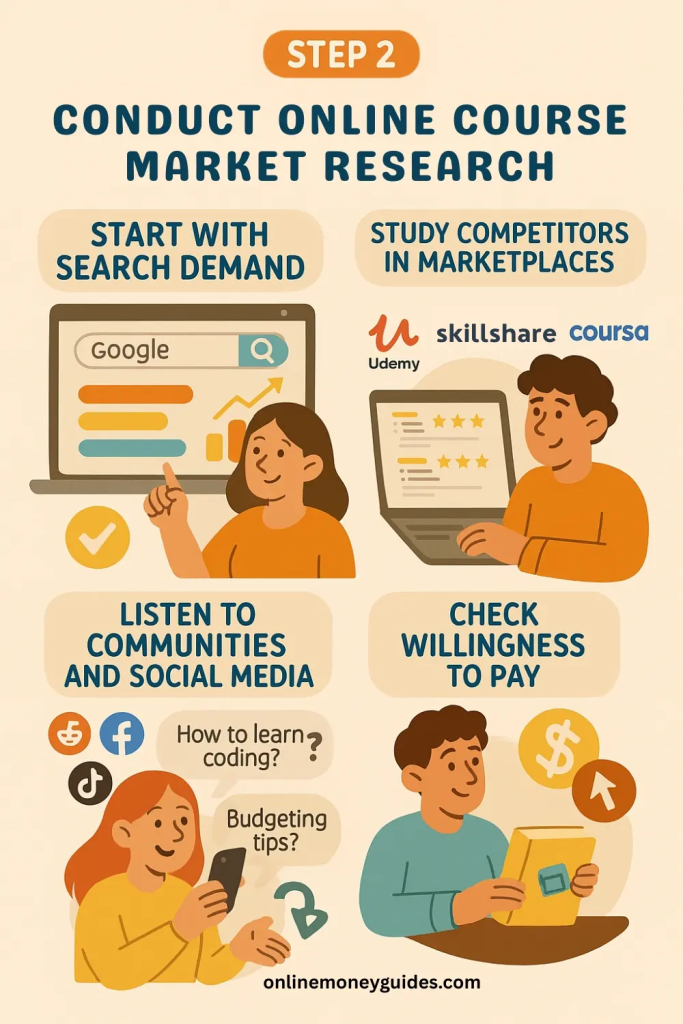
Step 2: Conduct Online Course Market Research
Once you’ve brainstormed possible topics, the next step is to test them against the market. This is where you shift from “what I could teach” to “what people are actively searching, buying, and asking for.”
Start with Search Demand
A profitable course idea usually shows up in search data. Tools like Google Trends and SEMRush give you a snapshot of what people are typing into search engines. Look for:
- Consistent interest over time: Avoid topics that spike and vanish.
- Steady or growing search volume: This signals long-term demand.
- Related searches: These reveal how people phrase their problems or what subtopics they care about.
For example, “digital marketing course” shows steady growth, while “Clubhouse app tutorials” faded after the app lost momentum.
Study Competitors in Marketplaces
Platforms like Udemy, Skillshare, and Coursera are goldmines for spotting demand. Search your potential topic and see:
- How many courses already exist.
- Enrollment numbers (many Udemy courses publicly show student counts).
- Reviews that reveal what students liked or still wanted more of.
A crowded marketplace isn’t always bad. It means people are buying. The key is to identify gaps: maybe existing courses are outdated, overly technical, or missing beginner-friendly explanations.
Listen to Communities and Social Media
Reddit threads, Facebook groups, LinkedIn, and even TikTok comments can surface unmet needs. People often post questions like:
- “How do I start learning Python without a computer science background?”
- “Is there a simple way to budget as a freelancer?”
Each of these is a potential course idea waiting to be turned into structured training.
Check Willingness to Pay
Free curiosity doesn’t always equal paying students. That’s why it’s important to verify if people are already buying solutions. You can do this by:
- Browsing Amazon for bestselling books in your niche.
- Checking if coaches, workshops, or seminars exist around the topic.
- Looking at ads. If businesses are paying to promote similar courses, that’s a green light.
Market research helps you filter out ideas that may sound fun but don’t pass the profitability test.
Step 3: Analyze Online Course Categories and Trends
At this stage, you’ve got some potential topics and you’ve done a little digging to see which ones might sell. Now it’s time to zoom out and see how your ideas fit into the bigger picture of online course categories. Certain categories consistently perform better than others because they solve evergreen problems or align with industries where people are willing to invest in learning.
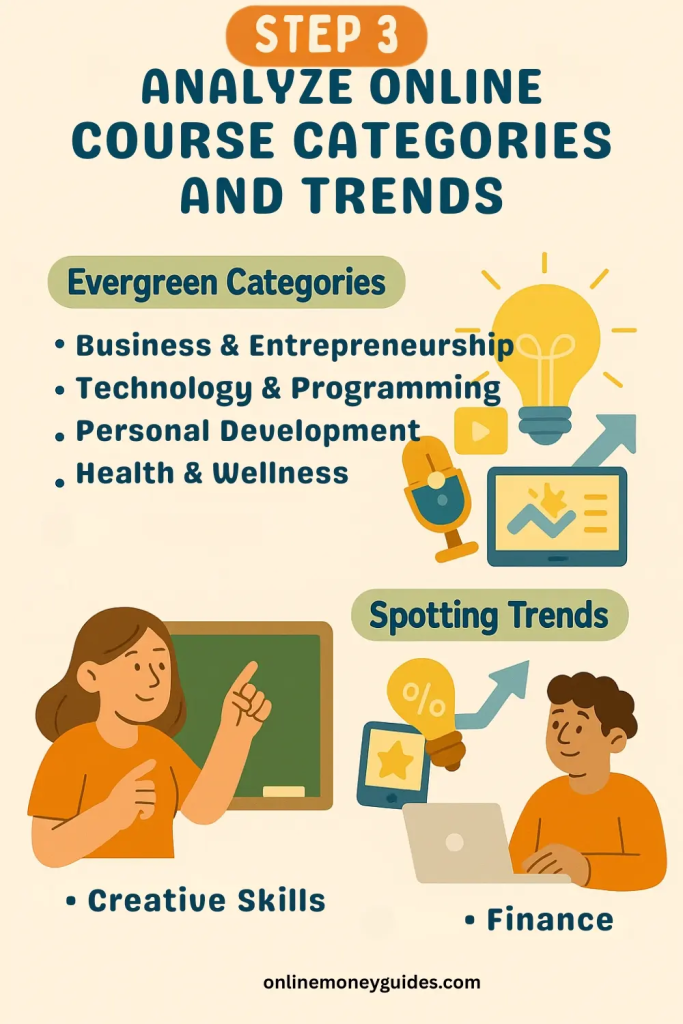
The Evergreen Categories
Data from Udemy and Coursera shows that a handful of course categories dominate enrollments year after year. These include:
- Business and Entrepreneurship: Sales, marketing, freelancing, and management.
- Technology and Programming: Coding, web development, AI, and cybersecurity.
- Personal Development: Productivity, mindset, communication skills.
- Health and Wellness: Fitness, nutrition, meditation, and stress management.
- Creative Skills: Graphic design, photography, video editing, writing.
- Finance: Personal budgeting, investing, crypto basics.
Each of these categories branches into dozens of niches. For example, under Technology you might find “Python for Data Science,” while under Health and Wellness there could be “Yoga for Busy Professionals.”
Spotting Trends
Alongside evergreen topics, there are also emerging areas worth noting. For example:
- AI and machine learning courses are gaining traction, especially beginner-friendly versions.
- Digital content creation (podcasting, YouTube, TikTok growth) is exploding as more people want to monetize their creativity.
- Remote work and productivity tools (like Notion, Slack, or Trello) are in high demand.
These trends can create opportunities for you to enter while the competition is still growing.
Choosing Between Categories
Don’t feel pressured to jump into a saturated category unless you see a clear angle. Sometimes smaller, niche categories outperform because they attract highly motivated learners. A focused course like “Budgeting for Freelance Designers” might sell better than a generic “Personal Finance 101.”
By analyzing categories and staying aware of trends, you can position yourself in spaces where students are not only interested but willing to pay. Once you’ve narrowed it down, the next step is to validate your online course idea before you start recording lessons.
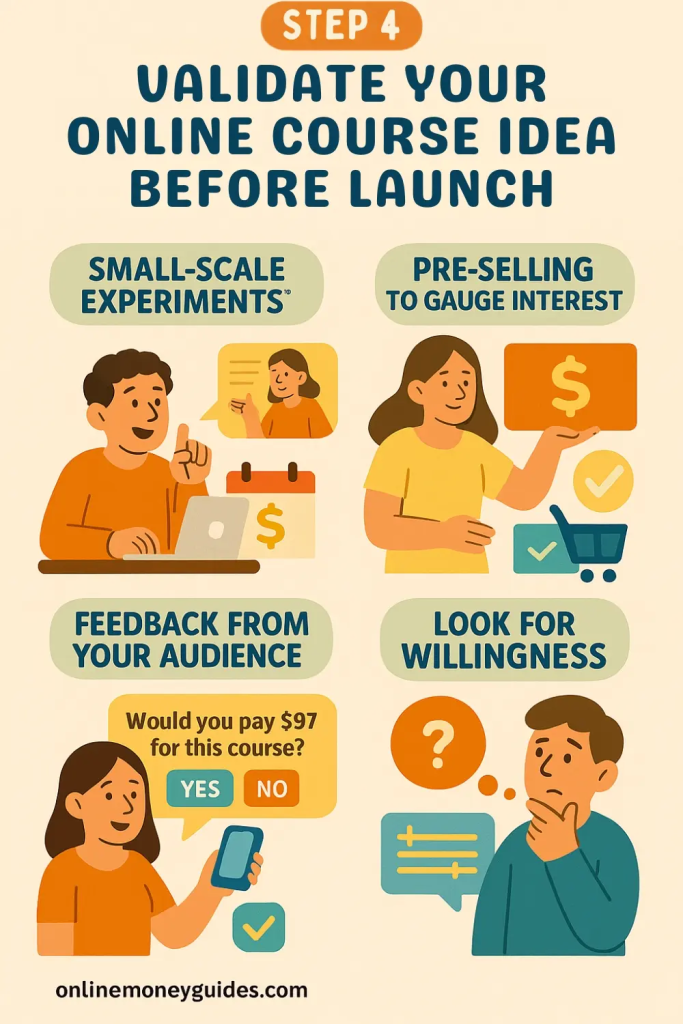
Step 4: Validate Your Online Course Idea Before Launch
This is the step that saves you from wasted time and frustration. It’s one thing to spot a promising category, but it’s another to prove that people will actually pay for your version of it. Validation means testing demand before you spend weeks recording videos or building a curriculum.
Small-Scale Experiments
One of the simplest ways to validate is by creating a “mini-version” of your course. Instead of recording 20 lessons, test your idea with:
- A paid workshop on Zoom.
- A one-hour masterclass delivered live.
- A short email course using a tool like ConvertKit.
If people are willing to pay for a smaller format, it’s a strong sign they’ll pay for the full version.
Pre-Selling to Gauge Interest
Another approach is to pre-sell your course. Kajabi makes it simple by combining sales pages, checkout, and email follow-up in one place. No extra tools required. You can launch with an early-bird discount and validate your course idea quickly, without waiting for the entire course to be complete.
Feedback from Your Audience
If you already have a following on social media, a blog, or even a small email list, ask your audience directly. Polls, Q&A sessions, or even a simple survey can reveal what people want. Be specific: instead of asking “Would you take a course on photography?” try “Would you pay $97 for a beginner-friendly smartphone photography course?”
Look for Willingness, Not Just Interest
Many creators make the mistake of asking friends or followers, “Would you take this course?” Most people will say yes just to be polite. What matters is whether they’ll pay. Validation is about finding paying students, not just curious ones.
When you’ve tested your idea through one or two of these methods, you’ll know whether it’s worth scaling into a full program. From here, it’s about choosing the best online course idea from your list and committing to it.
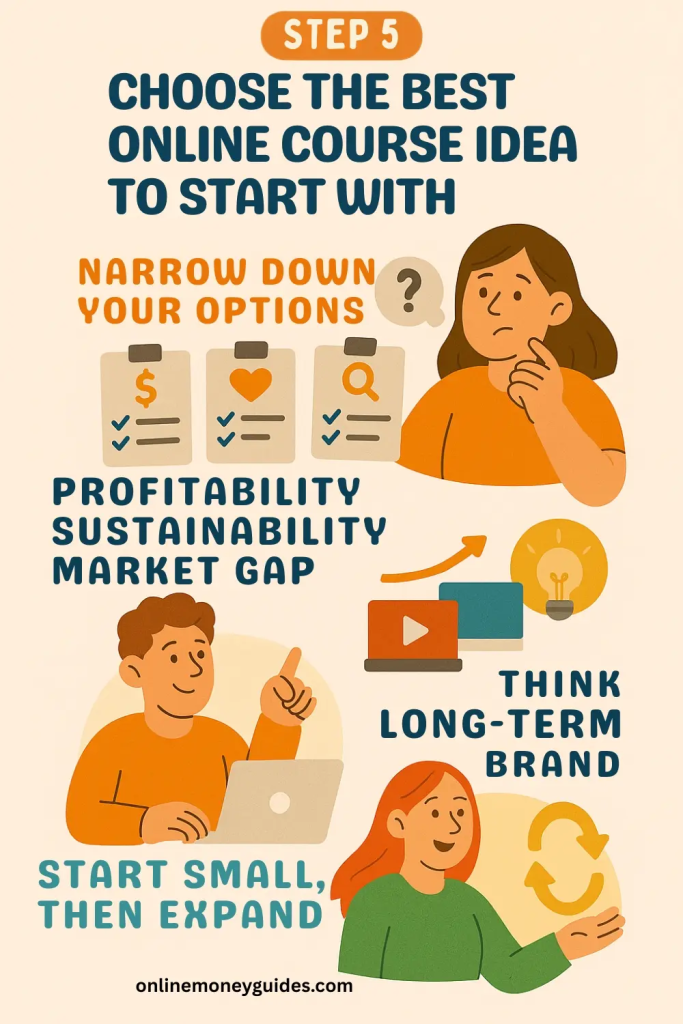
Step 5: Choose the Best Online Course Idea to Start With
By now, you might have several topics that look promising. Maybe your skills, market research, and validation experiments uncovered three or four good directions. The challenge is deciding where to begin.
Narrowing Down Your Options
Think of this step as filtering your list with three lenses:
- Profitability: Which topic showed the strongest demand in your validation step?
- Personal Sustainability: Which idea excites you enough to stick with through planning, filming, and promoting?
- Market Gap: Which area feels underserved or poorly covered by existing courses?
The best choice is the one where all three overlap. For example, if you validated both “Excel for beginners” and “YouTube growth for small businesses,” but you feel more energy for video creation, the second option may be more sustainable even if both are profitable.
Start Small, Then Expand
One mistake many creators make is trying to build a “mega course” that covers everything. It’s smarter to start with a focused, outcome-driven course. For instance:
- Instead of “Complete Digital Marketing Mastery,” begin with “How to Run Your First Facebook Ad in 7 Days.”
- Instead of “All About Fitness,” start with “Beginner Strength Training Without a Gym.”
Focused courses often sell better because they promise clear, tangible results. Later, you can expand into advanced or related courses and build a full catalog.
Think Long-Term Brand
Also consider how your chosen idea fits into your bigger goals. A profitable online course isn’t just about short-term sales; it can be the foundation of your brand. Choosing a topic that connects with other products, services, or content you want to create will help you grow a sustainable business, not just a one-off project.
Once you’ve chosen your starting point, the next step is to look at monetization methods and platforms so you can bring your course to life and reach paying students.

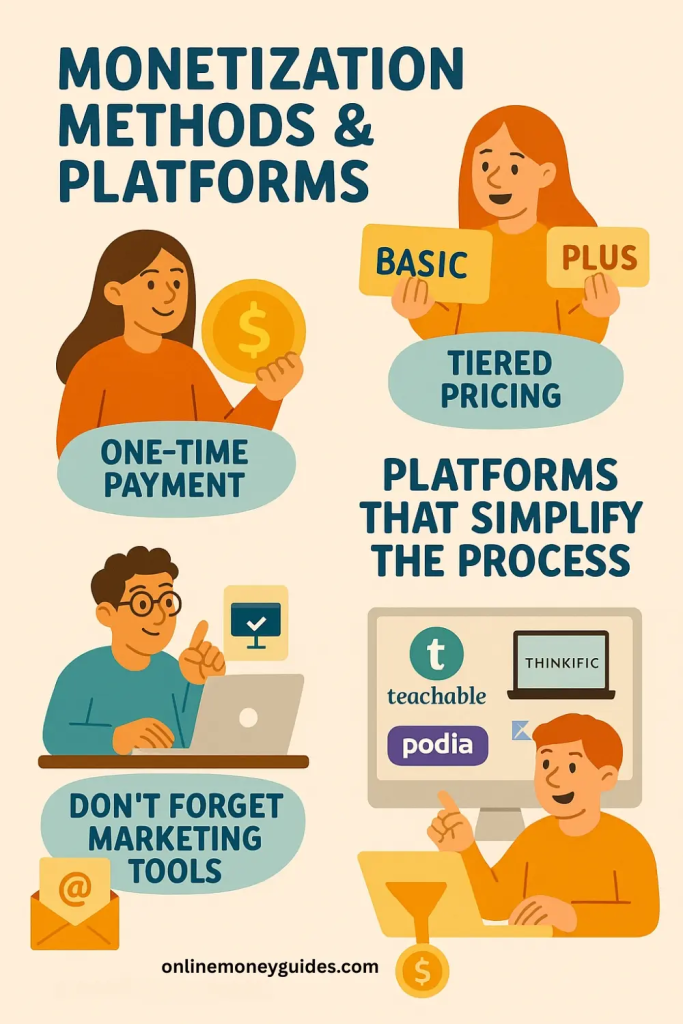
Monetization Methods & Platforms
Choosing your course idea is only half the journey. The other half is figuring out how to deliver it and actually get paid. Thankfully, you don’t need to reinvent the wheel. There are proven platforms and monetization models that make it easier for beginners to start earning.
Monetization Models to Consider
There are a few ways creators typically make money from courses:
- One-time payment: Students pay once and get lifetime access. This is the simplest and most beginner-friendly model.
- Subscription model: Students pay monthly or yearly to access a library of courses, common on platforms like Skillshare.
- Tiered pricing: Offering different packages (basic videos, videos + templates, videos + coaching) allows you to reach both budget learners and premium buyers.
Each model has its trade-offs. One-time payments give immediate cash flow, while subscriptions build recurring revenue. Tiered pricing works well when you have extras like coaching or templates to add.
Platforms That Simplify the Process
Where you host your course matters. You’ll need a platform that handles video delivery, payments, and student access without tech headaches. Here are some strong options:
- Teachable: Beginner-friendly, customizable, and widely used by solo creators.
- Thinkific: Similar to Teachable but with more flexibility for scaling into multiple courses.
- Podia: Great for creators who want an all-in-one solution with email and community features.
- Kajabi: Higher cost but powerful automation and marketing tools built in.
Marketplaces like Udemy and Skillshare are different in that they bring the audience to you but limit your pricing control. They’re a good way to test your idea with less upfront risk, but long-term, many creators prefer self-hosted platforms where they own the customer relationship.
Don’t Forget Marketing Tools
Creating a course is one part; selling it is another. Building an email list early will give you direct access to your most interested learners. Tools like ConvertKit and ActiveCampaign make this easy and integrate seamlessly with course platforms.
By combining the right monetization model with the right platform, you can set yourself up to sell confidently.
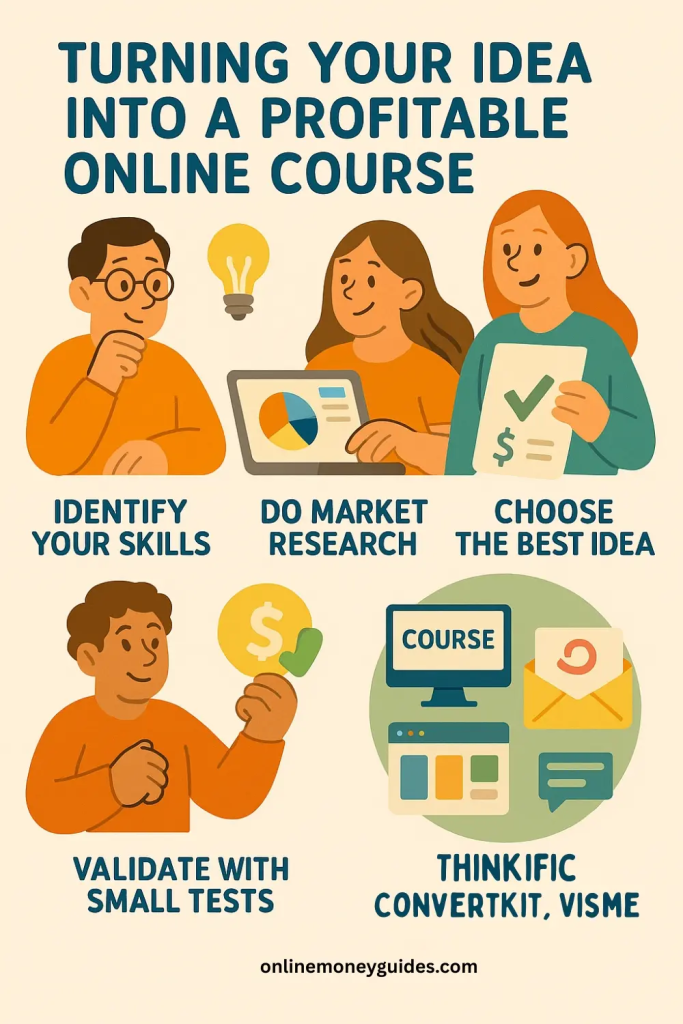
Turning Your Idea Into a Profitable Online Course
Finding profitable online course ideas doesn’t have to feel overwhelming. It’s not about guessing or hoping your passion will somehow click with students. It’s about following a clear process: identifying your skills, doing online course market research, analyzing categories and trends, validating your idea with small tests, and then choosing the best one to pursue.
The real magic happens when you combine your unique experiences with what people are already looking for. That overlap is where courses sell, and where your work truly makes an impact. With the right tools—whether that’s hosting on Thinkific, marketing through ConvertKit, or designing course materials in Visme, you can turn a single idea into a digital product that earns income and builds your authority.
Remember, you don’t need to create the “perfect” course out of the gate. Start small, validate, and grow. The online course space is booming, and there’s room for everyday creators to carve out their place. Your students aren’t waiting for the most polished celebrity instructor. They’re waiting for someone like you to explain things in a way they can actually understand.
So take the first step today. Brainstorm, research, and test. The sooner you begin, the sooner you’ll know which idea can become your profitable online course.
Finding your idea is only step one. To learn how to design, market, and scale your course, check out our Ultimate 2025 Online Course Guide.