You’ve probably seen it happen before.
Someone spends months creating an online course, designing slides, recording videos, and obsessing over the logo, only to launch it and hear nothing but crickets.
It’s not that their course wasn’t good. It’s that they skipped the most important step: validation.
Validating your online course idea isn’t about perfection or expensive tools. It’s about making sure people actually want what you’re planning to sell, before you spend all your time creating it. Think of it as a reality check that saves you from wasted effort and gives you clarity on what your audience truly needs.
In this step-by-step guide, we’ll walk through how to validate your online course idea using simple, proven methods that don’t require a big audience or ad budget. You’ll learn how to test real demand, collect feedback, and even pre-sell your course to confirm there’s money waiting for your idea.
By the end, you’ll have a clear roadmap to go from “I think this might work” to “I know this will sell.”
This article is part of our Ultimate 2025 Online Course Guide, where we cover every step of building, launching, and scaling your course into a six-figure business.

Why Validating Your Online Course Idea Matters
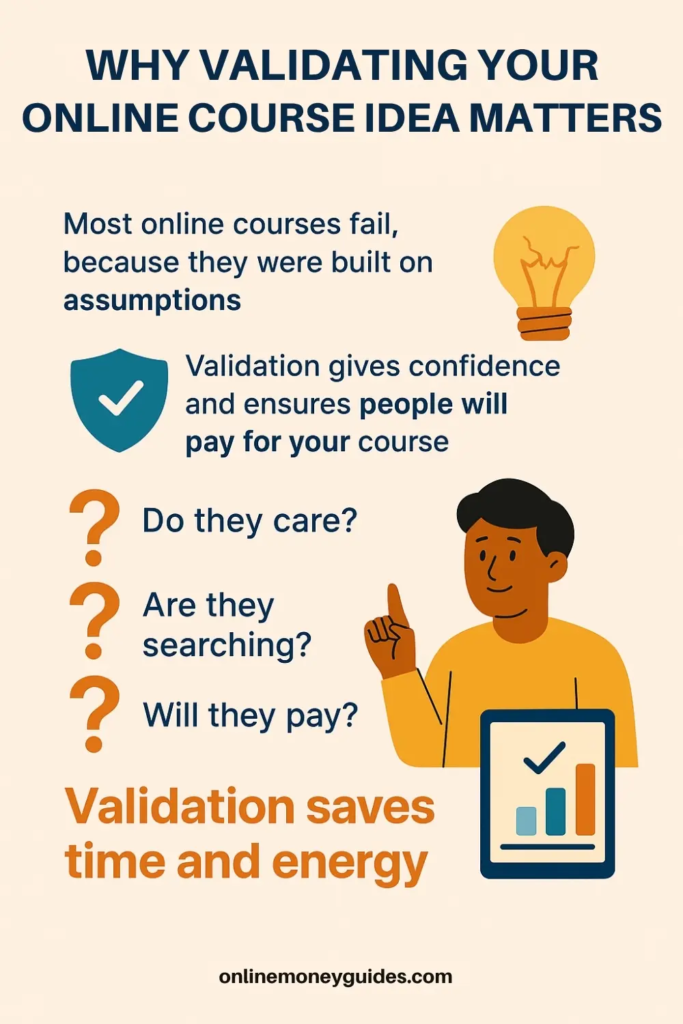
Most online courses fail, not because of bad teaching or lack of passion, but because they were built on assumptions.
Validation removes that guesswork. It gives you confidence that your idea has real potential and that people are willing to pay for it.
When you validate your course concept, you’re not just checking for interest; you’re testing for commitment. You’re finding out:
- Does your audience care enough to learn this topic?
- Are they actively searching for solutions like yours?
- And most importantly, will they spend money on it?
Even successful creators like Ali Abdaal and Justin Welsh validate ideas through their audience before building anything. It’s not about being cautious; it’s about being smart with your energy.
Validation also shortens your path to profitability. You can start small, refine fast, and launch with confidence, not anxiety.
Next, let’s look at how to start this process with quick, low-effort online course market research that gives you solid data to work with.
Step 1: Do Quick Online Course Market Research
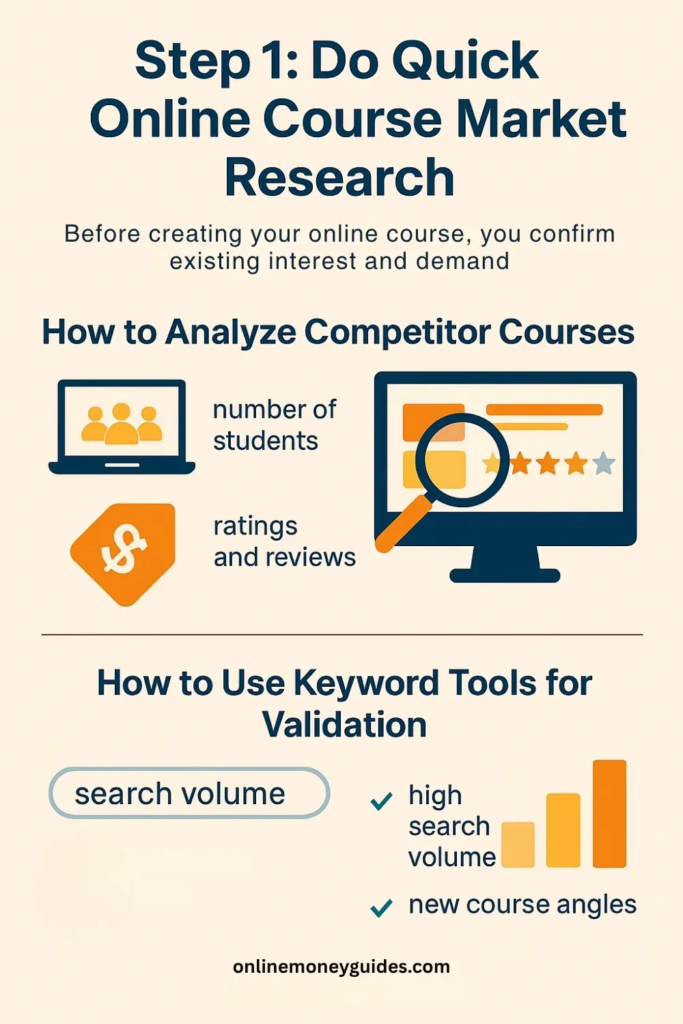
Before you record a single lesson, you need to confirm that people are already searching for what you plan to teach. Market research doesn’t have to be complicated; it’s simply about spotting where attention and demand already exist.
How to Analyze Competitor Courses
Head to Udemy, Skillshare, or Teachable, and search for your topic. Look for:
- The number of students enrolled (a sign of demand)
- Ratings and reviews (to understand what students like or dislike)
- Pricing and structure (to see how competitors position their offer)
If multiple courses exist in your niche, that’s actually a good thing. It means people are willing to pay for that transformation. Your goal isn’t to reinvent the wheel; it’s to find gaps in what’s already being taught and fill them with your unique angle.
How to Use Keyword Tools for Validation
Once you see interest in competitor platforms, go deeper with keyword research. Tools like Ubersuggest, Ahrefs, or Google Trends help you check how many people search for your course topic each month.
For instance, if “learn digital illustration” or “start a freelance business” gets thousands of searches monthly, that’s a green light.
Use related phrases to discover new angles. Searching “validate online course idea” or “test online course demand” might reveal specific topics your audience is exploring, things you can address directly in your course.
Market research gives you data-driven confidence. It turns vague assumptions into measurable proof that your idea has potential.
Step 2: Talk to Your Audience to Validate Your Online Course Idea
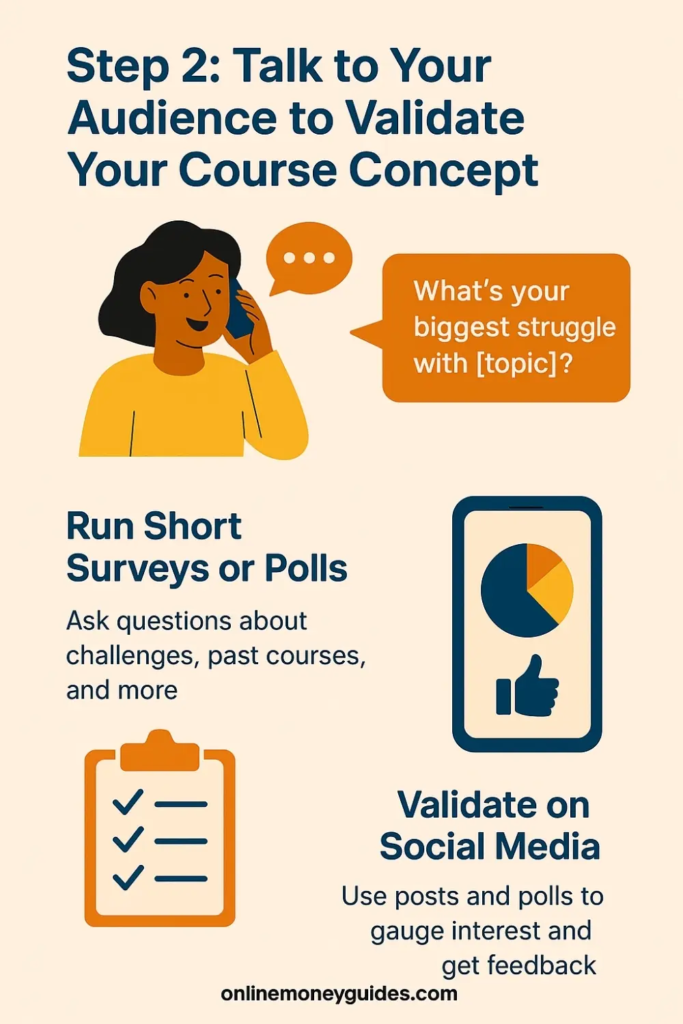
At this stage, it’s time to move from data to real conversations. Numbers can show trends, but people reveal the truth. The fastest way to validate your online course idea is by talking directly to your audience, whether that’s your email list, social media followers, or online communities you’re part of.
You’re not trying to sell yet. You’re listening. You want to understand what your audience struggles with, what they’ve already tried, and what kind of transformation they’re looking for.
Start with a simple post or story on your social platforms. Say something like:
“I’m working on a course to help people [specific result]. What’s your biggest struggle with this topic right now?”
When people reply, pay attention to their words. The phrases they use are gold; they’ll help you later when you write your sales copy or design your course modules.
Run Short Surveys or Polls
If you want more structured data, create a short survey, just 5 to 7 questions max. Keep it easy and conversational. Tools like Typeform or Tally.so make it simple to collect responses without any tech overwhelm.
Ask things like:
- What’s the biggest challenge you face when trying to [specific result]?
- Have you ever paid for a course about this topic before?
- What would make a course on this feel worth it to you?
This is where you start to see patterns. When several people mention the same frustration or goal, you know you’re onto something worth building.
Validate on Social Media
Social media is one of the most powerful and free ways to test online course demand before you build anything.
You can:
- Use Instagram Stories or LinkedIn polls to gauge interest.
- Post short reels or threads explaining your course idea and ask for feedback.
- Notice which posts spark comments, saves, or shares; those reactions are signals of curiosity and demand.
Even a handful of genuine replies or DMs can give you more insight than hundreds of anonymous survey responses.
Talking to your audience this way helps you confirm there’s a real problem to solve and that people see you as the person to help solve it.
Step 3: Create a Simple Landing Page to Test Online Course Demand
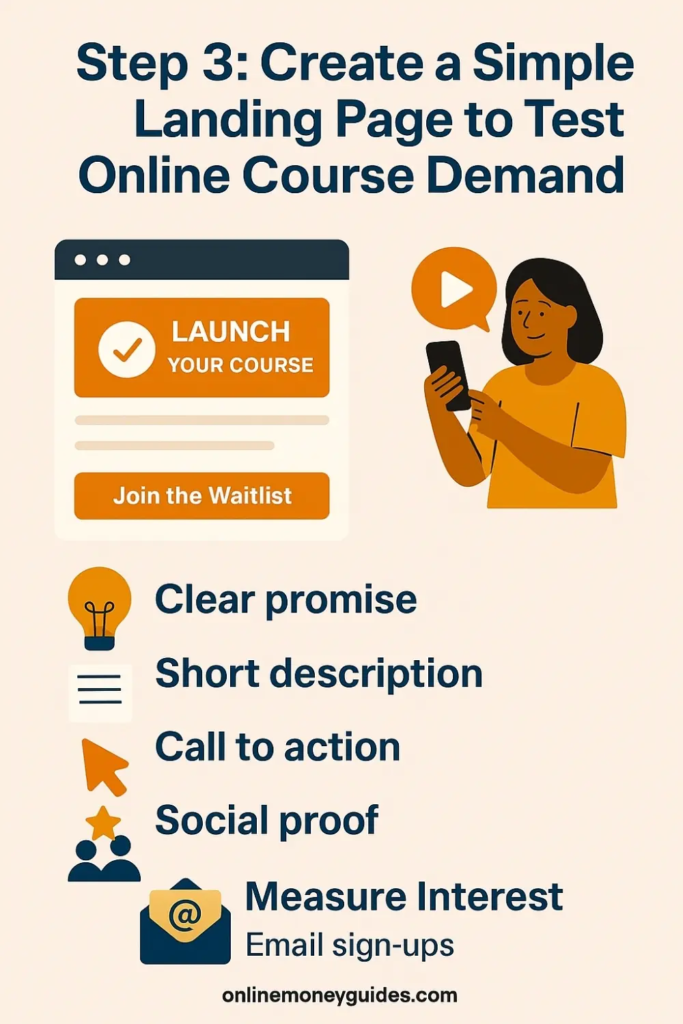
Now that you’ve gathered insights from real people, it’s time to put your idea out there and see if anyone bites. The best way to test online course demand is by building a simple landing page, something that explains your course idea clearly and gives people an easy way to express interest.
This isn’t about building a full website or recording lessons yet. It’s about creating a single page that answers one question: Do people care enough to sign up?
What Your Validation Page Should Include
Your landing page doesn’t need to be fancy. In fact, simplicity often works better. Here’s what matters most:
- A clear promise: What problem does your course solve, and what result will students get?
- A short description: Explain the transformation in a few sentences.
- A call to action: “Join the waitlist,” “Reserve your spot,” or “Get early access.”
- Social proof (if you have it): Testimonials or engagement stats to build trust.
You can even add a short video explaining why you’re creating the course; it humanizes your offer and helps people connect with you.
Tools for Building Your Landing Page
If you’re just starting, tools like ConvertKit or Systeme.io make this process easy and affordable.
- ConvertKit lets you create beautiful, mobile-friendly landing pages and collect emails, perfect for building a “waitlist” while you test demand.
- Systeme.io goes a step further with pre-built funnels and checkout pages, so you can pre-sell later if your idea gains traction.
You can even offer a small incentive, like a free guide or a bonus lesson, to encourage sign-ups. Think of it as an early thank-you for their trust.
How to Measure Interest
Once your page is live, share it wherever your audience hangs out, on social media, your newsletter, or relevant online communities. Then, track the numbers that matter:
- Email sign-ups or waitlist subscribers: These show curiosity and intent.
- Click-through rates: Measure how many people visit vs. take action.
- Comments and DMs: Qualitative feedback that reveals excitement or hesitation.
Even 50–100 genuine sign-ups can indicate strong early demand. Remember, it’s better to have a small, engaged audience ready to buy than a large group that’s only half-interested.
Creating this simple landing page transforms your course idea from a thought into something tangible. You’re not just guessing anymore, you’re collecting proof that people are paying attention.
Step 4: Use Surveys and Mini-Tests to Collect Feedback
At this point, you’ve confirmed there’s curiosity. Now, you want to learn why people are interested and what would make them buy. This is where surveys and mini-tests come in, small, low-pressure ways to validate your online course idea before investing more time or money.
The goal here isn’t to collect hundreds of random responses. It’s to understand your potential students on a deeper level, their language, motivations, and hesitations. That’s what shapes a course people actually finish and recommend.
How to Design Your Validation Survey
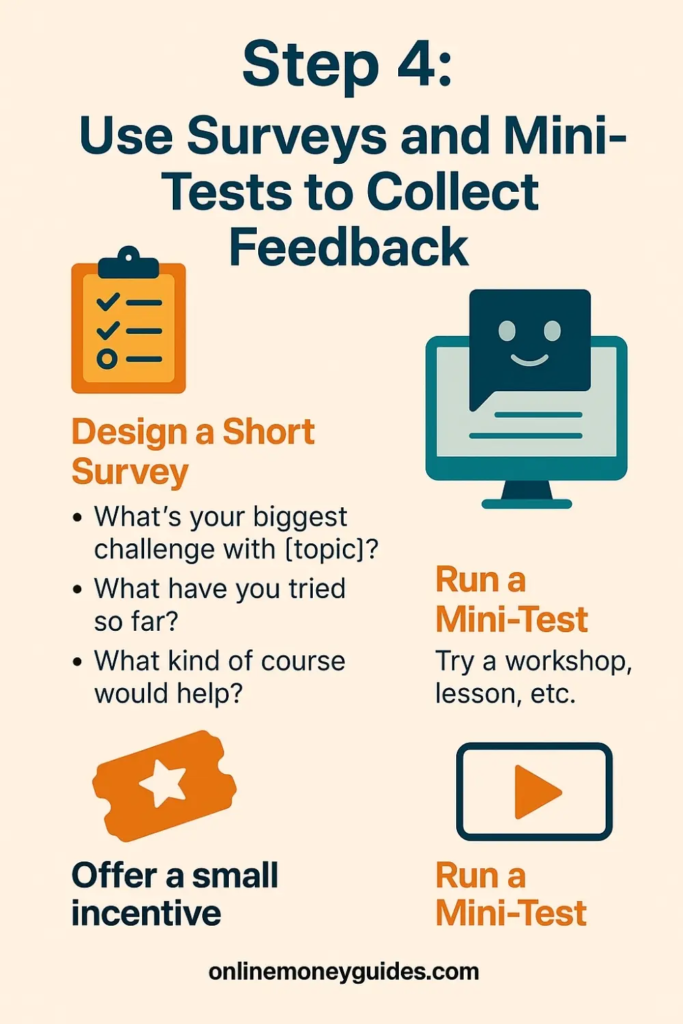
Keep it short, friendly, and specific. You’re having a conversation, not writing an exam. Ask questions that reveal what people care about most. For example:
- What’s the biggest challenge you face with [topic]?
- What have you already tried to fix it?
- What kind of course would help you finally solve this?
That’s it, three or four focused questions are enough. The key is quality, not quantity. When you see similar answers repeating, you’ve struck on a real pain point worth building around.
If you want a professional feel, tools like Typeform or Tally.so make surveys simple and engaging to fill out. You can even offer a small incentive, like early access or a bonus resource, to thank participants for their time.
Run a Mini-Test or Soft Launch
After you’ve gathered survey data, take things one step further: create a small, testable version of your idea.
This could be a one-hour live workshop, a short three-day challenge, or even a mini-course that covers just one lesson from your full plan.
The point isn’t to make it perfect. You’re checking for genuine engagement. Notice how people respond: do they show up live, ask questions, complete the lesson, or share feedback afterward?
If your test participants ask, “When’s the full course coming out?”, congratulations. That’s the clearest validation signal you can get.
Surveys and small-scale tests help you gather proof and confidence at the same time. You’re not building in the dark anymore, you’re shaping your idea based on real voices, not assumptions.
Step 5: Pre-Sell or Offer a Mini-Version of Your Course
This is where everything starts to get real. You’ve done your research, collected feedback, and now it’s time to find out if people will actually pay for your idea.
Pre-selling is the most powerful form of validation because it turns interest into commitment. You’re not just seeing who likes your idea, you’re seeing who believes in it enough to invest.
And don’t worry, pre-selling doesn’t mean tricking people into buying something that doesn’t exist yet. It’s about being transparent: you’re offering an early, discounted “founder’s version” of your course in exchange for feedback that helps you shape it better.
Why Pre-Selling Is the Ultimate Validation
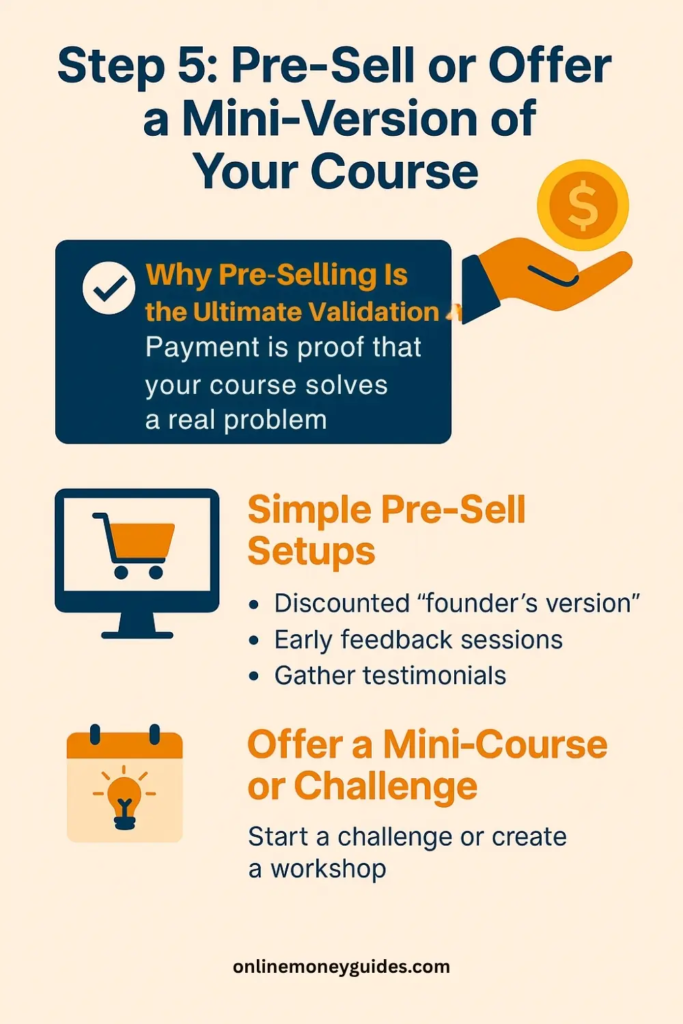
When someone puts money down, it’s proof that our course solves a real problem. Even a few paying students can confirm that you’ve found the right audience, topic, and promise.
Think of pre-selling like Kickstarter for your course. You’re testing whether people want to help bring your idea to life. And just like crowdfunding, even a handful of sales signals momentum worth pursuing.
You can make this as simple as opening ten early-bird spots and personally emailing those who’ve shown interest. Let them know this is an early access round for people who want to help shape the course with you.
Simple Pre-Sell Setups
You don’t need a fancy funnel or a big budget to pre-sell successfully. Tools like Systeme.io or Podia make it easy to create a simple checkout page and handle payments.
Here’s how it could look in action:
- Offer your course at a “founding member” price, clearly stating that the course is in development.
- Promise exclusive feedback sessions or early access to updates as a reward for joining early.
- Collect their testimonials later to strengthen your final launch page.
A few genuine pre-orders can give you the same clarity that months of planning never could.
Offer a Mini-Course or Challenge
If you’re not ready to pre-sell yet, you can still validate through a mini-offer, a bite-sized version of your main course that tackles one focused outcome.
This could be a 3-day challenge, a 60-minute workshop, or a “starter kit” that previews your teaching style. You’ll quickly see what resonates and what doesn’t.
The beauty of this approach is that it doubles as marketing. You’re serving your audience while collecting live feedback, testimonials, and validation data all at once.
When you pre-sell or offer a mini-version, you shift from theory to proof. You stop wondering if your course idea is good enough, and start knowing who it’s good enough for.

Step 6: Measure Results and Refine Your Course Idea
By now, you’ve gathered data, tested interest, and maybe even made a few early sales. This is the point where you look at everything you’ve learned and decide how to move forward. Validation isn’t about getting a “yes” or “no.” It’s about gathering proof and then adjusting based on that proof.
The most successful course creators treat validation as an ongoing process. They listen, test, and refine until their message and market align naturally.
What Validation Metrics Actually Matter
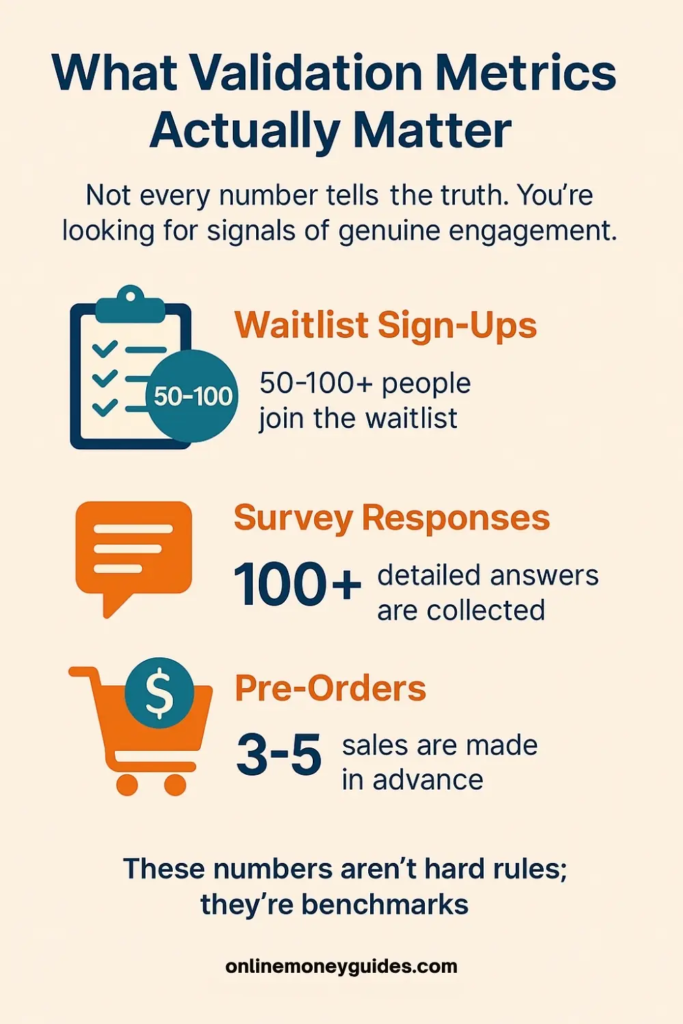
Not every number tells the truth. You’re looking for signals of genuine engagement, the kind that shows people aren’t just curious; they’re ready to act.
Here’s what to pay attention to:
- Waitlist sign-ups: If at least 50–100 people join your waitlist from your landing page or emails, that’s a strong signal that your idea resonates.
- Survey responses: Getting 100+ thoughtful responses means people care enough to share their struggles.
- Pre-orders: Even 3–5 confirmed purchases are proof of real demand. Money validates faster than likes or comments ever could.
These numbers aren’t hard rules; they’re benchmarks. If you fall short, it doesn’t mean your idea failed. It just means you may need to tweak the angle, title, or target audience.
How to Refine Based on Feedback
Go back through your surveys, comments, and DMs. Look for repeating words and themes. What problems do people mention most often? What outcomes are they craving?
Then, compare that feedback to what you promised on your landing page. Do they match? If not, refine your positioning until they do.
For example:
- Maybe your “Instagram growth” course gets better traction when framed as “Build a Personal Brand That Attracts Clients.”
- Or your “freelance writing” idea gains momentum when you shift focus to “Land Your First Paid Client in 30 Days.”
Small adjustments in framing can turn lukewarm interest into real enthusiasm.
Refinement is what separates good creators from great ones. You’re not just chasing trends, you’re listening deeply and creating something people truly need. Once your results feel solid and your confidence grows, you’re ready to move into launch preparation.
Tools to Simplify Your Course Validation Process
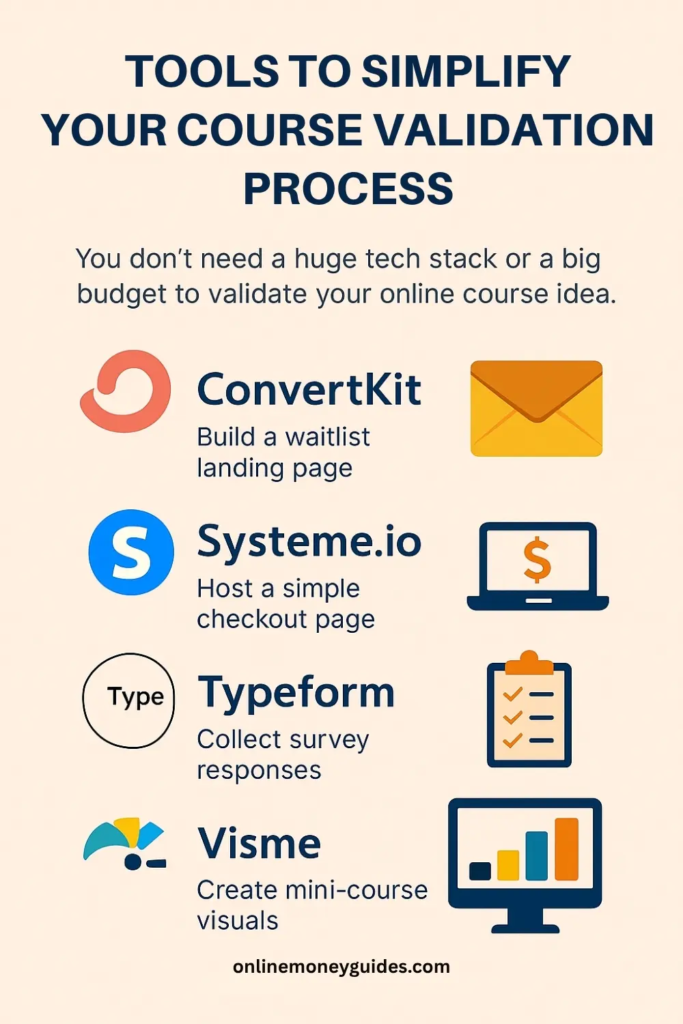
You don’t need a huge tech stack or a big budget to validate your online course idea. The goal is to work smarter, to use tools that make it easy to collect feedback, test interest, and keep things organized without getting lost in software setup.
Here are a few reliable tools that creators and digital entrepreneurs use every day to validate course ideas quickly and efficiently:
- ConvertKit – great for building a waitlist landing page, sending email sequences, and tracking who signs up. It’s simple, clean, and made for creators.
- Systeme.io – an all-in-one platform for building validation funnels, hosting simple checkout pages, or even pre-selling. Perfect for early testing without technical headaches.
- Typeform – for collecting survey responses in a way that feels personal and engaging. Its conversational design gets better-quality answers.
- Visme – useful for creating mini-course visuals, pitch decks, or mockups to showcase what your course will look like.
You can start with just one or two of these tools. What matters isn’t the software, it’s the clarity you gain from using it intentionally.
Validation is less about automation and more about connection. These tools simply help you listen better and make decisions faster.
Confidence Comes from Clarity
You’ve made it through every step of the validation process, from researching demand to listening to your audience, testing ideas, collecting feedback, and maybe even pre-selling your first version.
What you’ve done here is more than just “market research.” You’ve learned how to build confidence through clarity. You now understand that validation isn’t about getting permission; it’s about gathering proof that you’re solving a real problem for real people.
Even if your validation didn’t bring the flood of interest you hoped for, that’s still valuable. It’s data. It’s direction. It’s your roadmap to refine, reposition, or pivot your idea until it lands.
Remember, even ten engaged people who trust you, reply to your emails, and want to learn from you are worth more than a thousand passive followers. Those ten people can become your first students, your first testimonials, and the foundation for everything that follows.
If you’re ready to take your idea further, check out OfferLab, Russell Brunson’s program built around creating and scaling irresistible offers. It’s hands-on guidance for creators who want to transform their early course idea into a thriving product.
You’ve already done the hardest part, starting. From here, it’s just refinement, momentum, and belief. You don’t need to have it all figured out. You just need to keep moving forward.
Once you’ve validated your idea, the next step is to build and market your course. Learn how in our complete guide to making money with online courses.